PROMO!
First order? Get 10% OFF with this code: 1storder
Our Product Categories
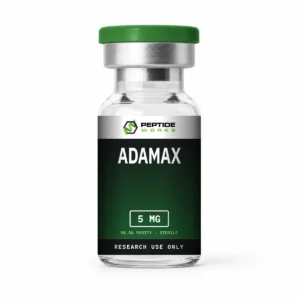
Adamax is a nootropic peptide designed to improve focus, mental clarity, memory, and overall brain function. It comes from the Semax peptide and is designed to be more stable and easier for the body to absorb, helping it last longer and work better. Researchers are interested in Adamax because it may help with faster recall, better alertness, and more resistance to mental stress.
Because of its unique peptide structure, Adamax has gained attention in the cognitive enhancement and neuro-support space as a powerful research compound for brain optimisation. While studies are still emerging, many users are interested in Adamax for its potential role in supporting learning, concentration, motivation, and healthy neurological function.
Peptide Sequence (IUPAC Condensed): Ac-Met-Glu-His-Phe-Pro-Gly-Pro-Ala-Gly-OH
Molecular Formula: C44H61O13N11S1
Molecular Weight: 1032.2 g/mol
Synonyms: Adamantane Semax
Adamax works by supporting several of the brain’s key cognitive and neuroprotective pathways. As an advanced Semax-derived peptide, it is thought to influence neurotransmitter activity, neurotrophic signalling, and cellular communication involved in focus, memory, motivation, and mental performance. Researchers are especially interested in Adamax for its potential ability to help the brain adapt to stress while supporting long-term neurological health.
Researchers believe Adamax may affect the brain-derived neurotrophic factor (BDNF) pathway, which is important for learning, memory, and the brain’s ability to adapt. It might also interact with dopamine pathways that play a role in motivation, focus, and mental drive, and could support serotonin signals that help with mood and mental resilience.
Early research also suggests Adamax may affect the PI3K/Akt and MAPK/ERK pathways, both of which are involved in neuronal survival, synaptic repair, and healthy communication between brain cells. Because of these combined effects, Adamax has become an increasingly talked-about research peptide in the areas of cognitive enhancement and neuro-support.
May support neuroplasticity and memory formation: One of the most studied mechanisms connected to Semax-derived peptides is their effect on the brain-derived neurotrophic factor (BDNF) pathway. BDNF is heavily involved in learning, synaptic plasticity, and long-term memory formation. Research published in Brain Research demonstrated that Semax increased BDNF protein levels, TrkB phosphorylation, and BDNF mRNA expression in the rat hippocampus, a brain region strongly associated with memory processing (1).
Potential cognitive enhancement and learning support: Studies suggest that Semax analogues may improve learning and cognitive performance by affecting neurotrophic and neurotransmitter systems. Researchers think this could help with attention, information processing, and the ability to learn new things (2).
May influence dopaminergic pathways linked to focus and motivation: Researchers have studied Semax-derived peptides for their effects on dopamine signaling in the brain. Studies found changes in dopamine activity in the striatum, which may be linked to motivation, focus, mental energy, and cognitive drive (3).
Potential modulation of serotonergic signalling: Researchers have also looked at how Semax-related compounds affect serotonin systems, which are important for mood, stress adaptation, and emotional resilience. Studies found changes in both serotonin and dopamine pathways, which may explain why these peptides are of interest for stress-related cognitive support (3).
May support neuronal survival and neuroprotection: Early research suggests Semax-related compounds may affect pathways inside cells that help with neuron repair and survival, such as the PI3K/Akt and MAPK/ERK signaling cascades. These pathways are well known in neuroscience for protecting neurons from oxidative stress, supporting synaptic repair, and keeping brain cells communicating well (4).
Potential support during neurological stress: Animal studies on brain injury found that Semax changed the levels of neurotrophins like BDNF and NGF in the hippocampus and frontal cortex after a loss of blood flow to the brain. Researchers saw possible protective effects during times of neurological stress and low oxygen (5).
May enhance neurotrophic signalling beyond BDNF alone: Besides BDNF, research on Semax has shown effects on nerve growth factor (NGF) and Trk receptor expression. These systems are important for keeping neurons healthy, helping synapses adapt, and allowing brain cells to communicate (6).
Growing interest in nootropic and neuro-support research: Because of its potential effects on BDNF, dopaminergic activity, serotonergic signalling, and neuroprotective pathways, Adamax has become an emerging compound of interest in the fields of cognitive enhancement, neuroplasticity, and neurological support research. However, direct human trials on Adamax itself remain limited, and further research is still needed to fully understand its long-term effects and mechanisms(7).
(1) Dolotov OV, Karpenko EA, Inozemtseva LS, Seredenina TS, Levitskaya NG, et al. Semax, an analog of ACTH(4-10) with cognitive effects, regulates BDNF and trkB expression in the rat hippocampus. Brain Res. 2006 Oct 30;1117(1):54-60.
(2) Radchenko AI, Kuzubova EV, Apostol AA, Mitkevich VA, Andreeva LA, Limborska SA, Stepenko YV, Shmigerova VS, Solin AV, Korokin MV, Pokrovskii MV, Myasoedov NF, Makarov AA. The Potential of the Peptide Drug Semax and Its Derivative for Correcting Pathological Impairments in the Animal Model of Alzheimer’s Disease. Acta Naturae. 2025 Oct-Dec;17(4):110-120.
(3) Eremin, K.O., Kudrin, V.S., Saransaari, P. et al. Semax, An ACTH(4-10) Analogue with Nootropic Properties, Activates Dopaminergic and Serotoninergic Brain Systems in Rodents. Neurochem Res 30, 1493–1500 (2005).
(4) Liu T, Li X, Zhou X, Chen W, Wen A, Liu M, Ding Y. PI3K/AKT signaling and neuroprotection in ischemic stroke: molecular mechanisms and therapeutic perspectives. Neural Regen Res. 2025 Oct 1;20(10):2758-2775.
(5) Shadrina M, Kolomin T, Agapova T, Agniullin Y, Shram S, Slominsky P, Lymborska S, Myasoedov N. Comparison of the temporary dynamics of NGF and BDNF gene expression in rat hippocampus, frontal cortex, and retina under Semax action. J Mol Neurosci. 2010 May;41(1):30-5.
(6) Dmitrieva VG, Povarova OV, Skvortsova VI, Limborska SA, Myasoedov NF, Dergunova LV. Semax and Pro-Gly-Pro activate the transcription of neurotrophins and their receptor genes after cerebral ischemia. Cell Mol Neurobiol. 2010 Jan;30(1):71-9.
(7) Suliman NA, Mat Taib CN, Mohd Moklas MA, Adenan MI, Hidayat Baharuldin MT, Basir R. Establishing Natural Nootropics: Recent Molecular Enhancement Influenced by Natural Nootropic. Evid Based Complement Alternat Med. 2016;2016:4391375.
The answers to the most frequently asked questions about the peptide.
Adamax is usually discussed as a research peptide administered by nasal spray, like Semax-based compounds. This method is often used because it may help the peptide reach the brain more effectively. However, research methods and ways of administering Adamax can vary widely.
In many countries, Adamax is sold legally as a research peptide or research compound. However, it is not approved by the FDA, MHRA, or EMA for the diagnosis, treatment, or prevention of disease. Regulations governing peptides can vary by country or region and intended use, so buyers should always check the regulations in their specific country or region before purchasing.
Adamax is believed to have been designed with improved blood-brain barrier penetration in mind. Its structural modifications are thought to increase stability and help support delivery to the central nervous system, although more research is needed to fully confirm its pharmacokinetic profile.
There is not much clinical data yet on the long-term safety of Adamax. However, based on studies of Semax-related peptides, some users have reported possible side effects like:
As with many research peptides, responses may vary depending on the individual, dosage, and method of administration.
Interest in Adamax has grown because researchers are increasingly exploring peptides that may support cognitive performance, neuroplasticity, and long-term brain health. Its potential interaction with BDNF, dopaminergic signalling, serotonergic pathways, and neuroprotective mechanisms has made it an emerging topic within the nootropic and neuro-support research space.

This blog explores the key differences between Adamax and Semax, including how each peptide may influence neuroplasticity, cognitive performance, brain recovery, and neural signalling pathways. It also compares related peptides, such as Selank, breaking down their proposed mechanisms, research applications, and potential roles in focus, memory, stress resilience, and neuro-support.

This blog explores how Adamax may support chronic inflammation by influencing immune signalling, oxidative stress, and cellular repair pathways. It also compares Adamax with peptides like BPC-157, TB-500, and Ipamorelin to examine the different ways these compounds are being researched for inflammation, recovery, and tissue support.

This blog looks at some of the most studied cognitive peptides, such as P-21, Semax, Selank, and Pinealon, and how they might help with memory, focus, brain flexibility, stress resilience, and overall brain function. It explains how each peptide may work, compares their uses in research, and explores how they affect learning, thinking, and brain support pathways.
Excellent Customer Support
Value For Money
99% Pure Guaranteed
World Wide Shipping
ALL CONTENT AND PRODUCT INFORMATION AVAILABLE ON THIS WEBSITE IS FOR EDUCATIONAL PURPOSES ONLY.
DISCLAIMER: These products are intended solely as a research chemical only. This classification allows for their use only for {name} research development and laboratory studies. The information available on our Peptide Works website: https://peptide-works.com/ is provided for educational purposes only. These products are not for human or animal use or consumption in any manner. Handling of these products should be limited to suitably qualified professionals. They are not to be classified as a drug, food, cosmetic, or medicinal product and must not be mislabelled or used as such.