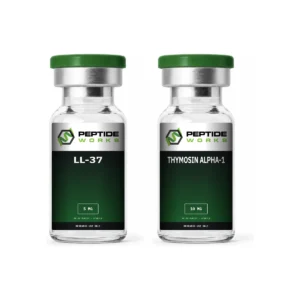
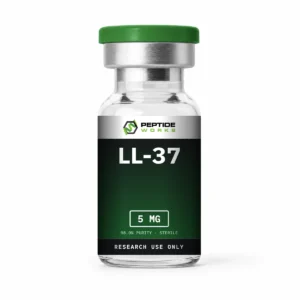
LL-37 is a 37-amino-acid cationic peptide derived from the human cathelicidin precursor protein hCAP18 and investigated in peptide chemistry, membrane-interaction studies, molecular signaling research, and analytical characterization.
LL-37 is a peptide consisting of 37 amino acids and is obtained from the C-terminal section of the human cathelicidin precursor protein hCAP18 (CAMP). It is considered an amphipathic host-defense peptide and is known for having a net positive charge and for adopting mainly an α-helical structure when associated with membranes. These physical and chemical properties allow it to interact with negatively charged lipid membranes and with other anionic molecular targets.
LL-37 has been widely studied in the laboratory with regard to its interactions with membranes, its antimicrobial properties, and its immunomodulatory mechanisms. Experimental research shows that LL-37 is able to associate with components of bacterial membranes, such as lipopolysaccharides (LPS) and lipoteichoic acids (LTA), and can affect the organisation and permeability of the membrane. Moreover, structural studies have proven that LL-37 can form oligomeric assemblies when certain membrane-mimicking experimental conditions are present.
Apart from its interactions with membranes, LL-37 is also investigated for the way it interacts with nucleic acids, cellular receptors and inflammatory signalling pathways, which is why it serves as a useful experimental model for the study of innate host-defence mechanisms and peptide–membrane relationships.
02
Chemical Classification
Chemical Name
Cathelicidin LL-37
Common Name(s):
LL-37; LL-37 peptide; Human LL-37
Molecular Formula
C205H340N60O53
Molecular Weight
4493 g/mol
CAS Number
154947-66-7
Purity
98%
Compound Class
Cationic Antimicrobial Peptide (CAMP)
Origin
Human Cationic Antimicrobial Protein 18
03
Molecular Characteristics
LL-37 is a linear, positively charged, and amphipathic peptide that has a net positive charge under physiological conditions and whose structure includes both hydrophilic and hydrophobic areas. The secondary structure of the peptide is very much influenced by the surrounding environment; in water, it takes on a fairly disordered form, but when it interacts with lipid membranes or with environments that mimic membranes, it tends to assume a mainly α-helical structure. This amphipathic arrangement results in the formation of separate positively charged and hydrophobic surfaces, allowing LL-37 to interact with the negatively charged lipid components and with other anionic molecular targets.
Structural studies have furthermore found that the peptide has a certain degree of conformational flexibility, exhibiting a typical helix-break-helix arrangement under specific experimental conditions. Because of its ability to associate with membranes and to oligomerize, LL-37 is a useful peptide for use in experimental studies of peptide–membrane interactions, molecular recognition, and host-defense mechanisms in controlled laboratory models.
04
Mechanism Under Investigation
LL-37 is mainly studied in relation to its interactions with biological membranes and molecular signalling systems. Because it is a cationic peptide, the positively charged amino acid residues in it can interact electrostatically with the negatively charged components of the membrane, and at the same time its amphipathic α-helical structure affects its association with the membrane and its interactions with the lipids. In the laboratory, researchers have looked at mechanisms such as membrane binding, membrane organisation, peptide aggregation, pore formation, and concentration-dependent changes in membrane integrity. The peptide has also been studied in experimental models of cellular signalling, such as those involving interactions with membrane-bound receptors and the downstream signalling pathways. Such studies are carried out in order to describe the peptide's molecular behaviour, structure–activity relationships, and the nature of its interactions in controlled experimental systems.
This summary reflects findings reported in published preclinical and in vitro research. The original studies supporting this information are listed in the references.
05
Experimental Research Areas
01
Antimicrobial Activity
LL-37 has been widely studied in vitro using antimicrobial models that look at its interactions with bacterial and fungal organisms. The research mainly concerns the way in which the peptide's cationic and amphipathic characteristics allow it to interact with microbial membranes, including causing changes to the structure and permeability of these membranes. The extent of these effects depends on factors such as experimental concentration, the species of microorganism involved, and the experimental conditions.
02
Biofilm Formation and Disruption
A major aspect of research into LL-37 is its relationship with microbial biofilms. Laboratory investigations have looked at its effects on bacterial attachment, the formation of biofilms, quorum-sensing pathways, and already established biofilm structures. Laboratory studies have examined LL-37-associated inhibitory effects on biofilms formed by bacterial species including Pseudomonas aeruginosa, Staphylococcus aureus and Acinetobacter baumannii.
03
Innate Immune Signaling
LL-37 is investigated as part of the innate immune system, with experimental studies looking at its interactions with immune cells, receptors and signalling pathways. The research examines the effect of LL-37 on chemotactic responses, inflammatory signalling and the action of immune mediators. Moreover, the responses that have been reported can vary greatly among different experimental models and conditions.
04
Cellular Migration and Tissue Models
Research into LL-37 has been carried out using cell migration, epithelial, and tissue repair models. Experimental studies look at processes including cellular migration, proliferation, re-epithelialisation and angiogenic signalling. The aim of these studies is to characterise the molecular pathways linked with LL-37 and not to determine its therapeutic efficacy.
05
Cancer Biology Research
LL-37 is also investigated in experimental cancer-biology models, with research examining its interactions with tumor cells, cellular signaling, and components of the tumor microenvironment. According to the literature, LL-37 can show context-dependent effects. So its activity remains an area of ongoing mechanistic research rather than an established clinical application.
06
Analytical Verification
The analysis of LL-37 usually involves a number of complementary methods in order to determine the peptide's identity, purity, and structural integrity. Reversed-phase high-performance liquid chromatography (RP-HPLC) is generally employed to check the chromatographic purity and to detect impurities associated with the peptide. At the same time, mass spectrometry (MS) is used to confirm the molecular mass and to aid in the verification of identity. In studies of LL-37 that have already been published, analytical HPLC has been combined with techniques such as ESI-MS and MALDI-TOF MS for the purpose of characterising the peptide. Methods using LC-UV-MS have also been shown to allow for the simultaneous profiling of LL-37 impurities and for mass-based confirmation. Taken together, these analytical methods offer complementary evidence concerning the composition and integrity of the LL-37 samples used in controlled laboratory research.
LL-37 in lyophilized form should be stored at 2–8°C in a tightly sealed container and protected from moisture and unnecessary environmental exposure.
Exposure to heat, moisture, and frequent temperature changes can affect sample integrity. Storage conditions and shelf life should follow the supplier's validated documentation for the specific product. Repeated freeze–thaw cycles may affect peptide integrity.
Supplied asLyophilized Powder
Storage2–8°C, tightly sealed container
ReconstitutionSterile diluent
08
Questions researchers ask
The human hCAP18 precursor protein naturally contains a 37-amino-acid peptide called LL-37, which is thought to be a host-defense peptide. Extensive research is being done on its molecular interactions with membranes and components of innate immune signaling.
From the cathelicidin family, LL-37 is a cationic, amphipathic host defense peptide that interacts with lipid membranes and other molecular targets in experimental settings thanks to its positively charged, hydrophobic domains.
LL-37 is able to associate with the negatively charged lipid components via electrostatic and hydrophobic interactions. Experimental studies show that this association can have an effect on membrane organisation, curvature and permeability, the exact effects however depending on the lipid composition, the peptide concentration and other experimental conditions.
Rather than relying on one well-established pathway, several mechanisms are currently being investigated. Research that has been published refers to membrane association and disruption, interactions with surface components of microorganisms such as LPS, and the modulation of cellular signalling pathways. The mechanism that is observed can vary a great deal depending on the experimental model and the conditions.
Research Use Only: LL-37 is supplied exclusively for laboratory research and analytical purposes. It is not intended for human or animal consumption, administration, diagnosis, treatment, prevention or cure of any disease or medical condition. Information provided on this page is for research purposes only and must not be interpreted as evidence of safety, efficacy, or suitability for clinical or therapeutic use.