PROMO!

First order? Get 10% OFF with this code: 1storder

Research hub

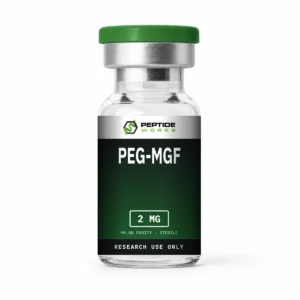
PEG-MGF Peptide Research Hub

PEG-MGF is a research-designated, polyethylene glycol (PEG)-modified form of Mechano Growth Factor (MGF), an E-domain peptide associated with the IGF-1 splice variant IGF-1Ec.

  • PEGylated peptide
  • MGF-derived peptide
  • IGF-1 splice-variant–derived peptide
  • synthetic peptide derivative
01

Technical Overview

PEG-MGF, or PEGylated Mechano Growth Factor, is a synthetic peptide conjugate based on the C-terminal E-domain sequence associated with the IGF-1Ec splice variant of the insulin-like growth factor 1 gene. The peptide component commonly investigated as MGF-E consists of a 24-amino-acid sequence derived from the distinctive carboxy-terminal region produced by alternative IGF-1 transcript processing. Published literature distinguishes this synthetic E-peptide from mature IGF-1 and from the complete IGF-1Ec precursor.

In PEG-MGF, the peptide is chemically modified through conjugation with polyethylene glycol (PEG). PEGylation alters the physicochemical characteristics of a peptide by adding a hydrophilic polymeric component. The resulting conjugate therefore differs structurally from unmodified MGF-E and must be characterized according to its specific PEG architecture and conjugation chemistry.

02

Chemical Classification

Chemical name
PEGylated Mechano Growth Factor E-peptide
Common name(s)
PEG-MGF, PEGylated MGF
Alternative nomenclature
PEGylated MGF-E peptide, PEG-modified IGF-1Ec E-peptide
Molecular formula
PEG-dependent; no universal formula
Molecular weight
Preparation-dependent; varies with PEG component
Compound Class
PEGylated peptide, IGF-1Ec-derived peptide
Origin
Synthetic
Purity
99.8%
Peptide sequence
YQPPSTNKNTKSQRRKGSTFEERK
03

Molecular Characteristics

PEG-MGF consists of a peptide component chemically linked to polyethylene glycol. The underlying MGF-E peptide is a short, 24-residue sequence corresponding to the distinctive C-terminal region associated with human IGF-1Ec. Alternative processing of the IGF-1 transcript introduces a sequence that differs from the E-domain associated with other IGF-1 splice variants.

Addition of PEG produces a larger peptide-polymer conjugate. Polyethylene glycol consists of repeating ethylene oxide units and is highly hydrophilic. Consequently, PEG conjugation changes properties such as hydrodynamic volume, aqueous behavior and steric accessibility compared with the unmodified peptide. PEGylation may also influence the susceptibility of peptide bonds to proteolytic access, although the extent depends strongly on PEG size, architecture and attachment site.

Therefore, for analytical purposes, a particular PEG-MGF preparation should be identified by its PEG size, linker chemistry, attachment position, and peptide identity.

04

Mechanism Under Investigation

PEG-MGF research is closely connected with investigation of the MGF E-peptide and the molecular biology of the IGF-1Ec splice variant. Human IGF-1Ec results from alternative processing of the IGF-1 transcript and contains a distinctive C-terminal sequence generated by the Ec splice configuration. The synthetic MGF E-peptide used experimentally corresponds to a portion of this C-terminal region rather than to mature 70-residue IGF-1 itself.

Current laboratory investigations have examined how synthetic MGF-derived sequences interact with intracellular signaling systems. Experimental cell models have investigated associations with ERK1/2-related signaling, focal-adhesion-associated pathways and IGF-1 receptor-linked signaling. However, the molecular mechanism of isolated MGF E-peptides has not been defined as conclusively as that of the canonical IGF-1/IGF-1 receptor system. Some experimental work has reported signaling associations, while other studies have been unable to reproduce previously reported cellular responses to synthetic MGF sequences.

This distinction is particularly important for PEG-MGF. PEG attachment produces a chemically modified molecule, and the steric environment surrounding the peptide may differ substantially from that of the unmodified sequence. General PEGylation research demonstrates that PEG position, molecular mass and architecture can influence peptide conformation, accessibility and molecular interactions.

Therefore, investigations using unmodified MGF-E should not be used to automatically deduce the precise molecular behavior of a PEG-MGF preparation. Alternatively, the peptide-polymer conjugate may be examined separately in a laboratory setting, taking into account PEG attachment, peptide identity, molecular size, chromatographic performance, and interaction with signaling components under specific experimental settings.

This summary reflects findings reported in published preclinical and in vitro research. The original studies supporting this information are listed in the references.

05

Experimental Research Areas

01

IGF-1 Splice-Variant Biology

Alternative IGF-1 gene processing and the production of IGF-1Ec transcripts with a unique E-domain sequence have been studied using MGF. This offers a molecular framework for examining the variations between the appropriate peptide regions and IGF-1 splice products.

02

Peptide and Protein Chemistry

Alternative IGF-1 gene processing and the production of IGF-1Ec transcripts with a unique E-domain sequence have been studied using MGF. This offers a molecular framework for examining the variations between the appropriate peptide regions and IGF-1 splice products.

03

PEGylation Research

PEG-MGF can be investigated as a peptide-polymer conjugate. Experimental work in PEG chemistry examines variables including PEG molecular weight, polymer architecture, conjugation position, linker chemistry, conjugation efficiency and the influence of these parameters on the resulting molecular species.

04

Cellular Signaling Research

Signaling systems, such as the ERK1/2 pathway and associated intracellular pathways, have been investigated in experimental studies using MGF E-peptides. These investigations provide a basis for examining molecular interactions involving MGF-derived sequences in regulated cellular settings.

05

Structure–Function Analysis

PEG-MGF provides a research context for comparing a chemically modified peptide with its corresponding non-PEGylated sequence. Researchers can examine how polymer attachment influences molecular size, steric characteristics, chromatographic properties, stability and accessibility of the peptide component.

06

Analytical Chemistry

Analytical techniques that can differentiate between free peptide, conjugated material, leftover PEG reagents, and associated contaminants are necessary for PEGylated peptides. Because of this, PEG-MGF is pertinent to the development of peptide conjugation, mass spectrometry, and chromatographic techniques.

06

Analytical Verification

Production of the peptide component of PEG-MGF may involve solid-phase peptide synthesis (SPPS), in which protected amino acids are sequentially assembled to generate the specified peptide sequence. Following synthesis and cleavage, chromatographic purification can be used before or after the PEG conjugation stage depending on the manufacturing process.

Because researchers must confirm both the identity of the peptide and the production of the peptide-polymer conjugate, PEGylation adds another analytical factor. Chromatographic purity can be evaluated and peptide-related contaminants can be found using analytical HPLC, including reversed-phase HPLC as necessary. The peptide component and conjugation product can be confirmed and molecular mass information can be obtained using LC-MS or other mass spectrometric techniques.

Because PEG size, linker chemistry and attachment position may vary between PEG-MGF preparations, analytical results should be interpreted against the specification for the particular material supplied.

Each batch should therefore be accompanied by a batch-specific Certificate of Analysis (COA) documenting compound identity, analytical method, purity and relevant batch information.

Certificate of Analysis
Batch20250924032
MethodCOA 2026
Document Download PDF
HPLC
Batch20250924032
MethodHPLC 2026
Document Download PDF
07

Storage & Handling

PEG-MGF supplied as a lyophilised research material should be stored under controlled conditions specified by the manufacturer or batch documentation. For longer-term laboratory storage, low-temperature conditions are commonly used for peptide preparations, with protection from moisture, excessive light and repeated temperature fluctuations.

The vial should remain sealed until required for analytical or experimental preparation. Hygroscopic exposure should be minimised because both peptide materials and PEG-containing conjugates may be affected by moisture.

An appropriate laboratory-grade solvent should be chosen based on the analytical technique and the material-specific specification when reconstitution is necessary for a laboratory operation. Reconstituted preparations should be handled to reduce the number of freeze-thaw cycles and labeled with preparation specifics.

The batch-specific Certificate of Analysis and supplier storage specification should take precedence over general peptide-storage guidance.

Supplied As Lyophilized Powder in Vial
Storage Store at 2–8°C
Handling Reconstitution Required
08

Questions researchers ask

PEG-MGF is a synthetic peptide-polymer conjugate in which a Mechano Growth Factor-derived peptide sequence is chemically linked to polyethylene glycol. The peptide component is commonly based on the 24-amino-acid C-terminal MGF E-peptide associated with IGF-1Ec.

For research and laboratory use only. Not for human or animal consumption.

PEG-MGF is supplied exclusively as a research material for qualified laboratory and analytical investigation. It is not supplied for diagnostic, therapeutic or preventative purposes. Product identity, purity and other specifications should be confirmed using the Certificate of Analysis provided for the applicable batch.

Available now

PEG-MGF Peptide from Peptide Works