
Peptide Chemistry
Protirelin has been used in studies on peptide structure, terminal modifications, synthesis, chromatographic separation and sequence-dependent physicochemical properties as a model tripeptide.
PROMO!
First order? Get 10% OFF with this code: 1storder
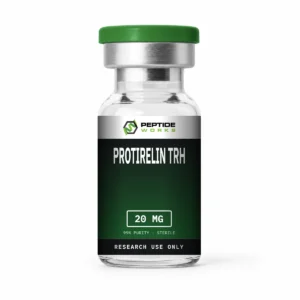
Protirelin (TRH) is a synthetic tripeptide and structural analogue of the endogenous hypothalamic peptide thyrotropin-releasing hormone.
Protirelin is a synthetic tripeptide which matches chemically the sequence of thyrotropin-releasing hormone (TRH), a peptide that occurs in nature. The molecule is made up of three residues derived from amino acids and has the structure pyroglutamyl-histidyl-prolinamide (pGlu-His-Pro-NH₂). The terminal pyroglutamyl and prolinamide groups are what set the mature molecule apart from a typical unmodified linear tripeptide.
Protirelin has a molecular formula of C16H22N6O4 and a molecular weight of about 362.38 g/mol . It is known within the fields of peptide and molecular biology research due to its well-defined three-amino-acid structure, its receptor-binding properties, and the extensive knowledge available regarding its peptide chemistry. It is also used in experimental work as a reference compound when studying thyrotropin-releasing hormone receptors, peptide-receptor interactions, intracellular signalling and enzymatic peptide degradation.
In the laboratory Protirelin can be identified using chromatographic and mass-spectrometric techniques, enabling researchers to look at the compound's identity, purity, molecular mass and degradation products under controlled analytical conditions.
Protirelin is a short tripeptide which consists of a pyroglutamic acid (pGlu) residue at its N-terminus, L-histidine, and an L-prolinamide residue at its C-terminus. The condensed sequence is usually given as pGlu-His-Pro-NH₂. Different from a typical three-amino-acid peptide having free amino and carboxyl terminals, Protirelin has modifications at both ends of the molecule.
The pyroglutamyl group at the N-terminus adopts a cyclic lactam configuration, and the proline residue at the C-terminus is amidated. These structural characteristics constitute part of the molecule's defined chemical identity. Protirelin has a relatively low molecular weight of 362.38 g/mol and includes a number of functional groups containing nitrogen and oxygen which are capable of taking part in hydrogen-bonding interactions. According to PubChem, the calculated XLogP3 value is about −2.5, indicating that the molecule is relatively polar.
Since it is a short peptide, Protirelin does not exhibit the extensive higher-order structures which are typical of larger polypeptides and proteins; rather, its physicochemical properties are mainly due to the conformational restrictions imposed by the pyroglutamyl and proline residues, the histidine imidazole group, the peptide bonds and the terminal amide.
Experimental literature has also looked into the enzymatic cleavage of the molecule, especially that which involves its pyroglutamyl-histidyl bond.
Investigations carried out in the laboratory so far with Protirelin and TRH have looked at its interaction with thyrotropin-releasing hormone receptors (TRHRs), a type of receptor that is part of the G-protein-coupled receptor family. In order to characterise ligand binding, receptor activation, the formation of second messengers and the subsequent intracellular signalling events, experimental receptor systems have been employed.
Experimental studies have described the coupling of TRH receptor systems to members of the Gq/G11 family of heterotrimeric G proteins. These proteins have been studied in relation to their role in activating phospholipase C and in the metabolism of membrane phosphoinositides. As a result, experimental cell systems have looked at the signalling components such as phospholipase C, inositol phosphates, diacylglycerol, intracellular calcium-associated signalling and protein kinase pathways.
Research into protirelin also involves a study of receptor-ligand recognition at the molecular level. Since the peptide has only three amino-acid-derived residues, each of the individual structural features—such as the N-terminal pyroglutamyl group, the central histidine residue and the C-terminal prolinamide—can be examined in structure-activity and receptor-binding experiments.
Research has also been carried out into the enzymatic breakdown of the peptide. The enzyme pyroglutamyl peptidase II, which is also referred to as a TRH-degrading ectoenzyme, has been studied for its ability to hydrolyse the pyroglutamyl-histidyl peptide bond in TRH. Experiments using this enzyme offer a means of investigating peptide recognition, substrate specificity and the degradation of peptides outside the cell.
Further research has also looked into the biosynthesis and processing of endogenous TRH from its larger precursor, proTRH, thus giving a molecular basis for comparing the mature tripeptide with the sequences derived from the precursor.
This summary reflects findings reported in published preclinical and in vitro research. The original studies supporting this information are listed in the references.
Protirelin has been used in studies on peptide structure, terminal modifications, synthesis, chromatographic separation and sequence-dependent physicochemical properties as a model tripeptide.
Laboratory research has examined how TRH interacts with thyrotropin-releasing hormone receptors. Such systems are employed in order to characterise ligand-receptor recognition, receptor activation and the molecular processes associated with the receptor.
The TRH receptor's interaction with Gq/G11 proteins, as well as its association with phospholipase C-linked signalling and phosphoinositide metabolism and the other intracellular signalling components, has been studied using experimental cell models.
Protirelin has been investigated in relation to enzymatic peptide degradation. Research has characterized pyroglutamyl peptidase II and its recognition of the pGlu-His region of the molecule.
Research into protirelinTRH has examined the cellular processing steps involved in generating mature TRH sequences, including precursor cleavage and post-translational modification.
Protirelin has been investigated using chromatographic and mass-spectrometric techniques for molecular identification, separation, quantification and fragmentation analysis. Liquid chromatography-electrospray mass spectrometry has, for example, been characterized for the analytical detection of TRH.
Established peptide-synthesis techniques, such as solid-phase peptide synthesis methods, can be used to create synthetic protirelin. The necessary peptide species can then be isolated through purification. Solid-phase techniques and reversed-phase HPLC purification have been reported in related studies on TRH peptide synthesis.
Peptide-related contaminants can be found and chromatographic purity can be evaluated using analytical high-performance liquid chromatography (HPLC). Based on molecular mass and distinctive ion behavior, liquid chromatography-mass spectrometry (LC-MS) offers complementary identity confirmation. Tandem-MS fragmentation and LC-electrospray mass spectrometry have been reported in published analytical studies for the detection and measurement of TRH.
For research materials, analytical documentation should correspond to the individual production batch. The Certificate of Analysis should identify the compound, batch or lot number, testing date, analytical methodology and measured purity. Where supplied commercially under the Broad Payments framework, the applicable batch should have a third-party Certificate of Analysis and a minimum stated purity of 98%.
Protirelin supplied as a lyophilised research material should be maintained under controlled conditions that minimise exposure to moisture, excessive heat and direct light. Long-term storage conditions should follow the specifications stated for the individual product batch; where specified for the material, frozen storage such as 2–8°C in a dry, desiccated environment may be used.
Containers should remain securely sealed until required for laboratory analysis. Repeated temperature cycling and unnecessary exposure to atmospheric moisture should be minimised because these conditions can influence the stability of peptide research materials.
Where a laboratory solution is prepared for analytical work, an appropriate research-grade solvent or diluent should be selected according to the intended analytical method. Solution stability, solvent compatibility and storage conditions should be established experimentally or according to the applicable analytical specification.
The synthetic tripeptide called protirelin is chemically equivalent to thyrotropin-releasing hormone (TRH). Pyroglutamyl, histidyl, and prolinamide residues make up its sequence: pGlu-His-Pro-NH₂.
Yes. Protirelin is classified as a tripeptide because its structure contains three amino-acid-derived residues linked through peptide bonds.
The sequence is pGlu-His-Pro-NH₂, also written as pyroglutamyl-histidyl-prolinamide. The molecule therefore contains an N-terminal pyroglutamyl group and a C-terminal amide.
Protirelin's primary CAS Registry Number is 24305-27-9. When reading analytical paperwork, it is important to confirm the chemical form because different salts or related forms may have different registry numbers.
Protirelin/TRH and thyrotropin-releasing hormone receptors (TRHRs) are the main subjects of laboratory research. Phospholipase C-associated signaling and receptor coupling to Gq/G11 proteins have been described experimentally.
HPLC and LC-MS are analytical techniques, while mass spectrometry provides molecular mass and fragmentation data for identity verification. There have been reports of LC-electrospray MS techniques designed for TRH analysis.
For research and laboratory use only. Not for human or animal consumption.
Protirelin is supplied strictly as a research material for qualified laboratory applications. Product information is provided solely for chemical, analytical and scientific reference and is not intended to provide diagnostic, therapeutic, dosing or administration guidance.