PROMO!

First order? Get 10% OFF with this code: 1storder

Research hub

Melanotan I Research Hub

Melanotan I is a synthetic α-melanocyte-stimulating hormone (α-MSH) analog investigated in peptide chemistry, receptor-binding studies, molecular signaling research, and structure–activity characterization.

  • Melanotan I
  • α-MSH analog
01

Technical Overview

Melanotan I (MT-I), also referred to as [Nle⁴,D-Phe⁷]-α-MSH and more commonly called afamelanotide, is a synthetic peptide analogue consisting of 13 amino acids that is based on α-melanocyte-stimulating hormone (α-MSH). In its structure there are two important modifications as compared to endogenous α-MSH: at position 4 norleucine (Nle) takes the place of methionine, and at position 7 D-phenylalanine (D-Phe) replaces L-phenylalanine. These changes were made in order to modify the peptide's stability and its characteristics for binding to receptors.

The molecular formula of Melanotan I is C₇₈H₁₁₁N₂₁O₁₉ and its molecular weight is about 1646.8 g/mol. In terms of structure, it has the His-Phe-Arg-Trp (HFRW) melanocortin recognition sequence, since this is important for the interactions that take place between melanocortin peptides and melanocortin receptors.

Experimental research has shown that Melanotan I acts as an agonist of melanocortin receptors, and structural studies have examined how it binds to receptors such as MC1R and the following activation of G-protein signalling pathways. Furthermore, cryo-electron microscopy has supplied molecular-level information about peptide recognition in the MC1R binding pocket and the role of calcium in receptor–ligand interactions.

Because of these features, Melanotan I is suitable for use in controlled laboratory studies concerning melanocortin receptor pharmacology, peptide–receptor interactions, structure–activity relationships, and intracellular signalling mechanisms.

02

Chemical Classification

Chemical Name
[Nle⁴,D-Phe⁷]-α-MSH
Common Name(s)
Melanotan-1, MT-I, MT-1, Afamelanotide
Molecular Formula
C78H111N21O19
Molecular Weight
1646.84 g/mol
CAS Number
75921-69-6
Amino Acid Sequence
Ac-Ser-Tyr-Ser -Nle-Glu -His-D-Phe-Arg-Trp-Gly-Lys- Pro-Val-NH2
Purity
99.6%
Compound Class
Melanocortin
03

Molecular Characteristics

Melanotan I is a synthetic, linear peptide made up of 13 amino acid residues and is structurally based on the endogenous peptide α-melanocyte-stimulating hormone (α-MSH). In its molecular structure there is norleucine at position 4 and D-phenylalanine at position 7, alterations which set it apart from the natural α-MSH sequence and which result in changes to its molecular stability and its interaction with receptors. The peptide still has the conserved His-Phe-Arg-Trp sequence that is responsible for melanocortin receptor binding, a key structural area for this binding process. Melanotan I includes a mix of hydrophobic, polar and charged amino acids, giving it the physicochemical properties needed for interactions between the peptide and its receptor. Because it contains a D-amino acid residue, it is more resistant to certain enzymatic degradation pathways than the corresponding native peptide. All of these structural features make Melanotan I a subject of research into the structure–activity relationships of melanocortin peptides, as well as for studying receptor recognition and molecular signalling interactions under controlled laboratory conditions.

04

Mechanism Under Investigation

Melanotan I is mainly studied as an agonist of the melanocortin receptor system, with special attention being given to the melanocortin-1 receptor (MC1R). Experimental binding studies have shown that Melanotan I binds to MC1R and causes there to be an increase in the amount of cyclic adenosine monophosphate (cAMP) within the cell.

MC1R is a G protein-coupled receptor (GPCR) which mainly interacts with the stimulatory G protein Gs. When a ligand binds to the receptor it becomes activated and leads to stimulation of adenylyl cyclase via Gs, thus raising the amount of cAMP inside the cell. This second messenger may then go on to activate protein kinase A (PKA) and various downstream signalling networks.

Further investigation through structural studies using cryo-electron microscopy has allowed a more detailed characterization of the way in which Melanotan I, which is also known as afamelanotide in the literature, binds to the orthosteric binding site of MC1R; the conserved HFRW melanocortin motif establishes important contacts with the receptor, and calcium ions play a role in both ligand recognition and receptor activation.

Melanotan I is therefore studied in experimental models of melanocortin receptor pharmacology, GPCR activation, peptide–receptor recognition, and cAMP-dependent signalling.

This summary reflects findings reported in published preclinical and in vitro research. The original studies supporting this information are listed in the references.

05

Experimental Research Areas

01

Melanocortin Receptor Pharmacology

Melanotan I has been widely studied as a synthetic agonist of the melanocortin receptor, with a special focus on the melanocortin-1 receptor (MC1R). In the laboratory, research has looked at the receptor-binding affinity, agonist activity and the differences between Melanotan I and endogenous α-MSH; assays for binding and function have shown that it interacts with the MC1R and causes cAMP responses.

02

Peptide–Receptor Structural Interactions

Structural research looks at the way Melanotan I interacts with the orthosteric binding site of MC1R, and cryo-electron microscopy studies of MC1R–Gs complexes have shown the interactions associated with the conserved melanocortin HFRW motif and have identified a role for calcium ions in the recognition of the peptide and in receptor activation.

03

Intracellular Signaling

Melanotan I is examined in cellular models to look at its coupling with Gs proteins, the activation of adenylyl cyclase, and the intracellular cAMP signalling. Research also looks into the downstream signalling components associated with MC1R activation, such as the PKA, CREB and MITF-related pathways.

04

Melanogenesis Models

Experimental studies make use of Melanotan I in order to examine the molecular regulation of melanin biosynthesis in melanocyte models, the research looking at changes in melanogenic signalling as well as in the activity or expression of molecular components linked to pigment synthesis, such as tyrosinase and MITF.

05

Structure–Activity Relationship Research

Melanotan I is moreover put to use in structure–activity relationship (SAR) studies in which modified melanocortin peptides are compared with endogenous α-MSH and other synthetic analogs; the substitutions of norleucine and D-phenylalanine are especially important for research into peptide stability, receptor affinity, and agonist activity.

06

Analytical Verification

The analysis of Melanotan I usually involves a number of complementary methods in order to check the peptide's identity, purity, and chemical integrity. Reversed-phase high-performance liquid chromatography (RP-HPLC) may be employed to establish the chromatographic purity and to identify any impurities or degradation products associated with the peptide. Meanwhile, mass spectrometry (MS) is used to confirm the molecular mass and helps with the verification of identity. More recent analytical studies have shown that validated RP-HPLC together with UHPLC-HRMS/MS can be used to characterise Melanotan I (afamelanotide) and to differentiate the degradation products that form under controlled stress conditions. The degradation pathways that were identified comprised oxidation, truncation and deacetylation, showing the usefulness of mass-spectrometric analysis for monitoring peptide integrity.

The purity and identity of the material intended for research use should be based on analytical tests carried out specifically for each batch and on the accompanying Certificate of Analysis (COA) rather than being assumed from the nominal product specifications.

Certificate of Analysis
Batch20250921012
Document Download PDF
HPLC
Document Download PDF
07

Storage & Handling

Melanotan I should be stored under controlled conditions to help limit degradation and protect the material from moisture and light. Storage conditions should follow the product documentation and batch-specific Certificate of Analysis (COA). For the supplied batch, the COA lists a storage temperature of 2–8°C.

During laboratory handling, avoid unnecessary exposure to heat, light, and repeated temperature changes. Stability studies have reported that afamelanotide can degrade under oxidative, acidic, basic, thermal, and UV conditions. Reported degradation pathways include oxidation, truncation and deacetylation.

For material prepared in solution, follow the applicable laboratory protocol and supplier documentation for storage. The batch-specific COA, product specification and Safety Data Sheet (SDS) should be checked for the relevant storage and handling information.

Supplied As Lyophilized Powder
Storage 2–8°C, away from light
Reconstitution Sterile diluent
08

Questions researchers ask

Melanotan I is a synthetic analog of α-melanocyte-stimulating hormone (α-MSH) which consists of 13 amino acids. It is mainly studied in laboratory models that focus on melanocortin receptor pharmacology, peptide–receptor interactions, and the related signalling pathways.

This compound is for research use only and is provided exclusively for use in laboratory research and analytical work. It is not intended for use in humans or in veterinary medicine, nor for consumption, administration, diagnosis, the treatment, prevention, or cure of any disease or medical condition. The information given on this page concerns only the chemical, molecular, analytical, and experimental research properties of Melanotan I. Any references to published studies, receptor interactions, signaling pathways, or other experimental results must not be understood as indicating that the substance is safe, effective, beneficial therapeutically, or appropriate for any clinical or cosmetic application.

Available now

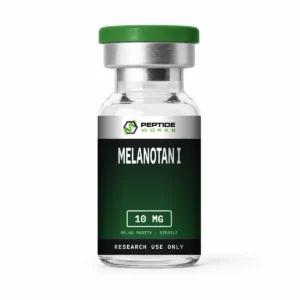
Melanotan I from Peptide Works