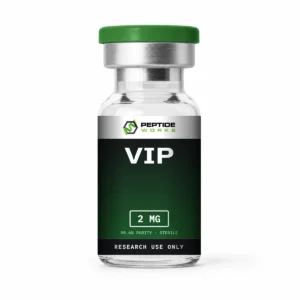
PROMO!

First order? Get 10% OFF with this code: 1storder

Research hub

VIP Research Peptide Hub

VIP (Vasoactive Intestinal Peptide) is a naturally occurring 28-amino-acid neuropeptide that functions as a signaling molecule through class II G protein-coupled receptors (GPCRs) and is studied in biochemical and molecular research.

  • vasoactive intestinal polypeptide
  • neuropeptide
  • Endogenous peptide
01

Technical Overview

Vasoactive Intestinal Peptide (VIP) is a neuropeptide consisting of 28 amino acids that is naturally occurring and is a member of the secretin/glucagon peptide family; it is formed by proteolytic cleavage of a larger precursor protein known as prepro-VIP, with the mature peptide having a characteristic amide group at its C-terminus.

Research carried out in the laboratory on VIP has mainly been concerned with its molecular interactions with the VPAC1 and VPAC2 receptors, both of which are classified as class B G-protein-coupled receptors (GPCRs). Both VIP and the structurally related peptide PACAP are able to interact with both of the receptor types, thus providing well-established experimental systems for the study of peptide–receptor recognition, receptor selectivity, and intracellular signal transduction.

At the molecular level, the activation of VPAC receptors is mainly linked to adenylyl cyclase and to cyclic AMP (cAMP) signaling, even though other pathways associated with the receptor have also been studied.

VIP therefore serves as a well-defined peptide ligand in laboratory investigations that look at the pharmacology of VPAC receptors, the relationship between peptide structure and activity, receptor binding, and intracellular signaling under controlled experimental conditions.

02

Chemical Classification

Chemical name
Vasoactive Intestinal Peptide
Common name(s)
VIP
Alternative nomenclature
Vasoactive Intestinal Polypeptide; VIP-28; Aviptadil
Molecular formula:
C₁₄₇H₂₃₇N₄₃O₄₃S
Molecular weight
3326.8 g/mol
Amino acid sequence
His-Ser-Asp-Ala-Val-Phe-Thr-Asp-Asn-Tyr-Thr-Arg-Leu-Arg-Lys-Gln-Met-Ala-Val-Lys-Lys-Tyr-Leu-Asn-Ser-Ile-Leu-Asn
Compound class
Peptide hormone, neuropeptide
Origin
Endogenous human peptide
Purity
99.6%
03

Molecular Characteristics

Vasoactive Intestinal Peptide (VIP) is a linear 28-amino-acid peptide belonging to the secretin/glucagon family of regulatory peptides. The mature human peptide has the sequence His-Ser-Asp-Ala-Val-Phe-Thr-Asp-Asn-Tyr-Thr-Arg-Leu-Arg-Lys-Gln-Met-Ala-Val-Lys-Lys-Tyr-Leu-Asn-Ser-Ile-Leu-Asn.

VIP has the molecular formula C₁₄₇H₂₃₇N₄₃O₄₃S and an average molecular weight of about 3326.8 g/mol; since the structure includes only one methionine residue and no cysteine residues, the mature peptide does not have any intramolecular disulfide bonds.

Since it is a relatively large linear peptide, VIP has a great many polar and charged amino acid residues and is therefore quite flexible in conformation. The fact that it has a well-defined primary sequence, a specific molecular mass, and a definite terminal structure gives it important features for use in analytical identification and for distinguishing it from shorter VIP fragments or peptides structurally related to it.

For laboratory material, molecular specifications should correspond to the exact VIP form supplied, as counter-ions or other preparation-specific characteristics may affect reported analytical properties.

04

Mechanism Under Investigation

Vasoactive Intestinal Peptide (VIP) has mainly been studied as a peptide ligand of the VPAC1 and VPAC2 receptors, both of which are members of the class B family of G-protein-coupled receptors (GPCRs). The two receptor types bind VIP with high affinity and offer well-established experimental methods for investigating peptide–receptor binding, receptor activation, and intracellular signal transduction.

VPAC Receptor Activation

After VIP binding, both VPAC1 and VPAC2 show a tendency to couple with Gαs proteins, leading to the activation of adenylyl cyclase. This in turn raises the level of intracellular cyclic adenosine monophosphate (cAMP), which then functions as a key second messenger in the signaling pathways associated with VPAC.

cAMP and Protein Kinase Signaling

Rising levels of cAMP can then activate protein kinase A (PKA) and other components of the cAMP-responsive signaling system. In the laboratory, measurements of cAMP accumulation, PKA activity, and the subsequent phosphorylation events are used as biochemical indicators for characterizing VIP-mediated receptor signaling.

Alternative Signaling Pathways

Even though signaling via Gαs–adenylyl cyclase is a major VPAC pathway, experimental studies show that VIP receptors are able to activate further signaling mechanisms depending on the receptor subtype and the particular cell type in question. These mechanisms involve phospholipase C (PLC), the mobilization of intracellular Ca²⁺, protein kinase C (PKC), and the ERK/MAPK-associated pathways.

Receptor Regulation

Research into VPAC receptors has also looked at various processes such as receptor desensitization, internalization, trafficking, and interactions with accessory proteins. The various mechanisms thus offer further methods for investigating how VIP-responsive receptor systems are regulated after ligand binding.

VIP offers a well-defined peptide ligand which can be used in the laboratory for the study of VPAC1/VPAC2 pharmacology, for the investigation of GPCR activation, for cAMP-dependent signaling and for receptor regulation. The molecular responses that are observed vary according to the receptor expression, the cell type and the experimental conditions.

This summary reflects findings reported in published preclinical and in vitro research. The original studies supporting this information are listed in the references.

05

Experimental Research Areas

01

VPAC1 and VPAC2 Receptor Pharmacology

VIP is widely used as a reference ligand in laboratory studies of the VPAC1 and VPAC2 receptors. Research has examined peptide binding, receptor activation, and differences in molecular recognition between these class B1 G-protein-coupled receptors.

02

Peptide–Receptor Structural Research

Structural studies have examined at the molecular level the way in which VIP interacts with VPAC receptors. Detailed information has been obtained about VIP's engagement with the VPAC1 receptor, its conformational dynamics, and ligand selectivity through the use of cryo-electron microscopy and molecular-dynamics simulations.

03

Intracellular Signalling

Research based on cells has looked at the activation of Gαs-associated adenylyl cyclase and the formation of cAMP after the VPAC receptor has been activated. Investigations have also been carried out into other signaling mechanisms and the proteins associated with the receptor in order to characterize the complexity of the VPAC signaling systems.

04

Structure–Activity Relationships

VIP is well suited to structure–activity relationship (SAR) research because individual amino-acid residues can be systematically modified and their contribution to receptor interaction evaluated. Alanine-scanning studies have identified multiple residues involved in VPAC1 and VPAC2 receptor recognition and activation.

05

Receptor Selectivity

Comparative laboratory studies have been carried out using VIP, PACAP, and modified peptide analogs in order to examine the molecular basis for selectivity of the VPAC1, VPAC2, and PAC1 receptors. Research into structure shows that differences in the way peptides interact with receptors and in their conformational dynamics are responsible for specific recognition of the receptors.

06

Receptor Regulation and Trafficking

Research also looks at desensitization, internalization, phosphorylation, and receptor trafficking of the VPAC receptor after ligand activation. Such studies offer molecular models of the way in which peptide-responsive GPCR systems are regulated under controlled experimental conditions.

06

Analytical Verification

The molecular identity and chromatographic purity of Vasoactive Intestinal Peptide (VIP) should be verified by means of analytical methods. In order to evaluate the purity and to separate the main peptide from impurities associated with the synthesis, from modified species, or from degradation products, reverse-phase high-performance liquid chromatography (RP-HPLC) can be employed. RP-HPLC has been widely used in the analytical studies that have been published regarding VIP and its derivatives.

To identify the molecule, electrospray ionization mass spectrometry (ESI-MS), LC-MS, or high-resolution mass spectrometry can be used to confirm that the molecular species observed is in agreement with that expected of the VIP peptide. In previously published research on VIP, ESI-MS has been employed to verify the molecular mass together with chromatographic purity.

Since VIP has a methionine residue which can be oxidized, the analytical evaluation should also take into account modified or degradation-related species where appropriate. The batch-specific records should include details of the material's identity, its purity, the analytical method used, and the lot number in order to support traceability in the laboratory.

Certificate of Analysis
Batch20251014034
MethodCOA 2026
Document Download PDF
HPLC
Batch20251014034
MethodHPLC 2026
Document Download PDF
07

Storage & Handling

Store VIP research material at 2–8°C according to the validated conditions specified for the supplied batch and chemical form. Keep the material protected from unnecessary temperature changes.

When VIP is in solution, its stability may vary with concentration, temperature and experimental conditions. Keep the container tightly sealed to limit exposure to moisture and environmental conditions.

Refer to the batch-specific Certificate of Analysis and supporting analytical documentation for the verified storage and handling requirements for the supplied VIP material.

Supplied as Lyophilized Powder in Vial
Storage Store at 2–8°C
Handling Reconstitution Required
08

Questions researchers ask

VIP is a peptide that occurs naturally and has 28 amino acids; it is also possible to produce synthetic VIP for use in laboratory research, since the synthetic form has a well-defined structure which enables controlled biochemical, analytical, and receptor-binding studies.

Vasoactive Intestinal Peptide is supplied as laboratory research material for scientific and analytical testing purposes only. Not for human or animal consumption or administration or for veterinary, pharmaceutical, diagnostic, therapeutic, or clinical purposes.

The information on this site is for scientific and technical reference use only. Any reference to the VPAC receptors, molecular interactions or signaling pathways is purely for laboratory study and should not be seen as evidence of clinical efficacy or therapeutic appropriateness.