PROMO!

First order? Get 10% OFF with this code: 1storder

Research hub

Sermorelin Peptide Research Hub

Sermorelin is a synthetic 29-amino-acid peptide corresponding to the N-terminal sequence of human growth hormone-releasing hormone (GHRH), studied as a research compound in peptide and endocrine signaling research.

  • Synthetic peptide
  • GHRH analog
  • peptide hormone
01

Technical Overview

Sermorelin is a synthetic peptide consisting of 29 amino acids and corresponds to the N-terminal 1-to-29 segment of human growth hormone-releasing hormone (GHRH/GRF); its amino acid sequence is Tyr-Ala-Asp-Ala-Ile-Phe-Thr-Asn-Ser-Tyr-Arg-Lys-Val-Leu-Gly-Gln-Leu-Ser-Ala-Arg-Lys-Leu-Leu-Gln-Asp-Ile-Met-Ser-Arg-NH₂, the molecule having a C-terminal amide as part of its specified molecular structure. According to the FDA's substance records, Sermorelin is classified as a human growth hormone-releasing factor (1–29) peptide amide.

Sermorelin is the N-terminal part of the longer naturally occurring GHRH sequence. In laboratory research, it is mainly studied in relation to the growth hormone-releasing hormone receptor (GHRH-R), which is a class B G-protein-coupled receptor. When the GHRH-R is activated, this leads to activation of the Gs-protein/adenylyl cyclase pathway and to the production of intracellular cyclic AMP (cAMP), thus providing clear molecular endpoints for studies of the receptor and its signaling.

Experimental applications can therefore include investigation of GHRH-R binding and activation, GPCR signaling, peptide structure–activity relationships and comparisons between GHRH-derived peptide sequences. Sermorelin's defined 29-residue structure also makes it suitable for analytical studies examining peptide identity, purity and molecular integrity.

The free peptide is cataloged separately from Sermorelin acetate. FDA records assign the free peptide CAS 86168-78-7, while Sermorelin acetate is recorded under CAS 114466-38-5. This distinction is important when documenting research material because the precise chemical form, counterion content and batch-specific analytical specifications should be established from the applicable Certificate of Analysis rather than inferred from the Sermorelin name alone.

02

Chemical Classification

Chemical name
L-Tyrosyl-L-alanyl-L-α-aspartyl-L-alanyl-L-isoleucyl-L-phenylalanyl-L-threonyl-L-asparaginyl-L-seryl-L-tyrosyl-L-arginyl-L-lysyl-L-valyl-L-leucyl-glycyl-L-glutaminyl-L-leucyl-L-seryl-L-alanyl-L-arginyl-L-lysyl-L-leucyl-L-leucyl-L-glutaminyl-L-α-aspartyl-L-isoleucyl-L-methionyl-L-seryl-L-argininamide
Common name(s)
Sermorelin
Molecular Formula
C149H246N44O42S
Molecular weight
3357.88 g/mol
Compound class
Synthetic peptide, GHRH analog, peptide hormone
Origin
Synthetic; derived from human GHRH(1–29)-amide.
Purity
99.3%
03

Molecular Characteristics

Sermorelin is a synthetic peptide consisting of 29 amino acids and corresponds to the biologically active N-terminal 1–29 portion of human growth hormone-releasing hormone (GHRH/GRF); its amino acid sequence is Tyr-Ala-Asp-Ala-Ile-Phe-Thr-Asn-Ser-Tyr-Arg-Lys-Val-Leu-Gly-Gln-Leu-Ser-Ala-Arg-Lys-Leu-Leu-Gln-Asp-Ile-Met-Ser-Arg-NH₂, the C-terminal amidation being included in its defined molecular structure.

The peptide contains a chemically varied combination of acidic, basic, polar and hydrophobic amino acid residues. Its single methionine residue contributes sulfur to the molecular composition, while the absence of cysteine means that Sermorelin does not contain cysteine-derived intramolecular disulfide bonds.

According to PubChem, the free peptide has the molecular formula C₁₄₉H₂₄₆N₄₄O₄₂S and an average molecular weight of about 3357.9 g/mol; the FDA's substance record gives Sermorelin the CAS number 86168-78-7 and also provides an average molecular weight of 3357.91 Da, as calculated from its sequence.

Sermorelin should also be distinguished analytically from Sermorelin acetate. The acetate form incorporates associated acetic acid/counterion content and may therefore have different reported molecular composition depending on how the material is represented. PubChem, for example, separately records a 1:1 Sermorelin acetate species with formula C₁₅₁H₂₅₀N₄₄O₄₄S.

For laboratory characterization, the 29-residue sequence, C-terminal amidation, chemical form, molecular identity and chromatographic purity should be considered together, with the batch-specific Certificate of Analysis taking precedence for the material supplied.

04

Mechanism Under Investigation

Sermorelin is investigated primarily through its interaction with the growth hormone-releasing hormone receptor (GHRH-R). As the synthetic amidated 1–29 fragment of human GHRH, it contains the N-terminal region associated with GHRH receptor activity. Research into this system provides a model for examining peptide–receptor recognition, G-protein-coupled receptor signaling and intracellular second-messenger pathways.

GHRH Receptor Interaction

GHRH-R belongs to the class B family of G-protein-coupled receptors (GPCRs). Interaction of GHRH-related peptides with this receptor promotes coupling predominantly to the stimulatory Gs protein, initiating intracellular signaling. Sermorelin can therefore be investigated in receptor-based experimental systems examining ligand binding, receptor activation and structure–activity relationships among GHRH-derived peptides.

Adenylyl Cyclase and cAMP Signaling

A main pathway involved when GHRH-R is activated is one in which Gs stimulates adenylyl cyclase, thus raising the level of intracellular cyclic adenosine monophosphate (cAMP). The increased level of cAMP then causes activation of protein kinase A (PKA) as well as of the related downstream signaling components. Hence, measurements of cAMP serve as a useful molecular endpoint for the investigation of GHRH-R activation under controlled experimental conditions.

Calcium-Associated Signalling

Experimental studies have also linked GHRH-R signaling with changes in intracellular calcium (Ca²⁺). Signaling that is dependent on cAMP can affect membrane depolarisation and voltage-sensitive calcium channels, and furthermore, pathways involving phospholipase C have also been described in the GHRH receptor system. These processes thus offer complementary endpoints for investigating how the activation of receptors leads to cellular responses.

Structure–Activity Research

Since Sermorelin is equivalent to GHRH(1–29)-NH₂, it is especially pertinent to research that aims to determine which parts of the larger GHRH molecule are needed for receptor recognition and signaling. The N-terminal segment consisting of 29 residues has been found to retain the main biological activity of GHRH, which means that Sermorelin can be used as a well-defined molecular probe in the study of GHRH-R pharmacology, GPCR signaling, and investigations into the structure–activity relationship of peptides.

Sermorelin Research Peptide Experimental Research Areas

GHRH Receptor Interaction

Sermorelin is investigated as a defined GHRH(1–29)-NH₂ peptide interacting with the growth hormone-releasing hormone receptor (GHRH-R). Receptor-based experiments provide a framework for examining peptide recognition, ligand binding and activation of this class B GPCR. Structural research on GHRH-R has identified specific receptor regions involved in recognition of GHRH-family peptide sequences.

cAMP-Dependent Signaling

GHRH-R activation is principally associated with Gs-protein coupling, adenylyl cyclase activation and intracellular cAMP production. These molecular endpoints can be measured in receptor-expressing cellular systems to investigate signaling initiated by GHRH-derived peptides.

Peptide Structure–Activity Research

Since Sermorelin consists of the N-terminal 29 residues of human GHRH, it serves as a useful model for studying the relationship between peptide sequence and receptor activity. Experiments involving native GHRH and structurally modified GHRH analogs can then be carried out to see how substitutions, truncation or conjugation affect receptor interactions and molecular behavior.

Proteolytic Stability

Sermorelin has likewise been looked at in studies concerning peptide degradation and stability. Research using LC-HRMS/MS showed that Sermorelin undergoes progressive degradation under in-vitro conditions simulating human plasma and found GHRH(3–29)-NH₂ to be a compound associated with this degradation. These experiments offer a basis for the investigation of peptide stability and proteolytic processing.

Comparative GHRH Analog Research

Sermorelin may be examined together with other peptides such as Tesamorelin and modified GHRH analogs in order to find out how changes in structure influence molecular stability and analytical behavior. Making such comparisons is especially helpful in distinguishing the characteristics of the unmodified GHRH(1–29) sequence from those of the more extensively modified analogs.

Analytical Detection Research

Sermorelin has been studied using liquid chromatography and high-resolution/tandem mass spectrometry in order to identify the peptide and to characterize its degradation products. These methods aid research into molecular identity, the fragmentation of the peptide and the analytical distinction between closely related GHRH analogs.

This summary reflects findings reported in published preclinical and in vitro research. The original studies supporting this information are listed in the references.

05

Experimental Research Areas

01

GHRH Receptor Interaction

Sermorelin is investigated as a defined GHRH(1–29)-NH₂ peptide interacting with the growth hormone-releasing hormone receptor (GHRH-R). Receptor-based experiments provide a framework for examining peptide recognition, ligand binding and activation of this class B GPCR. Structural research on GHRH-R has identified specific receptor regions involved in recognition of GHRH-family peptide sequences.

02

cAMP-Dependent Signaling

GHRH-R activation is principally associated with Gs-protein coupling, adenylyl cyclase activation and intracellular cAMP production. These molecular endpoints can be measured in receptor-expressing cellular systems to investigate signaling initiated by GHRH-derived peptides.

03

Peptide Structure–Activity Research

Since Sermorelin consists of the N-terminal 29 residues of human GHRH, it serves as a useful model for studying the relationship between peptide sequence and receptor activity. Experiments involving native GHRH and structurally modified GHRH analogs can then be carried out to see how substitutions, truncation or conjugation affect receptor interactions and molecular behavior.

04

Proteolytic Stability

Sermorelin has likewise been looked at in studies concerning peptide degradation and stability. Research using LC-HRMS/MS showed that Sermorelin undergoes progressive degradation under in-vitro conditions simulating human plasma and found GHRH(3–29)-NH₂ to be a compound associated with this degradation. These experiments offer a basis for the investigation of peptide stability and proteolytic processing.

05

Comparative GHRH Analog Research

Sermorelin may be examined together with other peptides such as Tesamorelin and modified GHRH analogs in order to find out how changes in structure influence molecular stability and analytical behavior. Making such comparisons is especially helpful in distinguishing the characteristics of the unmodified GHRH(1–29) sequence from those of the more extensively modified analogs.

06

Analytical Detection Research

Sermorelin has been studied using liquid chromatography and high-resolution/tandem mass spectrometry in order to identify the peptide and to characterize its degradation products. These methods aid research into molecular identity, the fragmentation of the peptide and the analytical distinction between closely related GHRH analogs.

06

Analytical Verification

The analytical verification of Sermorelin Peptide should involve confirming the identity of the peptide, its molecular integrity and its chromatographic purity. RP-HPLC can be employed in order to evaluate the chromatographic purity and to separate the main peptide component from any detectable peptide-related impurities. Analytical studies that have previously been carried out on GHRH-related peptides have made use of RP-HPLC together with mass-spectrometric techniques for their characterization.

High-resolution mass spectrometry, involving tandem MS (HRMS/MS), is able to offer further evidence regarding the identity of a peptide by identifying its characteristic precursor and fragment ions; Sermorelin has been investigated directly by means of UHPLC-HRMS/MS, and the methods that have been published show that intact GHRH(1–29)-NH₂ can be distinguished from degradation products such as GHRH(3–29)-NH₂.

More recent analytical methods have also shown that Sermorelin can be identified using LC-HRMS/MS and UHPLC-MS/MS, showing the variety of chromatographic and mass-based techniques that can be applied to this peptide.

Certificate of Analysis
Batch2026071520-2
MethodCOA 2026
Document Download PDF
HPLC
Batch2026071520-2
MethodHPLC 2026
Document Download PDF
Third Party Certificate
Batch12 May 2026
Document Download PDF
07

Storage & Handling

Store Sermorelin research material at 2–8°C, as specified for the current batch. Keep the material in its original, tightly closed container and protect it from moisture and unnecessary environmental exposure.

During laboratory handling, wear appropriate protective gloves and keep the container closed when not in use. Minimize unnecessary temperature changes and moisture exposure, and handle the material using standard laboratory practices for research chemicals.

Supplied as Lyophilized Powder in Vial
Storage 2–8°C
Handling Reconstitution Required
08

Questions researchers ask

Sermorelin is a synthetic peptide corresponding to the N-terminal 29-residue region of human growth hormone-releasing hormone (GHRH). It is commonly designated GHRH(1–29)-NH₂ or GRF(1–29)-NH₂.

Sermorelin is supplied exclusively as a laboratory research material for scientific and analytical purposes. It is not intended for human or animal consumption, administration, diagnosis, treatment, prevention, or clinical or veterinary use.

The information on this page provides scientific and technical reference for qualified research professionals and does not constitute medical, clinical, or therapeutic guidance.

Available now

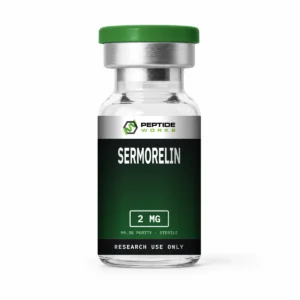
Sermorelin peptide from Peptide Works