PROMO!

First order? Get 10% OFF with this code: 1storder

Research hub

IGF-1 LR3 Peptide Research Hub

IGF-1 LR3 is a recombinant analog of human insulin-like growth factor-I (IGF-I), featuring an arginine substitution at position 3 and a 13-amino-acid N-terminal extension.

  • Insulin-like growth factor-I analog
  • Long-[Arg3]-IGF-I
  • Long R3 IGF-I
  • LR3IGF-I
  • Long-(Arg3) insulin-like growth factor-I
01

Technical Overview

IGF-1 LR3 (Long R3 Insulin-Like Growth Factor-I) is a modified form of human IGF-I which has been developed for use in biochemical and cell-based laboratory research. It is a polypeptide made up of 83 amino acids, is not glycosylated and includes a 13-amino-acid extension at its N-terminus as well as an arginine residue within the part of the sequence that is derived from IGF-I; these structural changes make IGF-1 LR3 different from native IGF-I.

Research carried out in the laboratory has looked into IGF-1 LR3 with regard to its binding to the IGF-1 receptor (IGF1R), its interactions with the receptor, and the intracellular signalling which is associated with the receptor. Since the molecular structure of IGF-1 LR3 is known, it forms a good foundation for comparative studies which examine the effect of modifications to IGF-1 on its interactions with IGF-binding proteins (IGFBPs) and with other parts of the IGF signalling system.

From an analytical point of view, IGF-1 LR3 can be analysed by means of various complementary techniques such as RP-HPLC, SDS-PAGE and mass spectrometry in order to determine its chromatographic purity, electrophoretic properties and molecular identity. Recombinant reference preparations have been found to have a molecular weight of about 9.1 kDa by means of mass spectrometry.

02

Chemical Classification

Chemical name
Long [Arg³] Insulin-Like Growth Factor-I (Long [Arg³]-IGF-I)
Common name(s)
IGF-1 LR3, Long R3 IGF-I, Long R3 IGF-1
Molecular formula
C400H625N111O115S9
Molecular weight
9,111 g/mol
Compound Class
Insulin-like growth factor-I analog
Origin
Recombinant analog derived from human insulin-like growth factor-I (IGF-I)
Purity
97.3%
CAS number
946870-92-4
Amino acid sequence
MFPAMPLSSL FVNGPRTLCG AELVDALQFV CGDRGFYFNK PTGYGSSSRR APQTGIVDEC CFRSCDLRRL EMYCAPLKPA KSA
03

Molecular Characteristics

IGF-1 LR3 (Long R3 Insulin-Like Growth Factor-I) is a recombinant, non-glycosylated polypeptide made up of 83 amino-acid residues; it is structurally based on the 70-residue human IGF-I sequence, although it has two characteristic modifications consisting of a 13-amino-acid extension at the N-terminus and the substitution of the glutamic acid at position 3 in the IGF-I section with arginine (Arg³).

The molecule has a molecular mass of about 9.1 kDa. Just as with native IGF-I, correctly folded IGF-1 LR3 has three intramolecular disulfide bonds, these bonds contributing to the three-dimensional structure of the protein.

The structural alterations described above make IGF-1 LR3 different from native IGF-1 and are important to take into account when examining its molecular interactions with IGF-binding proteins (IGFBPs) and the IGF signaling system. When it comes to analytical characterization, the fact that the peptide consists of 83 amino acid residues, has a certain molecular weight, possesses a disulfide-linked structure, and is not glycosylated offers key features for verifying the identity and structural integrity of research-grade IGF-1 LR3.

04

Mechanism Under Investigation

IGF-1 LR3 has mainly been studied in connection with the insulin-like growth factor 1 receptor (IGF1R) and the molecular signaling systems associated with it. The IGF1R is a receptor tyrosine kinase, and when the ligand binds to it there is autophosphorylation of the receptor together with the recruitment of intracellular signalling proteins. These interactions offer measurable molecular endpoints for the study of the IGF signalling network under controlled laboratory conditions.

IGF1R-Associated Signalling

Stimulating IGF1R is able to set off a number of intracellular signalling cascades. Of these, the two main pathways that have been studied are the PI3K–Akt pathway and the RAS–RAF–MAPK/ERK pathway. Research experiments have shown that PI3K, Akt and other downstream signalling components are activated as a result of stimulation of IGF1R.

IGF-Binding Protein Interactions

A distinctive feature of IGF-1 LR3 is the way in which its structure has been altered as compared to that of native IGF-I. When one is looking at the interactions between modified IGF analogues and IGF-binding proteins (IGFBPs), the N-terminal extension and the substitution of Arg³ become important. This gives a molecular basis for comparative studies focusing on ligand availability, binding properties, and receptor-associated signalling in the IGF system.

Comparative Molecular Research

IGF-1 LR3 may thus be used as a well-defined analogue when comparing IGF1R activation, receptor phosphorylation, intracellular signal transduction and IGFBP interactions with those of native IGF-I and other structurally modified IGF ligands.

The exact signaling pattern obtained with IGF-1 LR3 will depend on the cell type, the level of receptor expression, the concentration of ligand and the experimental conditions. For this reason, the mechanistic results must be understood in the context of the particular biochemical or cell-based research model employed.

This summary reflects findings reported in published preclinical and in vitro research. The original studies supporting this information are listed in the references.

05

Experimental Research Areas

01

IGF-I Receptor Signaling

Long R3 IGF-I activates the type 1 insulin-like growth factor receptor (IGF-1R) in cultured HEK293 cells. Experimental studies have compared IGF-1R activation by Long R3 IGF-I with activation by native IGF-I and insulin. The same study also measured activation of the insulin receptor (IR) by these ligands.

02

IGF-Binding Protein Interactions

Long R3 IGF-I has approximately 1,000-fold lower affinity for IGFBP-3, IGFBP-4, rat plasma IGFBPs, and L6 myoblast IGFBPs than native IGF-I. Studies also show that Long R3 IGF-I retains activity at the type 1 IGF receptor.

03

IGFBP-3 and IGFBP-5 Studies

Recombinant IGFBP-3 suppresses Long-R3-IGF-I-stimulated proliferation in L6 myogenic cells but does not suppress Long-R3-IGF-I-stimulated differentiation. Recombinant IGFBP-5 suppresses Long-R3-IGF-I-stimulated proliferation in porcine embryonic myogenic cells.

04

Cell Proliferation and Differentiation

Long R3 IGF-I has been tested in cultured myogenic and bone-marrow-derived cell models. Studies have measured its effects on cell proliferation and differentiation and compared these responses with native IGF-I and other IGF-I analogues.

05

IGF-I Analogue Structure and Function

Long R3 IGF-I contains an N-terminal extension and an arginine substitution at position 3. These modifications reduce its affinity for IGFBPs while retaining activity at the type 1 IGF receptor. Studies have compared Long R3 IGF-I with native IGF-I and other IGF-I analogues to examine these differences.

06

Analytical Verification

The analytical verification of IGF-1 LR3 must confirm both its molecular identity and its purity. In order to evaluate its chromatographic purity and to separate the main protein component from any related impurities, reverse-phase HPLC (RP-HPLC) can be employed. Published studies have used RP-HPLC together with mass spectrometry to determine the molecular identity of Long R³ IGF-I.

Electrospray mass spectrometry or LC-MS serves as supplementary confirmation of molecular identity and the expected mass. According to published analytical research, recombinant Long R³ IGF-I was characterised using liquid chromatography and electrospray MS, with the analogue reported to have a molecular weight of about 9,110 Da.

When more detailed information regarding the structure is needed, chemical or enzymatic cleavage followed by LC-MS can be used to obtain further information at the sequence level. The analytical documentation for each batch should include the identity of the material, its purity, the analytical methods employed, and the relevant lot details in order to support laboratory traceability and the verification of the research material.

Certificate of Analysis
BatchP250918033
MethodCOA 2026
Document Download PDF
HPLC
BatchP250918033
MethodHPLC 2026
Document Download PDF
07

Storage & Handling

Store IGF-1 LR3 at 2–8°C in its original sealed container. Protect the material from moisture, heat, light, contamination, and unnecessary environmental exposure.

During laboratory handling, use clean laboratory equipment and minimize unnecessary transfers and repeated exposure to laboratory surfaces. Keep the container closed when not in use and return the material to the specified storage conditions after handling.

Supplied As Lyophilized Powder in Vial
Storage Store at 2–8°C
Handling Reconstitution Required
08

Questions researchers ask

The designation LR3 stands for Long R3 and indicates two key structural changes as compared with native IGF-I: the molecule has a 13-amino-acid extension at its N-terminus ("Long") and an arginine in place of the amino acid at position 3 of the IGF-I-derived sequence ("R3").

IGF-1 LR3 is provided strictly for research and laboratory use only. It is not intended for human or animal consumption, administration, or veterinary use. The material is not intended for diagnosis, treatment, cure, or prevention of any disease or medical condition and is not supplied for clinical or therapeutic applications. It is intended solely for qualified research professionals conducting laboratory or scientific research. This material must not be represented, promoted, or used as a substitute for an approved medical or veterinary product.

Available now

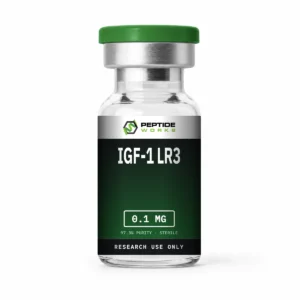
IGF-1 LR3 Peptide from Peptide Works