
MOTS-c Research Hub
MOTS-c is a mitochondria-derived peptide encoded within the mitochondrial 12S rRNA region and investigated in laboratory research for its molecular characteristics, peptide structure, and interactions within cellular signalling pathways.
- MOTS-c
- Mitochondria-derived peptide
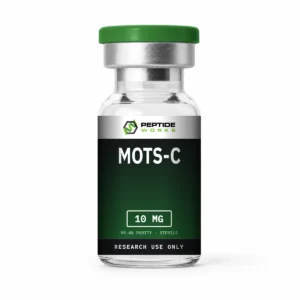
Technical Overview
MOTS-c is a peptide consisting of 16 amino acids which was identified from a short open reading frame in the mitochondrial 12S ribosomal RNA area; the sequence of this peptide differs from that of peptides encoded by conventional nuclear protein-coding genes and has therefore made it the subject of study in the fields of mitochondrial genetics and intracellular signalling.
Laboratory studies have looked at MOTS-c in a number of areas such as mitochondrial biology, cellular metabolism, nucleotide biochemistry, communication between mitochondrial and nuclear cells, and intracellular signalling. Moreover, experimental research has also examined its association with the folate and purine biosynthesis pathways, AMP-activated protein kinase (AMPK)-associated signalling, and stress-responsive nuclear transcription.
Chemical Classification
- Chemical Name
- L-methionyl-L-arginyl-L-tryptophyl-L-glutaminyl-L-α-glutamyl-L-methionyl-glycyl-L-tyrosyl-L-isoleucyl-L-phenylalanyl-L-tyrosyl-L-prolyl-L-arginyl-L-lysyl-L-leucyl-L-arginine
- Common Name(s)
- MOTS-c
- Molecular Formula
- C101H152N28O22S2
- Molecular Weight
- 2174.6 g/mol.
- CAS Number
- 1627580-64-6
- Amino Acid Sequence
- MRWQEMGYIFYPRKLR
- Purity
- 99.4%
- Compound Class
- Mitochondria-derived peptide (MDP)
Molecular Characteristics
MOTS-c is a linear peptide made up of 16 amino-acid residues arranged in the sequence Met-Arg-Trp-Gln-Glu-Met-Gly-Tyr-Ile-Phe-Tyr-Pro-Arg-Lys-Leu-Arg; its primary structure includes a mixture of charged, aromatic, hydrophobic, and polar residues, which results in a peptide that has chemically diverse side-chain functionality.
The sequence includes a number of basic amino acids, such as arginine and lysine, together with one glutamate residue. Aromatic amino acids are also present, the contribution to the hydrophobic and aromatic properties coming from tryptophan, phenylalanine, and two tyrosine residues. Two methionine residues provide sulfur-containing thioether groups which should be taken into account when studying peptide oxidation and analytical stability.
MOTS-c has no cysteine residues and so does not form intramolecular disulfide bonds as a result of its native sequence. Unlike cyclic or chemically conjugated peptides, its reported native structure lacks covalent cyclisation, lipid attachment or modification with polyethylene glycol.
Because it is a relatively short peptide, its conformation can vary depending on the solvent composition, the ionic strength, the concentration, and the experimental conditions. As a result, its physicochemical properties make it useful to assess by means of chromatography, mass spectrometry, and solution stability as part of laboratory characterization.
Mechanism Under Investigation
Experimental studies have looked at MOTS-c with regard to mitochondrial signaling and the regulation of cellular metabolism. Among the main biochemical systems studied is one-carbon metabolism, the folate cycle and the process of de novo purine biosynthesis. Early research described the changes that occurred in these interconnected pathways in experimental systems treated with MOTS-c and found a link with the endogenous purine intermediate 5-aminoimidazole-4-carboxamide ribonucleotide (AICAR).
Since AICAR is involved in the cellular energy-sensing pathways that involve AMP-activated protein kinase (AMPK), later studies have looked at MOTS-c in relation to the signaling associated with AMPK. These studies are included within the wider research concerning how peptides derived from the mitochondria take part in the communication between mitochondrial activity, nucleotide metabolism and intracellular signalling networks.
Another area that is currently being investigated is mitochondrial-to-nuclear signalling, a process which is sometimes referred to as mitonuclear or retrograde communication. Experiments have examined where MOTS-c is located under conditions of metabolic stress and have looked at its presence in the nucleus. Research employing cell models has investigated the associations between nuclear MOTS-c and stress-responsive transcriptional processes.
Other published research has looked into the transcription factor-binding motifs associated with the genes that are regulated by MOTS-c, including motifs linked to the NRF2, ATF1, ATF7, and JUND signalling networks. This research offers a molecular basis for understanding how a peptide encoded in the mitochondria might take part in the communication between the state of the mitochondria and nuclear gene regulation.
These mechanisms are still the subject of experimental research and are studied by means of biochemical assays, cultured-cell systems, metabolomic analysis, gene-expression techniques and other controlled laboratory models.
This information reflects findings reported in published preclinical and in vitro research. The original studies supporting this information are listed in the references.
Analytical Verification
Synthetic MOTS-c can be produced by solid-phase peptide synthesis (SPPS), in which protected amino acids are added sequentially according to the specified 16-residue sequence. After synthesis and peptide cleavage, chromatographic purification can separate the target peptide from truncated sequences, synthesis by-products, and other impurities.
High-performance liquid chromatography (HPLC) can be used to assess chromatographic purity and establish a retention profile under defined analytical conditions. Liquid chromatography–mass spectrometry (LC-MS) or related mass-spectrometric techniques can provide molecular-mass evidence consistent with the expected MOTS-c sequence.
Batch-specific analytical documentation must include the compound identity, batch or lot number, testing date, analytical method, and measured purity. A Certificate of Analysis (CoA) must document these batch-specific results.
Each product batch must be supported by independent third-party testing and a batch-specific Certificate of Analysis (CoA).
Storage & Handling
Research material containing MOTS-c in lyophilised form should be stored under controlled conditions in order to reduce its exposure to heat, moisture and light; for long-term storage in the laboratory, low temperatures are generally employed for peptide materials, with the containers being kept tightly sealed and protected from environmental moisture.
Temperature fluctuations and freeze-thaw cycles should be avoided since such conditions may make it difficult to assess stability. Moreover, oxidation during laboratory storage should be given some thought as the MOTS-c sequence includes two methionine residues.
When carrying out analytical laboratory work with the peptide, researchers must take into account the solvent composition, the concentration, the storage temperature, the container material, and the length of time when planning stability studies. Instead of assuming that prepared solutions have the same stability properties as the lyophilised material, they should follow the requirements of the particular laboratory assay.
Questions researchers ask
MOTS-c is a peptide consisting of 16 amino acids which is encoded by a short open reading frame linked to the mitochondrial 12S ribosomal RNA; its amino acid sequence is MRWQEMGYIFYPRKLR and it has been studied in the fields of mitochondrial biology, cellular signaling, and metabolic biochemistry.
MOTS-c is made up of 16 amino acid residues; its sequence is Met-Arg-Trp-Gln-Glu-Met-Gly-Tyr-Ile-Phe-Tyr-Pro-Arg-Lys-Leu-Arg.
Yes, MOTS-c is a mitochondrial-derived peptide since its sequence was found in a short open reading frame linked to mitochondrial DNA rather than in a typical nuclear protein-coding gene.
A system that is examined very frequently is that which is associated with AMPK. Laboratory research that has already been published has looked at this together with the folate cycle, de novo purine biosynthesis and the cellular intermediate AICAR.
MOTS-c can be identified by means of techniques such as HPLC and mass spectrometry; HPLC is able to determine chromatographic purity, whereas LC-MS or other similar mass-spectrometric methods can give molecular-mass evidence that is in agreement with that expected for the peptide.
MOTS-c is supplied for research and laboratory use only. It is not intended for human or animal consumption. This product is provided solely for qualified scientific, analytical and laboratory research. No information presented on this page should be interpreted as instructions for administration, dosing, diagnosis, treatment, or prevention of any disease or medical condition.