PROMO!

First order? Get 10% OFF with this code: 1storder

Research hub

MK-677 Research Hub

MK-677 (Ibutamoren) is a synthetic, non-peptide small-molecule compound investigated in laboratory research for its chemical properties and interactions with the ghrelin receptor (GHSR1a) in controlled experimental systems.

  • MK-677
  • Ibutamoren
01

Technical Overview

MK-677, also known as ibutamoren, is a synthetic, non-peptide small molecule which is mainly studied in the fields of receptor pharmacology, molecular signaling, and the investigation of ligand–receptor interactions. The mesylate salt form, ibutamoren mesylate, has a different chemical structure to peptide-based research compounds and does not have an amino acid sequence.

It is known in the scientific literature as a synthetic ligand for the growth hormone secretagogue receptor (GHSR), which is also called the ghrelin receptor. Because of its non-peptidic molecular structure it has proved to be useful in laboratory studies which look at how structurally different ligands interact with this G protein-coupled receptor.

The research which has involved ibutamoren has consisted of receptor-binding studies, cellular signaling assays, structural biology investigations and studies into GHSR activation. High-resolution structural studies have also looked at ibutamoren in the context of GHSR complexes in order to characterize the molecular interactions taking place in the receptor-binding pocket.

Lab identification of ibutamoren mesylate is possible on the basis of its molecular composition, chromatographic behaviour and mass spectrometric profile.

02

Chemical Classification

Chemical Name
Ibutamoren mesylate
Common Name(s)
MK-677; Ibutamoren mesylate
Molecular Formula
C₂₈H₄₀N₄O₈S₂
Molecular Weight
624.8 g/mol
CAS Number
159752-10-0
Amino Acid Sequence
N/A
Purity
99.8%
Compound Class
Synthetic non-peptidic compound
03

Molecular Characteristics

MK-677 is structurally a synthetic non-peptide organic compound and not a peptide or protein; it therefore does not have an amino acid chain and no peptide sequence corresponds to it.

The molecule ibutamoren has a relatively complex heterocyclic molecular structure which includes an indoline-spiro-piperidine section as well as structural elements containing amide, ether and sulfonyl groups. It also has aromatic and nonpolar areas, together with a number of heteroatoms that are capable of taking part in intermolecular interactions.

The mesylate form is the methanesulfonate salt of ibutamoren. This difference is significant from an analytical point of view since the free compound and the mesylate salt have different molecular formulae and molecular weights.

The three-dimensional arrangement of ibutamoren has been studied with regard to its position within the ligand-binding region of GHSR; the molecular structure of the compound allows it to form hydrophobic, hydrogen-bonding and other non-covalent interactions with the residues in the receptor-binding pocket.

Since MK-677 is a small molecule and not a peptide, its analytical characterization is carried out by referring to its chemical structure, molecular mass, chromatographic profile, and other relevant physicochemical parameters rather than by using peptide sequencing.

04

Mechanism Under Investigation

Experimental studies that have been published have looked at MK-677 mainly in relation to the growth hormone secretagogue receptor (GHSR), which is a member of the class A family of G protein-coupled receptors. In this area of research, ibutamoren has been described as a synthetic non-peptide agonist of the GHSR.

Structural investigations carried out by means of cryogenic electron microscopy have given detailed information about the interaction between ibutamoren and GHSR; the results show that ibutamoren occupies areas of the receptor's ligand-binding pocket which are also used in the recognition of the endogenous peptide ligand ghrelin, even though there are substantial structural differences between the two molecules.

Molecular investigations have revealed a number of receptor residues that are involved in ibutamoren recognition. The ligand and residues in the GHSR binding cavity interact through hydrogen-bonding, hydrophobic, and cation-Ï€ interactions, according to experimental structural analysis. Additionally, the functions of certain receptor residues in ligand-dependent signaling have been studied by mutagenesis experiments.

Research has also looked at the conformational changes that take place in GHSR after a ligand has bound. Special attention has been paid to the structural features involving the transmembrane domains of the receptor and to the changes connected with G-protein coupling.

This research offers a laboratory model which can be used to study ligand recognition, receptor conformational dynamics, and GPCR signalling. MK-677 is especially relevant to it since the fact that it has a non-peptide structure allows for comparisons to be made between synthetic small-molecule ligands and endogenous peptide ligands that interact with the same receptor system.

This information reflects findings reported in published preclinical and in vitro research. The original studies supporting this information are listed in the references.

05

Experimental Research Areas

01

Receptor Pharmacology

MK-677 has been studied as a laboratory ligand for GHSR, and receptor-based assays have been employed in order to examine ligand recognition, receptor activation, and the concentration-dependent signalling responses under controlled experimental conditions.

02

Structural Biology

The position of ibutamoren in the GHSR ligand-binding pocket has been determined using cryo-electron microscopy and molecular modelling. Thanks to these studies, researchers are able to look at the specific molecular interactions between the compound and the receptor residues.

03

GPCR Signaling

Experimental research has looked at GHSR when acting as a G protein-coupled receptor and has investigated the structural changes connected with ligand-dependent receptor signalling. MK-677 is a non-peptide ligand that is used in the study of these molecular processes.

04

Ligand–Receptor Interactions

Studies carried out in the laboratory have looked into the hydrogen bonding, hydrophobic interactions, electrostatic interactions, and cation–π interactions connected with ibutamoren binding to GHSR.

05

Molecular Pharmacology

MK-677 has been looked at in molecular pharmacology research, with a focus on receptor selectivity, ligand binding, and signaling assays. The research in this area concentrates on experimentally measurable molecular interactions rather than on therapeutic outcomes.

06

Comparative Ligand Research

The fact that ibutamoren has a different structure means that it can be compared in experiments with peptide ligands such as ghrelin, and structural studies have made use of these comparisons to examine how chemically different molecules are able to occupy the same receptor-binding site areas.

06

Analytical Verification

Laboratory characterization of MK-677 can use chromatographic and mass spectrometric techniques to determine the identity and purity of the compound. High-performance liquid chromatography (HPLC) can be employed to assess chromatographic purity and identify other detectable components in the sample. Liquid chromatography coupled with mass spectrometry (LC-MS) can provide complementary molecular mass information to aid in compound identification.

Where necessary, further analytical techniques can be used to characterize the molecular structure or physicochemical properties of the material.

The analytical documentation prepared on a batch basis should include the identity of the compound, the lot or batch number, the date of testing, the analytical method used and the measured purity. The Certificate of Analysis must correspond exactly to the batch of ibutamoren mesylate supplied for laboratory research.

Certificate of Analysis
Batch20250914038
Document Download PDF
HPLC
Document Download PDF
07

Storage & Handling

Store MK-677 in its original sealed container. Protect the material from moisture, heat, light, contamination and unnecessary environmental exposure. Avoid repeated temperature changes during storage.

During laboratory handling, use clean laboratory equipment and minimize unnecessary exposure to air and ambient conditions. Keep the container closed when not in use and handle the material in a clean, dry laboratory environment. Reseal the container securely after handling.

Supplied as Capsule
Storage Keep them dry and away from heat
08

Questions researchers ask

MK-677 is commonly known by the name ibutamoren, which is a synthetic non-peptide small molecule. It has been studied in the fields of molecular and receptor pharmacology, especially with regard to the growth hormone secretagogue receptor (GHSR).

For research and laboratory use only. Not for human or animal consumption. This item is supplied solely as a research chemical for use by qualified research professionals and for analytical purposes. All product information is provided exclusively for chemical identification, analytical characterization, and scientific research. It does not provide information regarding dosing, administration, diagnosis, treatment, prevention, or medical use.

Available now

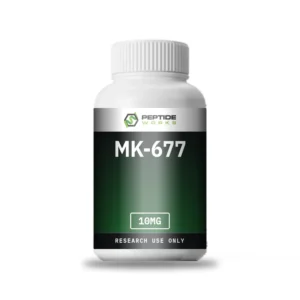
MK-677 from Peptide Works