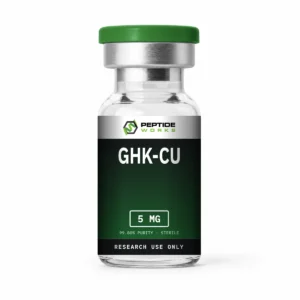
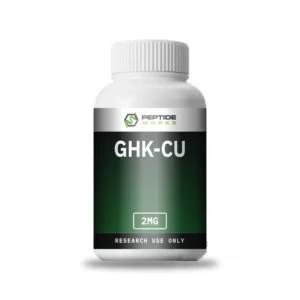
GHK-Cu is a copper-binding tripeptide complex formed when glycyl-L-histidyl-L-lysine (GHK) coordinates a copper(II) ion. GHK itself is a naturally occurring tripeptide first identified in human plasma and has subsequently been detected in other biological fluids and tissues. The copper complex is commonly referred to as GHK-Cu, copper tripeptide-1 or copper(II)-GHK.
Structurally, GHK contains three amino acids—glycine, histidine and lysine—whose functional groups provide coordination sites for Cu²⁺. Copper-binding studies have investigated the resulting complex using spectroscopic, electrochemical and structural techniques, demonstrating that metal coordination substantially influences the molecular properties of the peptide.
GHK-Cu has been investigated primarily in experimental research concerning copper homeostasis, extracellular-matrix biology, cellular signalling, gene expression and tissue-remodelling processes. Cell-based studies have examined responses involving fibroblasts and other skin-associated cell types, including changes in extracellular-matrix components and enzymes involved in matrix turnover. Other research has explored antioxidant-associated mechanisms and the ability of the GHK ligand to participate in copper transport and exchange reactions.
Unlike receptor-selective peptide hormones, GHK-Cu does not have a single, universally accepted cognate cell-surface receptor that explains all reported biological observations. Its proposed mechanisms instead involve copper coordination together with multiple cellular and molecular interactions.
GHK-Cu should be analytically separated from uncomplexed GHK for laboratory research since copper coordination influences its physicochemical and spectroscopic properties. Therefore, rather than just being an unaltered synthetic peptide, it is better described as an experimental copper–peptide combination.