PROMO!

First order? Get 10% OFF with this code: 1storder

Research hub

Hexarelin Peptide Research Hub

Hexarelin is a synthetic hexapeptide classified as a peptidyl growth hormone secretagogue and member of the growth hormone-releasing peptide (GHRP) family.

  • Synthetic hexapeptide
  • growth hormone-releasing peptide (GHRP)
  • peptidyl growth hormone secretagogue (GHS)
  • GHRP-6 superanalog
01

Technical Overview

Hexarelin is a synthetic hexapeptide that belongs to the growth hormone-releasing peptide (GHRP) family and has two D-configured residues and a C-terminal amide. Hexarelin and the GHRP-6 protein are structurally identical due to the integration of 2-methyl-D-tryptophan at the second residue position.

Laboratory research has investigated Hexarelin principally in relation to growth hormone secretagogue receptor (GHS-R) pharmacology and peptide–receptor signaling. Early experimental work characterised Hexarelin as a GHRP-6 analogue and examined its activity in receptor-associated cellular systems.

From a molecular-research perspective, Hexarelin provides a defined peptide structure for investigating structure–activity relationships, receptor recognition and intracellular signaling associated with growth hormone secretagogue peptides. Its substitution of D-tryptophan with a 2-methyl derivative also provides a structural basis for comparative studies with related GHRP compounds

02

Chemical Classification

Chemical name
L-Histidyl-2-methyl-D-tryptophyl-L-alanyl-L-tryptophyl-D-phenylalanyl-L-lysinamide
Common name
Hexarelin
Alternative nomenclature
EP-23905, EP23905, MF-6003, His-D-2-methyl-Trp-Ala-Trp-D-Phe-Lys-NH₂
Molecular formula
C47H58N12O6
Molecular weight
887.04 g/mol
Compound Class
Synthetic hexapeptide, growth hormone-releasing peptide (GHRP), growth hormone secretagogue (GHS), GHRP-6 superanalog
Origin
Synthetic peptide derived from GHRP-6
Purity
99.5%
Amino acid sequence
H-His-D-2-Me-Trp-Ala-Trp-D-Phe-Lys-NH2
CAS number
140703-51-1
03

Molecular Characteristics

A synthetic linear hexapeptide made up of six amino acid residues is called hexarelin. D-phenylalanine at position 5, 2-methyl-D-tryptophan at position 2, and a C-terminally amidated lysine residue are all part of its structure. These distinct structural characteristics set hexarelin apart from peptides that are similarly related, including GHRP-6.

Hexarelin does not contain disulfide bonds or glycosylation. Its defined amino-acid sequence, D-residue stereochemistry, methylated tryptophan and C-terminal amidation are therefore important parameters when establishing molecular identity. These characteristics can be evaluated using complementary analytical techniques such as chromatography and mass spectrometry.

04

Mechanism Under Investigation

The growth hormone secretagogue receptor type 1a (GHS-R1a) signaling system is the main context in which hexarelin has been studied as a synthetic ligand. Hexarelin has been utilized in laboratory receptor-expression models to study GHS-R1a, a G-protein-coupled receptor (GPCR), and related intracellular signaling mechanisms.

GHS-R1a-Associated Signaling

Phospholipase C (PLC)-dependent signaling is linked to GHS-R1a activation. Phosphoinositide turnover and the production of intracellular second messengers are two aspects of this receptor pathway that provide quantifiable biochemical endpoints for investigating ligand–receptor interactions in carefully regulated experimental settings.

Intracellular Calcium Mobilisation

Hexarelin has also been investigated in relation to intracellular Ca²⁺ signalling. Experiments using cells expressing human GHS-R1a have measured changes in intracellular calcium following Hexarelin exposure, providing a laboratory model for examining receptor activation and receptor desensitisation.

Receptor-Binding and Structure–Activity Research

Hexarelin's well-defined structure also makes it pertinent to research on receptor binding and the structure–activity link. Hexarelin's interactions with molecular targets have been studied in relation to GHRP-6 and structurally modified analogs.

In addition to GHS-R1a-associated research, Hexarelin-derived ligands have been used experimentally in studies involving the CD36 scavenger receptor, providing another molecular system for investigating peptide–receptor recognition and binding selectivity.

Overall, Hexarelin provides a defined synthetic peptide for laboratory investigation of GHS-R1a receptor pharmacology, PLC-associated signalling, intracellular calcium mobilisation, receptor desensitisation and peptide structure–activity relationships. Observed molecular responses should be interpreted according to the specific receptor system, cell model and experimental conditions used.

This summary reflects findings reported in published preclinical and in vitro research. The original studies supporting this information are listed in the references.

05

Experimental Research Areas

01

GHS-R1a Receptor Pharmacology

Hexarelin has been investigated as a synthetic ligand of the growth hormone secretagogue receptor type 1a (GHS-R1a). Laboratory receptor systems provide a controlled framework for studying ligand binding, receptor activation and molecular signalling associated with this G-protein-coupled receptor.

02

Intracellular Signal Transduction

Cell-based studies have used Hexarelin to examine GHS-R1a-associated intracellular signalling, including phospholipase C-linked pathways and changes in intracellular second messengers. These experiments help characterise the molecular events occurring following receptor activation under defined laboratory conditions.

03

Calcium-Signalling Research

Changes in intracellular Ca²⁺ provide a measurable endpoint for studying GHS-R1a activation. Hexarelin can therefore be used in receptor-expression and cell-based assays investigating calcium mobilisation and other receptor-associated signaling processes.

04

CD36 Binding Research

Additionally, hexarelin has been studied as a ligand of the CD36 scavenger receptor, offering a different mechanistic field of study from GHS-R1a signaling. Researchers may now investigate peptide–receptor recognition at the molecular level thanks to photoaffinity-labelling experiments that have revealed a particular area of CD36 linked to hexarelin binding.

05

Structure–Activity Relationships

Hexarelin is appropriate for structural–activity relationship (SAR) research because to its well-defined hexapeptide structure. The effects of specific amino acid substitutions on molecular recognition and binding affinity at GHS-R1a and CD36 have been studied in comparison with GHRP-6 and structurally altered analogs.

06

Comparative Peptide Research

In order to examine variations in sequence, stereochemistry, receptor affinity, and molecular selectivity, hexarelin can also be contrasted with similar synthetic GHRPs. Without the need for medicinal or human-use framing, these investigations shed light on the structural characteristics controlling peptide–receptor interactions.

06

Analytical Verification

Hexarelin's chromatographic purity and peptide identification should both be verified analytically. To evaluate purity and separate the main peptide component from contaminants or degradation products associated to synthesis, reverse-phase HPLC (RP-HPLC) can be utilized. HPLC is also used to characterize commercial analytical standards for hexarelin.

Based on the anticipated molecular species and distinctive fragmentation behavior, LC-MS or LC-MS/MS can confirm molecular identification. Intact hexarelin has been discovered as one of the growth hormone-releasing peptides found using targeted LC-MS/MS techniques in published analytical procedures.

In addition to mass and chromatographic parameters, Hexarelin's reported stereochemistry, modified 2-methyl-D-tryptophan residue, and C-terminal amidation should be considered while recording identification. Batch-specific analytical documentation should describe lot data, purity, identification, and analytical procedure in order to aid traceability.

Certificate of Analysis
Batch20250914019
MethodCOA 2026
Document Download PDF
HPLC
Batch20250914019
MethodHPLC 2026
Document Download PDF
07

Storage & Handling

Hexarelin research material should be stored according to the validated conditions specified for the supplied chemical form and batch. Lyophilised peptide should remain in its original sealed container and be protected from moisture, excessive light and unnecessary temperature fluctuations. General scientific guidance for synthetic peptide reference materials emphasises that storage conditions should be established according to peptide-specific stability data rather than assumed from a universal storage temperature.

Supplied As Lyophilized Powder in Vial
Storage Store at 2–8°C
Handling Reconstitution Required
08

Questions researchers ask

Hexarelin is a synthetic hexapeptide and is not a naturally occurring endogenous peptide. Its defined structure includes modified and D-configured amino-acid residues introduced as part of its peptide design.

Hexarelin is intended for research and laboratory use only. It is not intended for human or animal consumption and is not intended for use in the diagnosis, cure, mitigation, treatment, or prevention of any disease or condition. The information provided on this page is limited to scientific and technical information about Hexarelin, including its molecular characteristics, analytical properties, and areas of laboratory research. Nothing on this page is intended to provide medical, clinical, therapeutic, or dosing guidance.

Available now

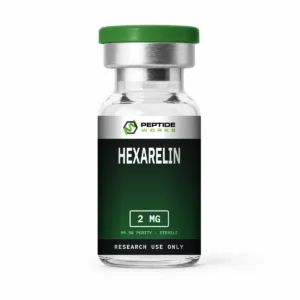
Hexarelin Peptide from Peptide Works