PROMO!

First order? Get 10% OFF with this code: 1storder

Research hub

Delta Sleep-Inducing Peptide (DSIP) Research Hub

DSIP, or delta sleep-inducing peptide, is a synthetic linear nonapeptide investigated in experimental research examining neuroendocrine signalling, stress-response pathways, circadian regulation and physiological processes associated with sleep.

  • DSIP
  • Synthetic Peptide
  • Nonapeptide
  • 9 Amino Acids
  • Linear Structure
01

Technical Overview

A synthetic version of a naturally occurring neuropeptide with nine amino acid residues is called delta sleep-inducing peptide (DSIP). When compared to bigger peptide hormones and proteins, DSIP has a very straightforward molecular structure.

DSIP was originally reported in the 1970s following experiments involving cerebral venous blood from rabbits during electrically induced sleep. Subsequent isolation and structural characterisation led to investigation of the nonapeptide as a potential endogenous signalling molecule. However, the precise biological status of DSIP remains scientifically uncertain: its endogenous precursor, biosynthetic pathway and specific receptor have not been conclusively established.

DSIP is recognised in research principally because of historical investigations into neuropeptide biology, sleep-associated physiology, neuroendocrine signalling and peptide pharmacology. Experimental studies have examined its molecular behaviour using biochemical, electrophysiological and preclinical models, although a definitive receptor-mediated mechanism has yet to be characterised.

02

Chemical Classification

Chemical Name
L-Tryptophyl-L-alanyl-glycyl-glycyl-L-aspartyl-L-alanyl-L-seryl-glycyl-L-glutamic acid
Common Name(s)
DSIP; Delta Sleep-Inducing Peptide; Emideltide (INN)
Molecular Formula
C35H48N10O15
Molecular Weight
848.81 g/mol
Purity
99.5%
CAS Number
62568-57-4
Compound Class
Synthetic linear nonapeptide
Origin
Synthetic peptide
Amino Acid Sequence
Trp-Ala-Gly-Gly-Asp-Ala-Ser-Gly-Glu
03

Molecular Characteristics

Delta sleep-inducing peptide (DSIP) is a short linear nonapeptide composed of nine amino acid residues with the sequence Trp-Ala-Gly-Gly-Asp-Ala-Ser-Gly-Glu (WAGGDASGE). Its molecular formula is commonly reported as C₃₅H₄₈N₁₀O₁₅, with a molecular mass of approximately 848.8 Da. The molecule's fundamental peptide structure can be formed without the need for glycosylation or other intricate post-translational modifications since it lacks disulfide links.

Because of its small size and high proportion of glycine and alanine residues, DSIP is conformationally flexible rather than possessing the stable tertiary architecture characteristic of larger proteins. A single persistent secondary structure has not been conclusively established under physiological conditions, and peptide conformation can vary with solvent, pH and ionic environment.

DSIP contains two acidic residues, aspartic acid and glutamic acid, contributing to an overall acidic character and a net negative charge around physiological pH. Its sequence combines polar residues with the hydrophobic aromatic residue tryptophan, although the molecule overall exhibits appreciable hydrophilic character.

04

Mechanism Under Investigation

Delta sleep-inducing peptide (DSIP), an experimental neuropeptide with an unidentified molecular mechanism, has been the subject of recent laboratory studies. In contrast to neuropeptides that have known cognate receptors, the endogenous biosynthesis mechanism of a particular high-affinity DSIP receptor is yet unknown. As a result, rather than identifying a single receptor-mediated process, published experimental research have concentrated on characterizing possible connections with larger neurotransmitter and neuroendocrine systems.

Published experimental studies describe investigations into DSIP-associated GABAergic and glutamatergic neurotransmission. Electrophysiological and biochemical models have examined whether exposure to DSIP is associated with changes in neuronal excitability and inhibitory or excitatory signalling. Opioid-related mechanisms have also been explored experimentally, including interactions with endogenous opioid signalling systems; however, direct binding of DSIP to a specific opioid receptor has not been established as its primary mechanism.

In vitro and preclinical models have additionally explored monoaminergic pathways, including serotonergic and catecholaminergic signalling. These studies have examined neurotransmitter concentrations, turnover and receptor-associated responses following DSIP exposure. The findings remain heterogeneous, and no individual neurotransmitter pathway has been established as a definitive molecular target.

Neuroendocrine signaling is another important field of study. DSIP has been investigated experimentally in connection with hormone secretion or control related to neuroendocrine signaling, as well as hypothalamic-pituitary regulatory processes. Although the underlying molecular intermediates are still unclear, these discoveries have led to theories on interactions between DSIP and central peptide-regulatory networks.

Studies have also examined peptide transport, degradation and distribution as potential determinants of DSIP activity. As a small linear nonapeptide, DSIP is susceptible to enzymatic processing, and the relationship between intact DSIP, potential metabolites and experimentally observed molecular responses remains under investigation.

Overall, DSIP is best characterised as an investigational neuropeptide without a confirmed cognate receptor or singular intracellular signalling pathway. Its proposed mechanisms remain centred on experimentally observed interactions with neurotransmitter, neuroendocrine and peptide-regulatory systems rather than a fully established molecular mechanism.

The precise solubility of synthetic DSIP depends on formulation, pH, and counter-ion composition; however it is generally compatible with aqueous laboratory settings.

It can degrade hydrolytically or enzymatically in solution, just like a lot of unaltered linear peptides. Thus, HPLC and mass spectrometry can be used to confirm purity and molecular identification, whereas lyophilization and regulated storage are frequently utilized to maintain analytical integrity.

The information on this page is based on research carried out in the laboratory and in preclinical studies on DSIP and must not be regarded as proof of clinical effectiveness or as indicating that it is appropriate for use in humans. References are provided for the studies that support this.

05

Experimental Research Areas

01

Sleep Architecture and Electrophysiology

DSIP was originally identified through experiments associated with sleep physiology, making sleep architecture one of its principal historical research areas. Experimental studies have used electroencephalography (EEG), polysomnographic measurements and animal models to examine patterns of neuronal electrical activity following DSIP exposure. Research has considered parameters such as sleep-stage distribution and electrophysiological characteristics without establishing DSIP as a definitive endogenous regulator of sleep.

02

Neurotransmitter System Research

Preclinical investigations have examined DSIP in relation to several neurotransmitter systems. Experimental models have explored GABAergic, glutamatergic, serotonergic, catecholaminergic and opioid-associated signalling, using biochemical measurements and neuropharmacological techniques. These studies seek to determine whether DSIP interacts directly or indirectly with established neuronal signalling networks; a specific cognate DSIP receptor remains unidentified.

03

Hypothalamic–Pituitary Regulation

DSIP has been investigated within neuroendocrine research, particularly in relation to hypothalamic and pituitary signalling. Experimental studies have examined associations between peptide exposure and regulatory processes involving corticotropin, corticosteroid and other pituitary-associated signalling systems. This work focuses on understanding potential interactions between DSIP and central neuroendocrine regulatory networks.

04

Peptide Distribution and Metabolism

Research has examined the distribution, enzymatic processing and metabolic stability of DSIP. Because DSIP is an unmodified nine-amino-acid peptide, experimental studies have investigated its susceptibility to peptidases and the possibility that metabolites or related molecular species may contribute to observations attributed to the intact peptide.

05

DSIP Molecular Identity and Endogenous Biology

An area particularly specific to DSIP concerns whether the peptide functions as a conventional endogenous neuropeptide. Researchers have investigated its occurrence in biological material, immunoreactive DSIP-like substances, potential precursor molecules and tissue distribution. Its biosynthetic precursor and dedicated receptor have not been conclusively established, leaving its endogenous molecular status an active scientific question.

06

Structure–Activity and Peptide Analogue Research

Synthetic DSIP and structurally modified analogues have been investigated to examine relationships between amino acid sequence, peptide stability and experimentally observed activity. These studies provide a means of determining which structural features of the WAGGDASGE nonapeptide are relevant to its biochemical behaviour.

07

Analytical and Biochemical Characterisation

Laboratory research also encompasses the identification and measurement of DSIP itself. Techniques including HPLC, mass spectrometry, immunoassays and peptide separation methods have been employed to investigate peptide identity, purity, biological samples and degradation products. These analytical approaches are particularly important given the historical difficulty of establishing the precise endogenous form and concentration of DSIP.

06

Analytical Verification

Analytical verification of DSIP should establish the nine-residue peptide's identity and chemical purity. Synthetic DSIP is usually prepared using SPPS. Preparative reverse-phase HPLC is then used to separate the target nonapeptide from shorter sequences, deletion products, and impurities linked to synthesis.

Analytical RP-HPLC can subsequently be used to determine chromatographic purity and assess batch consistency. Because DSIP has a defined theoretical molecular mass of approximately 848.8 Da.

Batch-specific testing should also assess relevant parameters such as peptide content, appearance and residual moisture where applicable. The resulting Certificate of Analysis (CoA) should document the DSIP sequence, batch number, stated purity, analytical HPLC data, mass-spectrometric identity confirmation and applicable specification limits, providing traceable evidence of analytical conformity.

Certificate of Analysis
Batch20250916033
Document Download PDF
HPLC
Batch20250916033
Document Download PDF
07

Storage & Handling

Store DSIP at 2–8°C in a tightly sealed container. Keep the material in its original container and follow the storage conditions specified for the current batch.

During laboratory handling, keep the container closed when not in use and use clean, dry equipment when working with the material. Avoid unnecessary exposure of the material to the surrounding environment during handling.

Supplied as Lyophilized Powder
Storage 2–8°C, away from light
Reconstitution Sterile diluent
After Reconstitution Refrigerate, limit freeze - thaw
08

Questions researchers ask

DSIP was originally reported as a naturally occurring nine-amino-acid peptide isolated from biological material, while research-grade DSIP is produced synthetically. However, its status as a conventional endogenous neuropeptide remains uncertain because a definitive biosynthetic precursor and dedicated receptor have not been established.

DSIP is provided for laboratory research and scientific investigation only. It is not for human consumption or veterinary use and is not intended for administration. It is not intended to diagnose, treat, cure, or prevent any disease or medical condition. Information on this page is provided for scientific research purposes only.

Available now

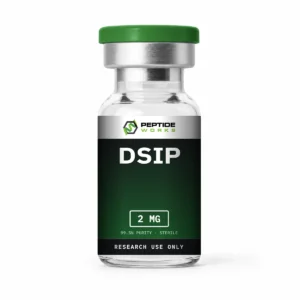
DSIP from Peptide Works