PROMO!

First order? Get 10% OFF with this code: 1storder

Research hub

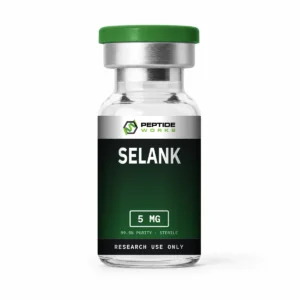
Selank Peptide Research Hub

Selank is a synthetic heptapeptide and structural analogue of the endogenous tetrapeptide tuftsin, consisting of the amino-acid sequence Thr-Lys-Pro-Arg-Pro-Gly-Pro (TKPRPGP), and is characterized as a laboratory research compound.

  • Synthetic heptapeptide
  • tuftsin analogue
01

Technical Overview

Selank is a synthetic research peptide developed as an analog of the endogenous peptide tuftsin. It belongs to a broader area of peptide research involving tuftsin-derived compounds, glyprolinesand proline-containing regulatory peptides, and has been investigated across a range of biochemical and preclinical experimental models.

Several molecular systems have been the subject of research into Selank, with a special focus on GABAergic signaling and the regulation of gene expression. Experimental studies have found changes in genes related to neurotransmitter receptors, transporters, ion channels and other signaling processes. These findings have thus far played a role in the investigation of a possible modulatory relationship between Selank and GABA-associated pathways.

Yet the available evidence does not identify a specific definite molecular target or mechanism for Selank; the results depend on the experimental model and conditions employed. For instance, the effects observed in animal tissue have not always been reproduced in isolated cell systems, which shows that Selank is relevant to research into model-dependent peptide responses and complex signaling interactions.

Additional research has considered Selank within the context of peptide metabolism, stability and structure–activity relationships, including comparisons with tuftsin and related peptide fragments. These areas provide opportunities to investigate how structural modification of short regulatory peptides influences their experimental molecular behavior.

Selank may best be described as a well-defined synthetic research peptide employed in molecular, biochemical and analytical studies. When considering the results obtained from in-vitro and preclinical models, it is necessary to take into account the particular circumstances of the experiments and to avoid drawing conclusions regarding clinical efficacy or therapeutic value from them.

02

Chemical Classification

Chemical name
L-threonyl-L-lysyl-L-prolyl-L-arginyl-L-prolyl-glycyl-L-proline
Common name(s)
Selank
Molecular Formula
C33H57N11O9
Molecular weight
751.87 g/mol
Compound class
Synthetic heptapeptide (tuftsin analogue)
Origin
Synthetic, tuftsin-derived analogue.
Purity
99.5%
03

Molecular Characteristics

Selank is a synthetic linear heptapeptide made up of seven amino acid residues and has the sequence Thr-Lys-Pro-Arg-Pro-Gly-Pro (TKPRPGP). When in its free-peptide form, its structure is expressed as H-Thr-Lys-Pro-Arg-Pro-Gly-Pro-OH, which shows the presence of a free N-terminus and a C-terminal carboxylic acid group. PubChem lists this identical sequence and terminal structure.

Structurally, the first four residues of Selank, Thr-Lys-Pro-Arg (TKPR), correspond to the sequence of the naturally occurring tetrapeptide tuftsin. Selank extends this motif with a C-terminal Pro-Gly-Pro (PGP) sequence, producing a defined structure suitable for comparative studies of peptide stability, degradation and structure–activity relationships.

The peptide has three proline residues, and these cause conformational constraints in the peptide backbone together with lysine and arginine residues which have basic side chains. Since Selank does not contain any cysteine or methionine residues, it neither has disulfide bonds derived from cysteine nor contains sulfur in its molecular formula.

According to PubChem, the free peptide has the molecular formula C₃₃H₅₇N₁₁O₉, an average molecular weight of about 751.9 g/mol, and the CAS number 129954-34-3; these figures are also in agreement with the batch-specific COA that we had previously examined.

Selank should be distinguished from chemically modified forms such as N-acetyl Selank and Selank diacetate, which have different molecular compositions and molecular weights. For laboratory research material, the sequence, terminal structure, chemical form, molecular identity and chromatographic purity should therefore be assessed against the applicable batch-specific Certificate of Analysis.

04

Mechanism Under Investigation

Selank is a synthetic heptapeptide derived structurally from the endogenous tetrapeptide tuftsin (Thr-Lys-Pro-Arg) through addition of the C-terminal Pro-Gly-Pro (PGP) sequence. Its molecular mechanism has been investigated primarily in relation to GABAergic neurotransmission, gene-expression regulation and peptide-mediated signaling. Available experimental evidence suggests a complex mechanism rather than interaction with a single conclusively established molecular target.

GABAergic System Research

A major area of investigation concerns the GABAergic system, particularly GABA_A receptor-associated processes. In rat frontal-cortex experiments, Selank exposure produced changes in the expression of multiple genes associated with GABA receptors, transporters, ion channels and other components of neurotransmission. Researchers observed similarities between some Selank- and GABA-associated expression patterns and proposed allosteric modulation of GABAergic signaling as one possible mechanism.

Gene-Expression Regulation

Selank has also been looked into regarding its effects on transcriptional regulation. In the study using rats, the researchers looked at 84 genes related to neurotransmission and found time-dependent changes in a number of transcripts. These results offer a basis for investigating how exposure to peptides might affect molecular signaling networks rather than acting solely via direct receptor binding.

Model-Dependent Molecular Effects

It is important to note that the responses observed depend on the experimental system. In human IMR-32 neuroblastoma cells, Selank by itself did not cause any significant changes in the mRNA levels of the GABAergic-system genes studied. On the other hand, the experiments that combined Selank with GABA resulted in expression patterns that were different from those obtained with GABA alone, which the researchers saw as partial evidence for an indirect or modulatory interaction with GABA-associated processes.

Structure–Activity Research

The TKPRPGP structure of Selank offers a model for studying how the expansion of the tuftsin sequence with PGP impacts the stability and molecular behavior of the peptide. Overall, Selank is well suited as a research peptide to study GABA-related signaling, transcriptional responses and peptide structure-activity connections. The exact molecular mechanism is being investigated and experimental observations should not be construed as proof of therapeutic efficacy or appropriateness for human use.

This summary reflects findings reported in published preclinical and in vitro research. The original studies supporting this information are listed in the references.

05

Experimental Research Areas

01

GABAergic Signaling Research

Selank has been investigated in relation to the GABAergic neurotransmitter system, including GABA receptor-associated processes, transporters and ion channels. In rat frontal-cortex experiments, Selank produced time-dependent changes in the expression of multiple neurotransmission-related genes. Researchers proposed that allosteric modulation of the GABAergic system represents one possible molecular mechanism, although this has not been conclusively established.

02

Gene-Expression Studies

Quantitative PCR has been employed in order to examine the effect of Selank on transcriptional responses. In one study, 84 genes associated with neurotransmission were looked at and changes in the GABA receptor subunits, the transport systems and other signaling components were found. These results offer experimental models for the investigation of peptide-associated regulation of gene expression.

03

Cellular GABA Interaction Models

Selank has also been examined using human IMR-32 neuroblastoma cells. In this model, Selank alone did not significantly alter the expression of the GABAergic-system genes investigated, whereas combining Selank with GABA produced expression patterns different from GABA alone. This illustrates the importance of experimental context when interpreting proposed Selank mechanisms.

04

Tuftsin and Glyproline Research

Selank is a synthetic compound which is based on tuftsin (Thr-Lys-Pro-Arg) and has been extended at its C-terminus with Pro-Gly-Pro (PGP); this structure serves as a basis for comparative studies looking at how the extension of the peptide chain affects the molecules' properties, their metabolic stability and the interactions linked to sequences derived from tuftsin and glyproline.

05

Peptide Stability and Metabolism

The addition of the PGP sequence was developed in part to alter the metabolic stability of the parent tuftsin sequence. Selank and related peptide fragments can therefore be investigated in experimental systems examining enzymatic degradation, peptide cleavage and structure–stability relationships.

06

Structure–Activity Relationships

The comparison of Selank, tuftsin, PGP and the various peptide fragments offers a basis for examining the effect of individual residues and sequence extensions on molecular behavior. These kinds of studies may be used to tell the properties linked with the TKPR parent motif apart from those resulting from the full TKPRPGP sequence.

07

Analytical Characterisation

Because of its definite seven-amino-acid structure, Selank is suitable for investigation by methods such as RP-HPLC and mass spectrometry; these techniques can be used to examine chromatographic purity, molecular identity, peptide-related impurities and degradation products.

Selank is best described as a peptide used in research involving GABA-related molecular studies, gene expression, peptide metabolism and structure–activity research. Results obtained from cellular and animal studies should always be clearly presented as experimental observations and not regarded as proof of clinical effectiveness or therapeutic value.

06

Analytical Verification

The analytical verification of the Selank Peptide should involve confirming its specified TKPRPGP sequence, its molecular identity and its chromatographic purity. Reversed-phase high-performance liquid chromatography (RP-HPLC) can be employed to separate the main peptide component from detectable peptide-related impurities and thus give a quantitative evaluation of the chromatographic purity.

Mass spectrometry, including LC-MS and high-resolution tandem mass spectrometry (HRMS/MS), offers further evidence with regard to molecular identity. Analytical research that has already been published has identified Selank on the basis of its TKPRPGP sequence, taking into account both its chromatographic retention properties and data on the accurate mass of the precursor ion and those of the characteristic fragment ions. The substance records published by the FDA define Selank as the seven-amino-acid peptide TKPRPGP.

For research material, HPLC purity and mass-based identity results should be assessed alongside the batch-specific Certificate of Analysis. Particular attention should be given to the stated peptide identity, purity, molecular mass, chemical form and any counterion content, since these specifications relate specifically to the individual batch being supplied.

Certificate of Analysis
Batch20250920014
MethodCOA 2026
Document Download PDF
HPLC
Batch20250920014
MethodHPLC 2026
Document Download PDF
07

Storage & Handling

Store Selank research material at 2–8°C and keep it in a tightly sealed container. Protect the material from moisture, heat, and unnecessary light exposure. Follow the storage conditions listed on the Certificate of Analysis for the specific batch.

Handle Selank carefully to limit exposure to moisture and temperature changes. Let a sealed vial reach room temperature before opening to reduce condensation. Keep the vial closed when not in use and avoid unnecessary temperature cycling during laboratory handling.

Supplied as Lyophilized Powder in Vial
Storage 2–8°C
Handling Reconstitution Required
08

Questions researchers ask

Selank is a synthetic heptapeptide. It was developed as an analog of the endogenous tetrapeptide tuftsin, with three additional amino acids—Pro-Gly-Pro—added to its C-terminus.

Selank is provided strictly for laboratory research and scientific purposes only. It is not intended for human or animal consumption or administration, diagnosis, treatment, cure, or prevention of any disease or medical condition. It is not intended for clinical or veterinary use.

The information provided on this page is for scientific and technical reference only and does not constitute medical, therapeutic, diagnostic, or veterinary advice.