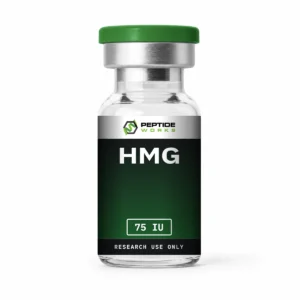
Human Menopausal Gonadotropin (hMG/menotropin) is investigated as a multi-component gonadotropin preparation containing FSH and LH-associated molecular activity. Its mechanism is therefore better described through the receptor interactions of its individual glycoprotein components rather than as the action of a single peptide.
Gonadotropin Receptor Binding
LH-associated components interact with the luteinizing hormone/choriogonadotropin receptor (LHCGR), whereas the FSH component interacts with the follicle-stimulating hormone receptor (FSHR). Both receptors offer well-established experimental settings for examining glycoprotein hormone–receptor recognition and are members of the G-protein-coupled receptor (GPCR) family.
cAMP-Associated Signaling
FSHR and LHCGR activation is associated with Gαs signalling, which stimulates adenylyl cyclase and increases levels of intracellular cyclic AMP (cAMP). This activates protein kinase A (PKA) and related downstream signaling processes. Because changes in cAMP and PKA activity can be measured experimentally, they provide useful biochemical markers for studying gonadotropin receptor signaling under controlled laboratory conditions.
Additional Signaling Pathways
Signaling involving β-arrestins, ERK/MAPK, intracellular Ca2+, and other receptor-associated pathways has also been uncovered by gonadotropin receptor studies. Experimental circumstances, glycoprotein composition, and receptor expression can all affect the relative signaling profile.
Instead of interpreting hMG as a single chemically uniform ligand, its molecular activity should be evaluated in conjunction with its batch-specific FSH/LH-associated composition and analytical features because it is a heterogeneous glycoprotein preparation.
This summary reflects findings reported in published preclinical and in vitro research. The original studies supporting this information are listed in the references.