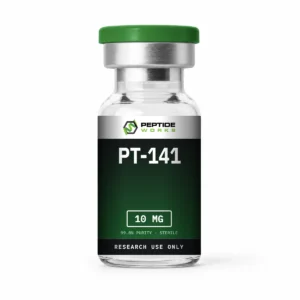
PT-141 has been investigated primarily as a melanocortin receptor ligand. The melanocortin receptor family consists of five G-protein-coupled receptor subtypes, designated MC1R through MC5R. Experimental pharmacology has examined the interaction of cyclic melanocortin analogs with these receptor systems to characterize ligand affinity, receptor selectivity and downstream molecular signaling.
Published experimental studies describe PT-141 as having activity at several melanocortin receptor subtypes, with MC3R and MC4R representing important targets in its pharmacological characterization. Research involving melanocortin ligands has therefore used receptor-expression systems, binding experiments and functional assays to examine the molecular interactions associated with these receptors.
Melanocortin receptors of the G-protein-coupled receptor (GPCR) type are the most prevalent. Studies of receptor activation often investigate coupling to intracellular signaling pathways, such as those involving adenylyl cyclase and cyclic adenosine monophosphate (cAMP). These precise signaling systems suggest measurable experimental results for receptor–ligand interaction research.
The cyclic configuration of PT-141 is also relevant to structure–activity research. Conformational restriction can alter the spatial orientation of amino-acid side chains involved in receptor recognition. The presence of D-phenylalanine, norleucine and N-terminal acetylation provides additional structural variables that have been examined within melanocortin peptide chemistry.
Consequently, PT-141 provides a defined synthetic molecule for experimental investigation of melanocortin receptor pharmacology, peptide–receptor recognition, GPCR signaling and peptide structure–activity relationships.
This summary reflects findings reported in published preclinical and in vitro research. The original studies supporting this information are listed in the references.