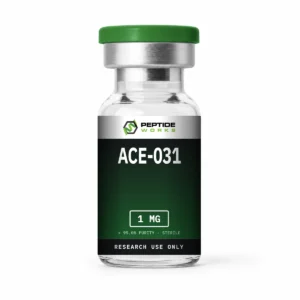
ACE-031 is a recombinant fusion protein comprising the extracellular domain of activin receptor type IIB (ActRIIB) linked to an immunoglobulin Fc domain, developed as a soluble ligand-binding construct for experimental research.
ACE-031 is a recombinant receptor fusion protein composed of the extracellular domain of human activin receptor type IIB (ActRIIB) and the Fc region of human immunoglobulin G1 (IgG1). The Fc domain supports dimer formation, while the extracellular ActRIIB domain provides the ligand-binding region. ACE-031 is a recombinant biologic protein rather than a conventional synthetic peptide or small molecule.
ACE-031 has been characterized for its interactions with extracellular ligands of the transforming growth factor-beta (TGF-β) superfamily, including myostatin (GDF-8) and activin-related ligands. Its molecular structure allows investigation of ligand–receptor interactions and extracellular ligand binding. Analytical characterization may include mass spectrometry, size-exclusion chromatography, high-performance liquid chromatography (HPLC) and SDS-PAGE to assess molecular identity, purity, and protein characteristics. Certificates of Analysis and batch-specific analytical data are examples of supporting documentation.
02
Chemical Classification
Chemical Name
Ramatercept
Common Name(s)
ACE-031
Molecular Formula
C133H227N43O33
Molecular Weight
2956.5 g/mol
CAS Number
N/A
Compound Class
Recombinant fusion protein (ActRIIB-Fc)
Origin
Recombinant / synthetic biotechnology-derived fusion protein
03
Molecular Characteristics
The extracellular ligand-binding region of human activin receptor type IIB (ActRIIB) and the Fc domain of human immunoglobulin G1 (IgG1) make up the recombinant fusion protein ACE-031. ACE-031 is a high-molecular-weight biologic with a dimeric quaternary structure created by Fc-mediated disulphide bonding. In contrast to short synthetic peptides, it has a specified primary amino acid sequence taken from these native human proteins. The Fc region supports molecule stability and structural integrity, while the extracellular ActRIIB domain maintains the structural components necessary for ligand recognition.
The protein adopts the secondary and tertiary structural features characteristic of folded globular proteins, including β-sheet-rich immunoglobulin domains and receptor-specific conformations necessary for ligand binding. As a recombinant glycoprotein, ACE-031 undergoes post-translational modifications, including N-linked glycosylation, which contribute to its physicochemical properties, solubility and conformational stability. The Fc domain also enhances resistance to proteolytic degradation and promotes structural persistence under experimental conditions.
ACE-031 is highly soluble in aqueous buffered solutions formulated for laboratory use and exhibits physicochemical properties typical of recombinant proteins, including amphipathic surface characteristics and a pH-dependent net charge determined by its amino acid composition. Appropriate storage conditions, including protection from repeated freeze–thaw cycles, elevated temperatures and prolonged exposure to light, help preserve its structural integrity. Molecular identity and structural consistency are routinely confirmed using analytical techniques such as SDS-PAGE, size-exclusion chromatography (SEC), mass spectrometry and glycosylation analysis as part of recombinant protein quality control.
04
Mechanism Under Investigation
Current laboratory investigations have examined ACE-031 as a soluble ligand trap that has been engineered from the extracellular domain of activin receptor type IIB (ActRIIB). Rather than functioning as an intracellular signalling molecule, ACE-031 has been characterised as binding extracellular ligands belonging to the growth factor-beta (TGF-β) superfamily before they interact with membrane-bound ActRIIB receptors.
Published experimental studies describe ACE-031 as demonstrating interaction with several ActRIIB ligands, including myostatin (growth differentiation factor-8; GDF-8), activin A and related members of the TGF-β superfamily. By forming stable ligand–protein complexes, the fusion protein has been investigated as a tool for examining receptor–ligand recognition, binding affinity and extracellular signalling dynamics. Structural and biochemical studies have characterised these interactions using ligand-binding assays, surface plasmon resonance and recombinant protein analyses.
In vitro models have explored how ligand sequestration by ACE-031 influences downstream signalling pathways ordinarily initiated through ActRIIB activation. Experimental investigations have examined canonical SMAD2/3 signalling, which represents one of the principal intracellular pathways associated with ActRIIB-mediated signal transduction. Molecular biology studies have also characterised transcriptional responses associated with TGF-β superfamily signalling using gene expression profiling, reporter assays and immunoblotting techniques.
Published research has further examined the interaction between ActRIIB ligands and alternative receptor complexes expressed in different tissues. These investigations have characterised receptor specificity, ligand competition and the molecular mechanisms governing extracellular signalling within the activin and myostatin pathways. Experimental studies have also examined receptor occupancy and ligand-binding kinetics using recombinant proteins and cultured cell systems.
The mechanism of ACE-031 continues to be investigated through biochemical assays, structural biology, cell-based experiments and preclinical models. Current evidence characterises its primary mode of action as extracellular sequestration of selected ActRIIB ligands, providing researchers with a tool for investigating TGF-β superfamily signalling, receptor biology and ligand-mediated intracellular signalling pathways under controlled laboratory conditions.
The findings presented here are based on published preclinical and in vitro research, with primary studies provided in the references.
05
Experimental Research Areas
01
Molecular Biology
Published molecular biology studies have utilised ACE-031 to investigate signalling pathways associated with the transforming growth factor-beta (TGF-β) superfamily. Experimental approaches have examined the regulation of ligand–receptor interactions, transcriptional responses and gene expression associated with activin receptor type IIB (ActRIIB) signalling using techniques such as quantitative PCR, Western blotting and reporter gene assays.
02
Cell Biology
In order to characterize extracellular ligand binding and receptor-mediated signaling, cell-based studies have looked at ACE-031 in cultured mammalian cells. ActRIIB-activated intracellular signaling pathways and interactions between recombinant fusion proteins and TGF-β family ligands have been studied in vitro.
03
Protein Biochemistry
Biochemical investigations have focused on the structural and functional properties of ACE-031 as a recombinant receptor fusion protein. Experimental studies have employed ligand-binding assays, surface plasmon resonance, enzyme-linked immunosorbent assays (ELISA) and protein interaction analyses to characterise binding affinity, ligand specificity and receptor–ligand complex formation.
04
Developmental Biology
ACE-031 has been utilised in developmental biology research to investigate signalling mechanisms regulated by members of the TGF-β superfamily. Published experimental models have examined the biological functions of activins, myostatin and related growth differentiation factors during developmental and tissue-specific signalling processes.
05
Signal Transduction Research
The function of ACE-031 in analyzing canonical and non-canonical pathways linked to ActRIIB activation has been studied through signal transduction research. In order to better understand receptor-mediated communication, laboratory studies have used biochemical assays and molecular analysis to characterize intracellular signaling networks, including SMAD-dependent pathways.
06
Preclinical Pharmacology
Preclinical pharmacology research has employed ACE-031 in experimental animal models and laboratory investigations to characterise its pharmacological properties, tissue distribution and ligand-binding behaviour. These studies have examined the interaction of the recombinant fusion protein with extracellular ligands and evaluated its pharmacokinetic and biochemical characteristics under controlled research conditions.
07
Structural Biology
Structural biology investigations have examined the molecular architecture of ACE-031 and its interaction with TGF-β superfamily ligands. Techniques including X-ray crystallography, cryo-electron microscopy, computational modelling and biophysical characterisation have been used to investigate receptor binding interfaces, protein conformation and ligand recognition at the molecular level.
06
Analytical Verification
Solid Phase Peptide Synthesis (SPPS) is not used in the production of ACE-031 because it is a recombinant fusion protein. Rather, it is made using recombinant DNA expression in mammalian cell systems, which is followed by a number of purification and analytical quality control steps intended to confirm its batch uniformity and structural integrity.
Following expression, ACE-031 is typically purified using protein chromatography techniques, including affinity and size-exclusion chromatography, to isolate the target fusion protein and remove host cell proteins, nucleic acids and other process-related impurities. Analytical high-performance liquid chromatography (HPLC) and size-exclusion chromatography (SEC-HPLC) are routinely employed to assess purity, aggregation and product homogeneity, while liquid chromatography–mass spectrometry (LC-MS) may be used to confirm molecular identity and evaluate molecular mass where appropriate. Complementary analytical techniques, including SDS-PAGE and glycosylation analysis, are also commonly used during characterization.
Before being released for use in research, standard quality control procedures include identity verification, purity assessment, and batch-specific testing. In order to provide traceable verification for laboratory research applications, the resulting analytical data are recorded in a Certificate of Analysis (CoA), which usually include batch identification, purity specifications, analytical test results, and other quality attributes.
ACE-031 is supplied as a lyophilized recombinant fusion protein. The lyophilized material should be stored at 2–8°C and protected from excessive heat and moisture. The container should remain tightly sealed during storage to help maintain the material's physical and structural properties.
Protect the product from prolonged exposure to direct light. Maintain storage conditions according to the applicable product specifications and current batch documentation.
Supplied asLyophilized Powder
Storage2–8°C, away from light
ReconstitutionSterile diluent
After ReconstitutionRefrigerate, limit freeze - thaw
08
Questions researchers ask
ACE-031 and myostatin are distinct biological entities with different functions. Myostatin, known as growth differentiation factor-8 (GDF-8), is an endogenous signalling protein belonging to the transforming growth factor-beta (TGF-β) superfamily. ACE-031 is a recombinant fusion protein engineered from the extracellular domain of activin receptor type IIB (ActRIIB) and the Fc region of human IgG1, and has been investigated as a soluble ligand trap that binds extracellular ligands, including myostatin (1).
No, ACE-031 is not a monoclonal antibody. It is a recombinant receptor fusion protein made up of the Fc region of human immunoglobulin G1 (IgG1) and the extracellular ligand-binding domain of ActRIIB. Although the Fc domain and antibodies have similar structural characteristics, its main function is to improve protein stability and make it easier to produce recombinant proteins rather than to recognize antigens.
Although both follistatin and ACE-031 can bind TGF-β superfamily members, their molecular structures and ligand recognition methods are different. While follistatin is a naturally occurring glycoprotein that interacts with activins and numerous similar ligands through different binding domains, ACE-031 is a manufactured ActRIIB receptor fusion protein. Studies looking into receptor-mediated signaling and ligand selectivity have looked at these variations.
A ligand trap protein is a recombinant protein engineered to bind extracellular signalling molecules before they interact with their native cell-surface receptors. These proteins typically incorporate the extracellular domain of a receptor fused to an Fc region, allowing them to sequester target ligands in solution. Ligand trap technology has been widely utilised to investigate receptor biology, ligand specificity and extracellular signalling pathways.
Activin receptor type IIB (ActRIIB) is a transmembrane receptor that mediates signalling by several members of the TGF-β superfamily, including myostatin, activins and growth differentiation factors. It has been extensively investigated because of its role in receptor–ligand interactions, SMAD-dependent signalling and the regulation of diverse cellular processes. Its broad ligand-binding profile makes it a valuable model for studying extracellular signalling networks.
The TGF-β superfamily comprises a large group of structurally related signalling proteins, including transforming growth factors (TGF-β1, TGF-β2 and TGF-β3), activins, inhibins, bone morphogenetic proteins (BMPs), growth differentiation factors (GDFs), anti-Müllerian hormone (AMH) and myostatin (GDF-8). These proteins have been characterised by their conserved cystine-knot structural motif and receptor-mediated signalling through serine/threonine kinase receptors.
ACE-031 has been characterised as binding extracellular ligands through the recombinant extracellular domain of ActRIIB. This domain retains the ligand recognition properties of the native receptor, allowing interactions with selected members of the TGF-β superfamily. Structural and biochemical studies have investigated these interactions using ligand-binding assays and recombinant protein analyses.
ActRIIB signalling has been investigated using a combination of biochemical, molecular and cell biology techniques. Common methodologies include ligand-binding assays, Western blotting for SMAD phosphorylation, reporter gene assays, quantitative PCR, immunofluorescence microscopy, flow cytometry and transcriptomic analysis. Structural investigations have also utilised X-ray crystallography, cryo-electron microscopy and surface plasmon resonance to characterise receptor–ligand interactions.
Published studies have utilised a range of mammalian cell lines expressing ActRIIB or related signalling components. Frequently used models include HEK293 cells for recombinant protein expression and signalling assays, CHO cells for recombinant protein production and C2C12 mouse myoblasts for investigating TGF-β superfamily signalling in vitro. The choice of cell line rides on the experimental objective and the signalling pathway under investigation.
ACE-031 is typically produced using mammalian recombinant expression systems capable of generating correctly folded and glycosylated proteins. Chinese hamster ovary (CHO) cells are among the most widely used expression platforms for recombinant fusion proteins, although human embryonic kidney (HEK293) cells may also be employed during research and early-stage protein characterisation. Mammalian systems are selected because they provide the post-translational modifications required for complex biologics.
Glycosylation is analysed using a combination of biochemical and analytical techniques. Common approaches include liquid chromatography–mass spectrometry (LC-MS), capillary electrophoresis, high-performance liquid chromatography (HPLC), glycan profiling and enzymatic deglycosylation followed by mass spectrometric analysis. These methods enable researchers to characterise glycan composition, glycosylation sites and batch-to-batch consistency.
The Fc domain of ACE-031 provides structural stability and facilitates dimerisation of the recombinant fusion protein through disulphide bond formation. It has also been characterised as contributing to purification by protein A affinity chromatography and influencing relations with the neonatal Fc receptor (FcRn), which is associated with the pharmacokinetic behaviour of Fc-containing proteins. The Fc region does not participate directly in ligand recognition, which is mediated by the ActRIIB extracellular domain.
Binding affinity between ACE-031 and its target ligands has been investigated using quantitative biophysical and biochemical techniques. Surface plasmon resonance (SPR) is commonly employed to determine association and dissociation kinetics, while bio-layer interferometry (BLI), enzyme-linked immunosorbent assays (ELISA), isothermal titration calorimetry (ITC) and cell-based binding assays have also been used to characterise receptor–ligand interactions and estimate equilibrium binding constants.
ACE-031 is for use in laboratories for research and analytical work only and is not intended for human or veterinary use, for consumption, administration, diagnosis, treatment, or for any clinical purpose. The information given on this page is provided for scientific reference only and should be regarded as supplementary to the cited research literature and the relevant analytical documentation.