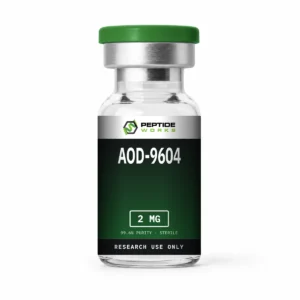
Current laboratory investigations have examined AOD-9604 as a synthetic peptide analogue corresponding to amino acid residues 177–191 of human growth hormone (hGH). Unlike full-length hGH, published experimental studies describe AOD-9604 as a peptide fragment that has been investigated independently to characterize the biological activity associated with the C-terminal region of the parent protein. Structure–function studies have focused on determining whether this peptide fragment demonstrates molecular interactions distinct from those of intact growth hormone.
In vitro models have explored the interaction of AOD-9604 with signaling pathways involved in cellular metabolism and peptide-mediated signal transduction. Experimental investigations have examined its influence on intracellular kinase activity, transcriptional regulation and enzyme-associated pathways using cultured cell systems and biochemical assays. Although these studies have identified molecular responses following peptide exposure, the precise receptor responsible for mediating these effects has not been conclusively established in the published literature.
Further investigation into whether AOD-9604 interacts directly with the classical growth hormone receptor (GHR) has been published. The peptide has often been described by structural and functional studies as lacking the receptor-binding domains necessary for classical growth hormone receptor activation, indicating that whatever molecular activity that has been detected may be caused by other processes. Therefore, the exact molecular target of AOD-9604 is still being researched.
Experimental studies have also characterized intracellular signaling events associated with peptide exposure, including investigations of mitogen-activated protein kinase (MAPK)-related pathways, AMP-activated protein kinase (AMPK)-associated signaling, and other phosphorylation-dependent regulatory networks. These pathways have been examined using biochemical assays, phosphoproteomic analyses, and molecular biology techniques to investigate changes in intracellular signaling under controlled laboratory conditions. However, the direct relationship between AOD-9604 and these signaling pathways has not been fully defined and continues to be investigated.
Current laboratory investigations, therefore, characterize AOD-9604 as an experimental peptide fragment whose molecular mechanism remains incompletely understood. Ongoing research continues to examine its receptor interactions, intracellular signaling pathways, and biochemical properties using cell-based assays, structural biology and preclinical experimental models to further define its mechanism of action.
The summary is based on findings recorded in published preclinical and in vitro literature, with main studies listed in the references.