PROMO!

First order? Get 10% OFF with this code: 1storder

Research hub

ARA-290 Research Hub

Ara-290 (cibinetide) is a synthetic, linear peptide consisting of 11 amino acids which has been derived from the helix B region of the surface-exposed part of erythropoietin (EPO) and has been developed as a well-defined molecular probe for the investigation of EPO-associated receptor signaling in experimental research models.

  • ARA-290
  • Synthetic Peptide
  • 11 Amino Acids
  • EPO-Derived
  • Linear Peptide
01

Technical Overview

The three-dimensional structure of erythropoietin (EPO) is the source of ARA-290, a synthetic peptide counterpart. It is an 11-amino-acid peptide designed to mimic the spatial properties of the erythropoietin molecule's helix B section while maintaining structural differences from the full-length glycoprotein. In contrast to recombinant erythropoietin, ARA-290 is a short synthetic peptide made using solid-phase peptide synthesis (SPPS) that has been studied as a research tool for peptide pharmacology and receptor-mediated signaling.

The peptide was developed following structure–function studies aimed at identifying regions of erythropoietin responsible for tissue-protective signaling independent of its erythropoietic activity. This research led to the design of ARA-290 as a peptide analog that could be examined separately from the parent protein. Since its initial characterization, ARA-290 has become recognized in laboratory research for investigating innate repair receptor (IRR) biology, cytokine receptor interactions and intracellular signaling pathways associated with erythropoietin-derived peptides.

Within laboratory settings, ARA-290 has been investigated using biochemical assays, cultured cell systems and preclinical experimental models to characterize its molecular interactions and signaling mechanisms.

02

Chemical Classification

Chemical Name
Cibinetide (synthetic erythropoietin helix B peptide analogue)
Common Name(s)
ARA-290, Cibinetide
Alternative Nomenclature
Helix B Surface Peptide (HBSP); Pyroglutamate Helix B Surface Peptide (pHBSP); Erythropoietin Helix B Peptide; EPO Helix B Peptide Analogue
Molecular Formula
C51H84N16O21
Molecular Weight
1257.3 g/mol
Purity
99.3%
CAS Number
1208243-50-8
Compound Class
Synthetic linear oligopeptide
Origin
Synthetic, EPO helix B-derived
Amino Acid Sequence
XEQLERALNSS
03

Molecular Characteristics

The 11-amino acid sequence of ARA-290, a synthetic peptide analogue, is taken from the three-dimensional structure of the human erythropoietin (EPO) helix B section. ARA-290 is a short linear peptide made using Solid Phase Peptide Synthesis (SPPS), in contrast to the native erythropoietin molecule, which is a highly glycosylated 165-amino acid glycoprotein. Its main structure has been modified to resemble a certain erythropoietin structural motif without requiring the full-length protein.

ARA-290's relatively short amino acid sequence prevents it from assuming the complex tertiary structure characteristic of erythropoietin. Instead, it mostly exists in solution as a flexible peptide; with pH, ionic strength, and solvent composition affecting any transient secondary structural characteristics. The peptide, which is usually supplied as a lyophilized powder, shows sufficient water solubility after reconstitution in appropriate laboratory buffers.

The physicochemical properties of ARA-290 are determined by its amino acid composition, including the distribution of charged, polar and hydrophobic residues, which influence its overall charge, solubility, and chromatographic behavior. Unlike recombinant erythropoietin, ARA-290 does not undergo post-translational modifications such as glycosylation, simplifying its analytical characterization.

The molecule should be treated under the proper laboratory conditions to maintain structural integrity since, like the majority of synthetic peptides, it is vulnerable to proteolytic degradation after reconstitution.

04

Mechanism Under Investigation

Recent research has focused on ARA-290, a synthetic peptide analog derived from the helix B region of erythropoietin (EPO). Its molecular interactions beyond the usual erythropoietin receptor homodimer that causes erythropoiesis have been investigated in published publications. Characterizing receptor-mediated signaling associated with the unique structural features of the peptide has been the primary focus of research.

In vitro models have explored the interaction of ARA-290 with the innate repair receptor (IRR), a receptor complex that has been proposed to comprise the erythropoietin receptor (EPOR) in association with the β-common receptor (CD131). Biochemical and cell-based studies have examined receptor binding, ligand recognition and downstream signal transduction using recombinant proteins, cultured cells and molecular biology techniques. Although this receptor complex has been extensively investigated, aspects of its molecular composition and signaling mechanisms continue to be characterized.

Published research has examined several intracellular signaling pathways following receptor engagement by ARA-290. Experimental investigations have characterized activation of Janus kinase 2 (JAK2) together with downstream signaling networks involving signal transducer and activator of transcription (STAT) proteins, phosphoinositide 3-kinase (PI3K)/Akt signaling, and mitogen-activated protein kinase (MAPK) pathways. These molecular interactions have been investigated using phosphorylation assays, Western blotting, reporter gene analyses and genetic manipulation in cultured cell systems.

Recent laboratory investigations have also examined transcriptional responses associated with exposure to ARA-290 using quantitative PCR, transcriptome analysis, and proteome profiling. By describing changes in gene expression and intracellular signaling under well controlled experimental conditions, these studies have shed light on receptor-mediated communication and cytokine signaling networks.

The molecular mechanism of ARA-290 continues to be investigated through biochemical assays, structural biology and preclinical research. Published evidence characterizes the peptide as an investigational erythropoietin-derived analogue whose principal area of study involves receptor-mediated signaling through the proposed innate repair receptor complex and the downstream intracellular pathways associated with this interaction.

The summary is based on findings recorded in published preclinical and in vitro literature, with main studies listed in the references.

05

Experimental Research Areas

01

Innate Repair Receptor (IRR) Biology

ARA-290 has been extensively investigated as a research tool for studying the proposed innate repair receptor (IRR), a receptor complex comprising the erythropoietin receptor (EPOR) and the β-common receptor (CD131). Published experimental studies have examined ligand–receptor interactions, receptor complex formation and downstream signaling events using recombinant proteins, cultured cells and preclinical models to further characterize IRR biology.

02

Erythropoietin-Derived Peptide Research

A principal area of ARA-290 research has focused on understanding the structure–function relationships of erythropoietin-derived peptide fragments. Experimental investigations have examined how the helix B region of erythropoietin contributes to receptor recognition and molecular signaling independently of the full-length glycoprotein. These studies have employed synthetic peptide analogues to investigate the biological properties of discrete structural domains within erythropoietin.

03

Cytokine Receptor Signalling

Published research has utilized ARA-290 to investigate cytokine receptor-mediated signaling pathways. Laboratory studies have characterized intracellular signaling following peptide–receptor interactions using techniques such as Western blotting, quantitative PCR, phosphoproteomic analysis and reporter gene assays. These investigations have focused on defining signaling networks associated with erythropoietin-derived peptide analogs.

04

Receptor–Ligand Interaction Studies

ARA-290 has been investigated in biochemical studies examining receptor binding, ligand affinity and molecular recognition. Experimental methodologies, including surface plasmon resonance (SPR), recombinant protein assays and cell-based receptor-binding experiments, have been employed to characterize the interaction between the peptide and proposed receptor complexes under controlled laboratory conditions.

05

Intracellular Signal Transduction

Animal models have been used to investigate intracellular signaling pathways associated with the ARA-290 peptide following receptor interaction. Scientists investigating the ARA peptide have examined phosphorylation-dependent signaling networks involving proteins like JAK2, STAT family members, PI3K/Akt, and MAPK using biochemical and molecular biology testing techniques. Studies have focused on defining signaling mechanisms rather than identifying physiological implications.

06

Preclinical Peptide Pharmacology

Preclinical investigations have utilized ARA-290 to characterize its pharmacological and biochemical properties in laboratory models. Research has examined peptide stability, tissue distribution, receptor engagement and pharmacokinetic characteristics using in vitro systems and animal models to understand the molecular behavior of the peptide under experimental conditions.

07

Peptide Characterisation and Analytical Science

Analytical studies have focused on the synthesis, purification, and quality assessment of ARA-290. Standard analytical methodologies, including high-performance liquid chromatography (HPLC), liquid chromatography–mass spectrometry (LC-MS), amino acid analysis and peptide mapping, have been employed to verify peptide identity, determine purity and confirm batch-to-batch consistency prior to laboratory use.

06

Analytical Verification

Solid Phase Peptide Synthesis (SPPS) is a commonly used method for assembling short peptide sequences and is used in the synthesis of ARA-290. Following peptide assembly, preparative high-performance liquid chromatography (HPLC) can be used to separate truncated peptide sequences, residual synthesis-related materials, and other process-related impurities from the crude product.

Liquid chromatography–mass spectrometry (LC-MS) is used to confirm molecular mass and support peptide identification while analytical high-performance liquid chromatography (HPLC) is used to assess batch consistency and determine peptide purity. Additional analytical methods, including peptide mapping and amino acid analysis, may be used to further characterize the finished peptide and verify sequence fidelity.

Conventional analytical verification techniques include batch-specific quality testing, purity determination, and identification confirmation before being made available for use in research. A Certificate of Analysis (CoA), which typically includes the batch number, peptide identity, purity specification, molecular mass confirmation, and relevant quality control data, is used to record the analytical results for laboratory research applications. This makes it possible to verify manufacturing consistency through traceability.

Certificate of Analysis
Batch20251015039
Document Download PDF
HPLC
Batch20251015039
Document Download PDF
07

Storage & Handling

In order to maintain its stability during storage and shipping, ARA-290 is usually given as a lyophilized peptide. According to the manufacturer's instructions, the lyophilized material should be kept in a refrigerator (2–8°C) and shielded from moisture, extreme heat, and prolonged exposure to direct sunlight. To preserve peptide integrity, the peptide must be reconstituted using a suitable sterile laboratory diluent and carefully mixed before being used in the lab.

The solution should be used within the suggested time frame and kept in a refrigerator after it has been reconstituted. Frequent freeze-thaw cycles should be avoided since they can lead to decreased sample uniformity and peptide degradation.

Supplied as Lyophilized Powder
Storage 2–8°C, away from light
Reconstitution Sterile diluent
After Reconstitution Refrigerate, limit freeze - thaw
08

Questions researchers ask

ARA-290 is a synthetic peptide analogue derived from the helix B region of human erythropoietin (EPO). It consists of an 11-amino acid sequence designed to reproduce the three-dimensional characteristics of a specific structural domain within the parent protein. Unlike recombinant erythropoietin, ARA-290 is a short, chemically synthesized peptide produced using Solid Phase Peptide Synthesis (SPPS).

ARA-290 is supplied solely as a laboratory research material. It is intended only for scientific research and analytical work. This product is not intended for human or veterinary use. The information provided with this material is limited to product identification, analytical characteristics and laboratory documentation. It is not intended to describe any application beyond laboratory research.

Available now

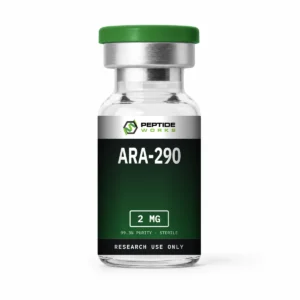
ARA-290 from Peptide Works