PROMO!

First order? Get 10% OFF with this code: 1storder

Research hub

KPV Peptide Research Hub

KPV is a synthetic tripeptide composed of lysine, proline, and valine (Lys-Pro-Val), corresponding to residues 11–13 at the C-terminus of α-melanocyte-stimulating hormone (α-MSH).

  • α-MSH-derived tripeptide
  • C-terminal tripeptide
  • Lys-Pro-Val peptide
  • melanocortin-related peptide fragment
  • endogenous α-MSH sequence fragment
  • synthetic tripeptide
01

Technical Overview

KPV is a synthetic tripeptide which corresponds to the three amino-acid residues at the C-terminus of α-melanocyte-stimulating hormone (α-MSH); its sequence is Lys-Pro-Val (KPV), that is, the 11th to 13th residues of α-MSH. The fact that this is a short and chemically defined structure means that KPV is appropriate for use in laboratory studies investigating the molecular properties of truncated melanocortin-derived peptides.

KPV has been the subject of investigation in research based on cells and involving the transport of peptides and intracellular signaling. Experimental studies have looked into its interaction with the PepT1 oligopeptide transporter, including the transporter-mediated uptake in models derived from epithelial and immune cells.

Researchers have also explored how KPV interacts with molecular signaling pathways, including changes associated with NF-κB signaling. Studies suggest that KPV does not simply behave in the same way as the complete α-MSH peptide. Instead, differences have been observed between KPV and other melanocortin-derived sequences, indicating that its molecular interactions may involve distinct signalling mechanisms.

From a technical perspective, KPV provides a compact peptide structure for investigating peptide transport, structure–activity relationships and cell-signaling interactions under controlled laboratory conditions. Its defined three-residue sequence also provides straightforward parameters for chromatographic and mass-spectrometric characterization.

02

Chemical Classification

Chemical name
L-Lysyl-L-prolyl-L-valine
Common name(s)
KPV, Lys-Pro-Val, Lysine-Proline-Valine
Molecular formula
C16H30N4O4
Molecular Weight
342.43 g/mol
Alternative nomenclature
Lys-Pro-Val, L-Lysyl-L-prolyl-L-valine, MSH (11–13), α-MSH (11–13), α-Melanotropin (11–13)
Compound Class
α-MSH-derived tripeptide
Origin
C-terminal tripeptide (Lys-Pro-Val) of α-melanocyte-stimulating hormone (α-MSH)
Purity
99.0%
CAS number
67727097-3
Amino acid sequence
H-Lys-Pro-Val-OH
03

Molecular Characteristics

KPV is a linear tripeptide made up of three L-amino acids in the order Lys-Pro-Val (K-P-V); it is the portion comprising the C-terminal amino acids 11 to 13 of α-melanocyte-stimulating hormone (α-MSH) and is likewise referred to as MSH(11–13).

KPV has two peptide bonds and is not linked by any disulfide bonds or glycosylation; the central proline residue causes conformational restriction in what would otherwise be a compact peptide backbone, and the lysine provides a basic side-chain amino group.

04

Mechanism Under Investigation

KPV has mainly been studied using cell-based and biochemical models that look at peptide transport and intracellular signaling. Since KPV is the C-terminal tripeptide of α-MSH it has the characteristic Lys-Pro-Val sequence, but experimental evidence shows that its molecular behaviour can be different from that of the whole α-MSH peptide.

PepT1-Mediated Transport

Laboratory research has examined whether KPV can act as a substrate for the peptide transporter 1 (PepT1). Experiments with models based on intestinal epithelial cells and immune cells showed that KPV is taken up via PepT1, thus offering a molecular system for investigating the mechanism by which the tripeptide enters specific cell types.

NF-κB-Associated Signaling

KPV has also been investigated in connection with the NF-κB signaling pathway. Experiments using cell cultures have shown changes in the activation of NF-κB and in its translocation to the nucleus after exposure to KPV. More in-depth studies have looked at the interactions between IκBα, p65RelA, and importin-α3, indicating that KPV is able to affect the nuclear transport of the components associated with NF-κB under certain experimental conditions.

Melanocortin-Associated Research

Even though KPV comes from α-MSH, it cannot be taken for granted that its signaling follows the classic melanocortin-receptor mechanism of the original peptide. Experimental studies have shown differences in the responses associated with the receptors and within the cells, so the connection between KPV's structure, the melanocortin receptors, and the alternative signaling mechanisms remains an area of continuous molecular investigation.

KPV offers a concise tripeptide model which can be used for the study of peptide transport, intracellular signaling and structure–activity relationships under controlled laboratory conditions. When interpreting the mechanistic findings, it is necessary to take into account the particular cell type, the level of transporter expression and the experimental system employed.

This summary reflects findings reported in published preclinical and in vitro research. The original studies supporting this information are listed in the references.

05

Experimental Research Areas

01

Peptide Transport Research

PepT1 (also known as SLC15A1) has been the subject of investigation. Studies using cell cultures have looked at the uptake of the tripeptide mediated by PepT1, thus establishing a well-defined experimental system for the investigation of the transport of short peptide sequences across cell membranes.

02

NF-κB Signalling

Research carried out in the laboratory has looked at KPV using models that involve NF-κB-associated intracellular signaling. The experimental outcomes have been measurements of NF-κB-dependent reporter activity, IκB-α degradation, and other related molecular responses, which has enabled the interaction between KPV exposure and this signaling network to be described under controlled conditions.

03

Peptide–Transporter Relationships

To investigate the relationship between cellular transport and the molecular responses associated with KPV, comparative cell models which exhibited different levels of PepT1 expression have been employed. This approach offers a useful way of distinguishing between effects that are dependent on the transporter and those involving other intracellular interactions.

04

Melanocortin-Derived Peptide Research

KPV, as the C-terminal fragment of α-MSH, offers a concise molecular structure for comparative studies with α-MSH and other melanocortin-derived sequences. Studies have looked into whether the molecular responses associated with KPV are dependent on classical melanocortin receptor signaling or instead involve alternative pathways.

05

Structure–Activity Research

Because of its three-residue structure, KPV is suitable for use in structure–activity relationship studies that involve peptide fragments derived from α-MSH and stereochemical analogues. Such studies could help to clarify the effect of peptide length, the configuration of the residues, and the sequence on molecular recognition and on the signaling responses that are measured experimentally.

06

Analytical Verification

The analytical verification of KPV (Lys-Pro-Val) must confirm both the identity of the tripeptide and its chromatographic purity. RP-HPLC may be used to examine the purity and to separate the main KPV component from impurities associated with the synthesis or degradation products. Experimental work that has already been published has also employed C18 HPLC together with UV detection in order to analyse Lys-Pro-Val in laboratory samples.

When it comes to molecular identification, mass spectrometry (MS or LC-MS) offers complementary confirmation by comparing the molecular species that are observed with the expected mass of KPV. In the case of the free-acid form, the batch analytical reports usually include both RP-HPLC purity testing and MS identity confirmation.

Since different salts or modified forms may have different analytical characteristics, it is necessary to record the exact chemical form. The documentation for each batch should include the peptide identity, the purity, the analytical methods used, and the lot information in order to ensure traceability in the laboratory.

Certificate of Analysis
Batch20250920023
MethodCOA 2026
Document Download PDF
HPLC
Batch20250920023
MethodHPLC 2026
Document Download PDF
07

Storage & Handling

Store KPV at 2–8°C in its original sealed container, in accordance with the storage conditions specified for the current batch. Protect the material from moisture, heat, light, contamination and unnecessary environmental exposure.

During laboratory handling, use clean laboratory equipment and minimize unnecessary transfers or prolonged exposure to laboratory surfaces. Keep the container closed when not in use and return the material to the specified storage conditions after handling.

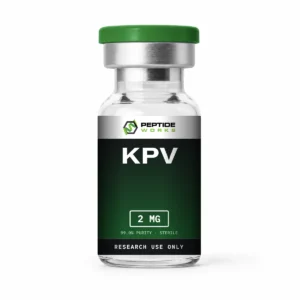
Supplied As Lyophilized powder in vials and capsules
Storage Store at 2–8°C
Handling Laboratory Use Only
08

Questions researchers ask

KPV is the form of the Lys-Pro-Val (K-P-V) sequence which occurs at positions 11 to 13 in naturally occurring α-melanocyte-stimulating hormone (α-MSH). In laboratory research, the tripeptide KPV can be produced synthetically.

KPV is supplied exclusively for scientific and analytical laboratory research. It is intended for use as a research material only and is not for human or animal consumption or administration. KPV is also not supplied for veterinary, medical, diagnostic, therapeutic or clinical applications.

Information on this page is provided exclusively for scientific and technical reference, including molecular characteristics, analytical verification, peptide transport and laboratory research. References to PepT1, NF-κB-associated signaling, or other molecular interactions describe areas investigated in scientific studies and should not be interpreted as evidence of clinical efficacy or suitability for therapeutic use.