

PROMO!
First order? Get 10% OFF with this code: 1storder


Written by

Studies show kisspeptin is a naturally occurring hormone that regulates reproductive hormone release and modulates sexual brain processing. Clinical studies suggest it may improve sexual desire and arousal in men and women with low sexual desire. A randomized clinical trial from Imperial College London found kisspeptin increased penile tumescence by up to 56% compared with placebo while increasing activity in brain regions involved in sexual arousal.
Unlike PDE5 inhibitors, kisspeptin acts primarily through central nervous system pathways rather than by increasing blood flow. Researchers also study PT-141 and oxytocin for their effects on sexual function through different brain mechanisms.
The research compounds sold by Peptide Works are intended for laboratory research only and not for human use. Researchers study these compounds to better understand their biological mechanisms and effects.
Understanding how these peptides influence sexual function begins with examining the brain pathways that regulate sexual response.
Explore Kisspeptin from Peptide Works, a hormone peptide that helps boost sexual desire and improve overall libido.

Sexual response begins in the brain. Several brain regions work together to control sexual desire, arousal, emotions, and hormone release. The hypothalamus regulates reproductive hormones, while areas of the frontal cortex and parietal cortex help process sexual cues, attention and emotional responses. Studies show kisspeptin increases activity in the anterior cingulate cortex and middle frontal gyrus, two brain regions involved in sexual and emotional processing.
PT-141 activates melanocortin receptors in the central nervous system, which are involved in the brain pathways that regulate sexual arousal. Oxytocin also acts in brain regions linked to social bonding, reward, and sexual behavior. Unlike PDE5 inhibitors, these peptides target brain pathways instead of primarily increasing blood flow. Their different mechanisms give researchers new ways to study sexual function and sexual desire.
Because PT-141 works through melanocortin receptors, understanding these receptors helps explain how brain-targeted therapies differ from blood flow-based treatments and how the brain influences sexual response.
Discover PT-141 from Peptide Works, a brain-targeted peptide that enhances physical arousal and sexual performance.
Melanocortin 4 receptors (MC4R) help regulate sexual response through brain pathways involved in sexual desire and arousal. When compounds such as PT-141 bind to melanocortin receptors, they activate central nervous system pathways, including those in the hypothalamus, that influence sexual function.
Studies suggest MC4R signaling plays an important role in the neural control of sexual behavior. Unlike PDE5 inhibitors, which mainly increase blood flow, melanocortin receptors act on brain pathways involved in sexual response.
Kisspeptin and oxytocin also affect sexual function through different receptors in the brain. PT-141 targets melanocortin receptors and studies suggest its brain-based mechanism may contribute to improvements in sexual function seen in clinical trials.
This brain-based mechanism makes PT-141 different from traditional erectile dysfunction medications.
Checkout Oxytocin from Peptide Works, a peptide that promotes emotional intimacy and bonding during sexual activity.
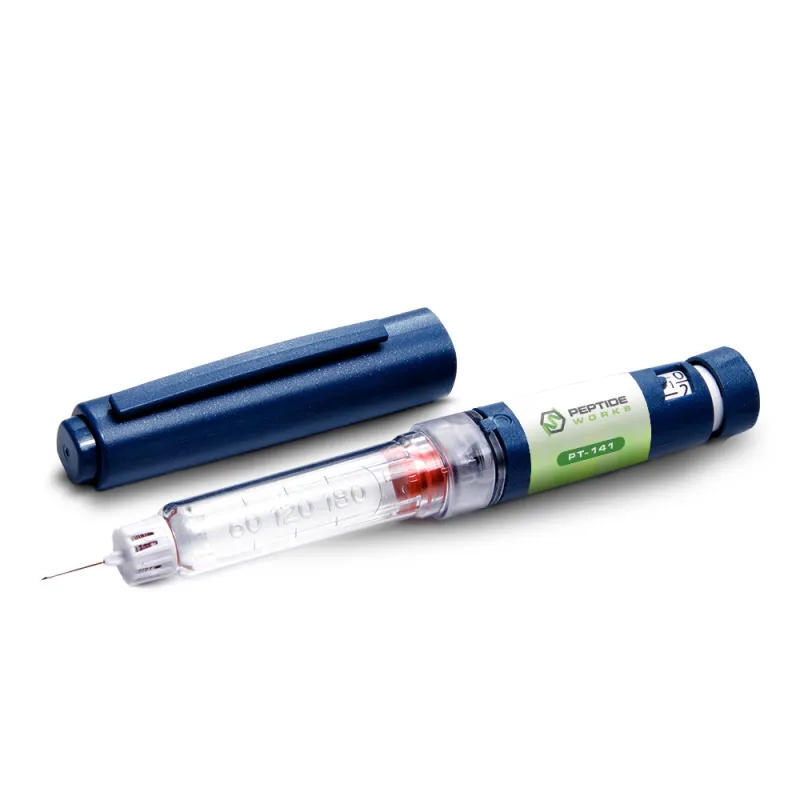
PT-141 works differently from traditional erectile dysfunction (ED) medications. It targets melanocortin receptors in the brain, while PDE5 inhibitors, such as Viagra, improve blood flow by blocking the PDE5 enzyme.
Studies suggest PT-141 may improve sexual desire and sexual arousal through its effects on the central nervous system. In contrast, PDE5 inhibitors require sexual stimulation to help produce an erection.
PT-141 has been studied in both men and women, while PDE5 inhibitors are mainly used to treat male erectile dysfunction. Because libido peptide acts on brain pathways instead of blood flow, it may benefit people whose symptoms are not fully addressed by blood flow-based treatments.
While PT-141 works through melanocortin receptors, kisspeptin is being studied for a different approach to sexual health.
Studies suggest kisspeptin may help improve low sexual desire in people with hypoactive sexual desire disorder (HSDD). Clinical trials found that kisspeptin modulated sexual brain processing and improved measures of sexual desire and sexual arousal in men with HSDD.
Early clinical studies also reported similar effects on sexual brain responses in women with HSDD. Kisspeptin is a libido peptide studied for its effects on low sexual desire.
Clinical trials found increased penile tumescence in men with HSDD during exposure to sexual stimuli. Along with improvements in behavioral measures of sexual desire. Studies also showed that kisspeptin was well tolerated during these trials.
Studies show kisspeptin stimulates luteinizing hormone (LH) within a short time after administration. The timing of the LH response varies by the delivery method, dose, and study protocol. Some clinical studies reported peak LH levels about 30 minutes after treatment, while others measured hormone responses over several hours.
This libido peptide also activates brain pathways involved in sexual desire. Clinical studies found rapid changes in sexual brain processing after administration. However, the timing of changes in low sexual desire has not been clearly established in clinical studies.
With multiple libido peptides available for research, comparing their different strengths helps researchers choose the right compounds for their studies.
The best libido peptide depends on the research goal. Clinical studies suggest kisspeptin shows the strongest evidence for low sexual desire in people with HSDD.
PT-141 has been studied for sexual arousal and erectile function through melanocortin receptors. Oxytocin is mainly studied for social bonding, intimacy, and pair bonding rather than directly increasing sexual desire.
| Peptide | Best For | Mechanism | Research Status |
|---|---|---|---|
| Kisspeptin | Low libido in both genders | Hormone axis stimulation | Multiple clinical trials ongoing |
| PT-141 | Physical arousal & ED | Brain melanocortin receptors | Extensive research studies |
| Oxytocin | Emotional intimacy | Brain reward pathways | Well-studied compound |
These promising research developments point toward a future where sexual health treatment could be completely transformed.
Libido peptides are an active area of sexual health research. Peptides like kisspeptin, PT-141, and oxytocin are being studied because they act on different brain pathways linked to sexual desire, arousal, and bonding. Each peptide works through a different biological mechanism.
Research is still ongoing. As more clinical studies are completed, scientists will learn more about how these libido peptides work and where they may have a role in future sexual health research.
All products discussed are supplied for research purposes only and are not intended for human use.
(1) Mills EG, Ertl N, Wall MB, Thurston L, et al. Effects of Kisspeptin on Sexual Brain Processing and Penile Tumescence in Men With Hypoactive Sexual Desire Disorder: A Randomized Clinical Trial. JAMA Netw Open. 2023 Feb 1;6(2):e2254313.
(2) George JT, Veldhuis JD, Roseweir AK, Newton CL, et al. Kisspeptin-10 is a potent stimulator of LH and increases pulse frequency in men. J Clin Endocrinol Metab. 2011 Aug;96(8):E1228-36.
(3) Mills EG, Silva MSB, Delli V, Decoster L, et al. Intranasal kisspeptin administration rapidly stimulates gonadotropin release in humans. EBioMedicine. 2025 May;115:105689.
(4) Diamond LE, Earle DC, Rosen RC, Willett MS, Molinoff PB. Double-blind, placebo-controlled evaluation of the safety, pharmacokinetic properties and pharmacodynamic effects of intranasal PT-141, a melanocortin receptor agonist, in healthy males and patients with mild-to-moderate erectile dysfunction. Int J Impot Res. 2004 Feb;16(1):51-9.
(5) Melis MR, Argiolas A. Oxytocin, Erectile Function and Sexual Behavior: Last Discoveries and Possible Advances. Int J Mol Sci. 2021 Sep 26;22(19):10376.
(6) Melis MR, Argiolas A. Oxytocin, Erectile Function and Sexual Behavior: Last Discoveries and Possible Advances. Int J Mol Sci. 2021 Sep 26;22(19):10376.
(7) Velmurugan H, Mannava AS, Thangaraju P, Neelambaran K. Kisspeptin and its Current Clinical Status-A Systematic Review. Curr Med Chem. 2025;32(7):1313-1322.
ALL CONTENT AND PRODUCT INFORMATION AVAILABLE ON THIS WEBSITE IS FOR EDUCATIONAL PURPOSES ONLY.
DISCLAIMER: These products are intended solely as a research chemical only. This classification allows for their use only for research development and laboratory studies. The information available on our Peptide Works website: https://peptide-works.com/ is provided for educational purposes only. These products are not for human or animal use or consumption in any manner. Handling of these products should be limited to suitably qualified professionals. They are not to be classified as a drug, food, cosmetic, or medicinal product and must not be mislabelled or used as such.
Peptide Works
Related Articles
How can ARA-290 Peptide Help Diabetic Patients?
Diabetes affects millions of people around the world and leads to serious health problems. Research shows that the ARA-290 peptide

Can AICAR Peptide Improve Endurance?
AICAR peptide has shown promising results for improving endurance capacity in studies. Research shows that AICAR activates AMPK, increasing glucose

Enhancing Energy with NAD+ Supplements
Energy is the driving force behind focus, movement, and recovery. When cells have less energy to work with, the body