
PROMO!
First order? Get 10% OFF with this code: 1storder


Written by

Copper Peptides are naturally occurring signaling molecules made of short amino acid chains bound to copper ions. Researchers have studied them for their role in cellular communication, tissue maintenance, and skin regeneration.
Growing evidence suggests they may help regulate biological processes involved in collagen production, extracellular matrix remodeling, antioxidant defense, and the body’s natural repair response.
Their broad activity across multiple cellular pathways has made Copper Peptides an important focus in regenerative research. Scientists continue to explore how these compounds support tissue health and wound healing under laboratory conditions. This growing body of research has increased interest in their biological potential.
Explore GHK-Cu from Peptide Works, a copper-binding peptide that supports collagen production, skin regeneration, and accelerated wound healing in research studies.
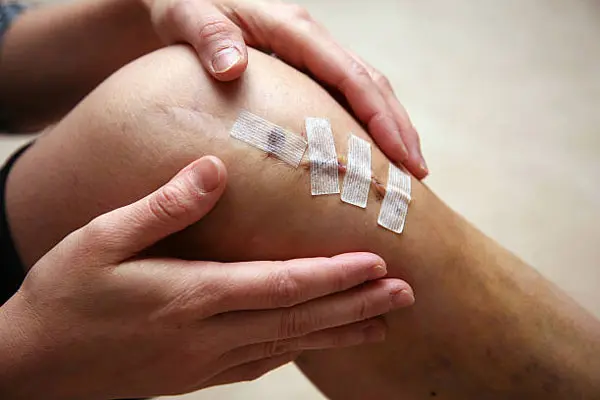
Copper Peptides act as signaling molecules during tissue repair. Research shows they help control the activity of cells that build and organize connective tissue. They support collagen formation and help activate lysyl oxidase. This copper-dependent enzyme creates strong cross-links in collagen and elastin. These cross-links improve the strength and stability of the extracellular matrix.
Studies show Copper Peptides help regulate how the extracellular matrix breaks down and rebuilds. They influence matrix metalloproteinases (MMPs) and their natural inhibitors (TIMPs).
This process helps clear damaged proteins and supports the formation of healthy new tissue. These effects are one reason Copper Peptides continue to be widely studied in regenerative research.
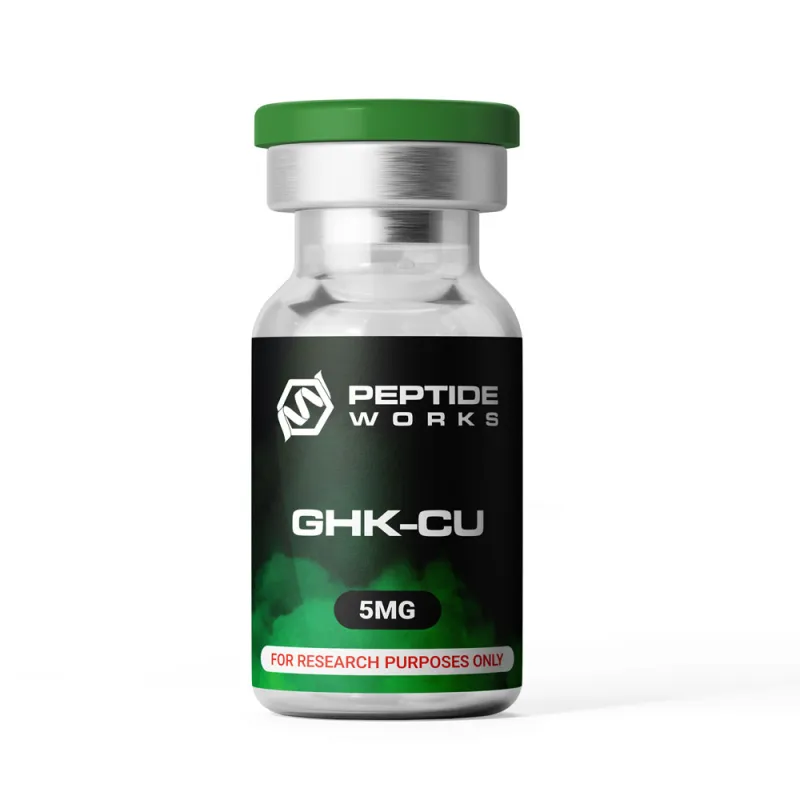
GHK-Cu is the most studied Copper Peptide in regenerative research. It is a naturally occurring tripeptide made of glycine, histidine and lysine bound to a copper ion. Researchers first identified it in human plasma. It is also found in saliva and urine. Studies suggest natural GHK-Cu levels decline with age. increasing interest in its biological role.
Research shows GHK-Cu supports several processes involved in tissue repair. It helps stimulate collagen production, supports fibroblast activity, and promotes extracellular matrix remodeling.
Studies have also examined its role in wound healing, skin regeneration, and antioxidant defense. Because of this broad biological activity, GHK-Cu has become the Copper Peptide used most often in laboratory and clinical research.
GHK-Cu helps increase collagen production by activating fibroblasts, the cells responsible for making collagen in connective tissue. Studies show Copper Peptides containing GHK-Cu stimulate collagen synthesis at very low concentrations without increasing fibroblast numbers. This means GHK-Cu improves collagen production by increasing cellular activity rather than cell growth.
Research also shows GHK-Cu supports extracellular matrix remodeling during tissue repair. It helps regulate the activity of matrix metalloproteinases (MMPs) and their natural inhibitors. This balance helps remove damaged matrix proteins while supporting new collagen formation and healthy connective tissue repair.
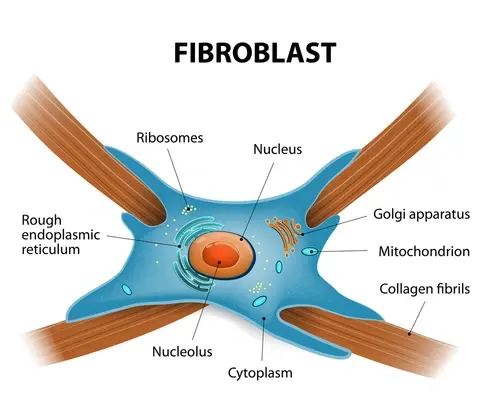
Fibroblasts are the main cells that keep skin strong and healthy. They produce collagen, elastin and other extracellular matrix proteins that give skin its structure and support. Fibroblasts also release signaling molecules that help maintain normal skin function and respond to changes in the surrounding tissue.
When the skin is injured, fibroblasts become active and move into the damaged area. They produce new extracellular matrix, support collagen formation and help rebuild the skin.
Studies show fibroblasts also communicate with immune cells and other skin cells to coordinate tissue repair. Because fibroblasts play such a central role in healing, researchers continue to study peptides, including BPC-157, for their potential effects on these repair processes.
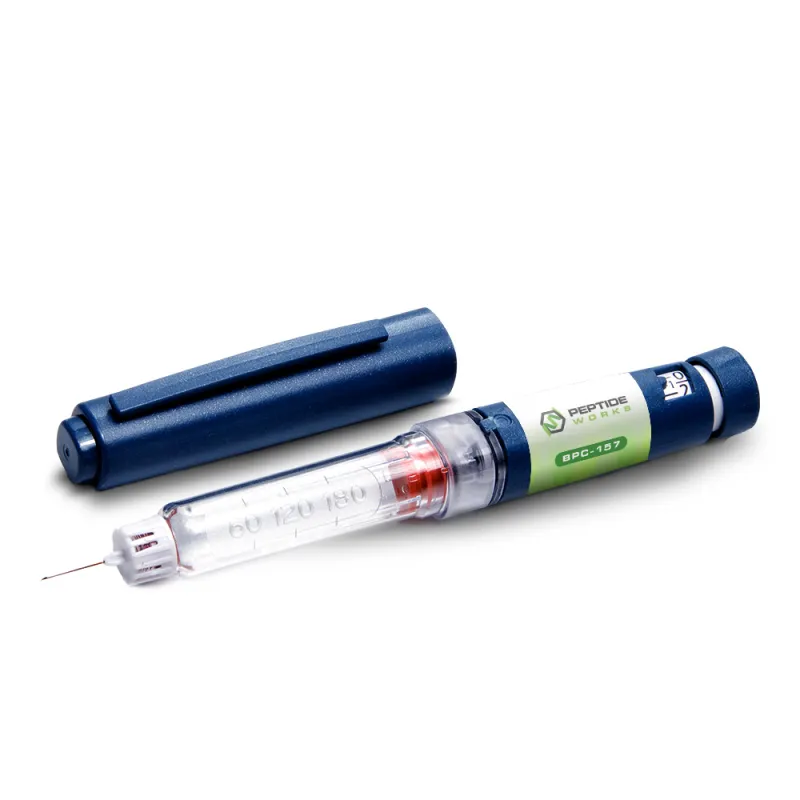
BPC-157 is a synthetic peptide studied for its potential role in wound repair. Preclinical research suggests it supports several stages of healing. Studies show it promotes angiogenesis, improves blood flow and supports granulation tissue formation. These processes help deliver oxygen and nutrients to injured tissue and create favorable conditions for repair.
Research also suggests BPC-157 supports fibroblast activity, collagen synthesis, and extracellular matrix remodeling during healing. Animal studies have reported improved repair in skin, tendon, ligament, muscle and bone injury models. However, nearly all evidence comes from laboratory and animal studies.
Shop BPC-157 from Peptide Works, a research peptide studied for its potential role in tissue repair, angiogenesis, and cellular migration in regenerative research settings.
The extracellular matrix (ECM) is the support system of the skin. It is made of collagen, elastin, and other proteins that keep skin strong, firm, and flexible. The ECM also helps skin cells communicate during tissue repair. GHK-Cu is widely studied for its role in collagen production and ECM remodeling.
It helps fibroblasts produce new collagen and supports the replacement of damaged matrix proteins. BPC-157 has been studied for supporting fibroblast activity, blood vessel formation, and granulation tissue during wound healing.
As skin ages, the ECM slowly breaks down. Collagen levels decrease, and damaged proteins build up. This makes the skin thinner and slows repair. Research suggests GHK-Cu helps maintain a healthy ECM by supporting collagen synthesis and normal matrix remodeling.
Preclinical studies suggest BPC-157 helps repair the ECM by supporting tissue regeneration and healing in animal models. Together, these peptides are important areas of regenerative research.
Copper Peptides show strong promise for the future of regenerative research. New studies continue to improve the understanding of how these peptides support tissue repair, skin regeneration, and healthy aging. As research advances, scientists may uncover new biological roles and potential applications for Copper Peptides.
Peptide Works is committed to providing high-quality research peptides to scientists around the world. By supplying reliable research products, the company helps support the work that drives new discoveries in regenerative science.
All products discussed are supplied for research purposes only and are not intended for human use.
(1) Pickart L, Margolina A. Regenerative and Protective Actions of the GHK-Cu Peptide in the Light of the New Gene Data. Int J Mol Sci. 2018 Jul 7;19(7):1987.
(2) Pickart L, Vasquez-Soltero JM, Margolina A. GHK Peptide as a Natural Modulator of Multiple Cellular Pathways in Skin Regeneration. Biomed Res Int. 2015;2015:648108.
(3) Seiwerth S, Milavic M, Vukojevic J, Gojkovic S, et al. Stable Gastric Pentadecapeptide BPC 157 and Wound Healing. Front Pharmacol. 2021 Jun 29;12:627533.
(4) Huang T, Zhang K, Sun L, Xue X, et al. Body protective compound-157 enhances alkali-burn wound healing in vivo and promotes proliferation, migration, and angiogenesis in vitro. Drug Des Devel Ther. 2015 Apr 30;9:2485-99.
ALL CONTENT AND PRODUCT INFORMATION AVAILABLE ON THIS WEBSITE IS FOR EDUCATIONAL PURPOSES ONLY.
DISCLAIMER: These products are intended solely as a research chemical only. This classification allows for their use only for research development and laboratory studies. The information available on our Peptide Works website: https://peptide-works.com/ is provided for educational purposes only. These products are not for human or animal use or consumption in any manner. Handling of these products should be limited to suitably qualified professionals. They are not to be classified as a drug, food, cosmetic, or medicinal product and must not be mislabelled or used as such.
Peptide Works
Related Articles
How can ARA-290 Peptide Help Diabetic Patients?
Diabetes affects millions of people around the world and leads to serious health problems. Research shows that the ARA-290 peptide

Can AICAR Peptide Improve Endurance?
AICAR peptide has shown promising results for improving endurance capacity in studies. Research shows that AICAR activates AMPK, increasing glucose

Enhancing Energy with NAD+ Supplements
Energy is the driving force behind focus, movement, and recovery. When cells have less energy to work with, the body