
Once amino acids are joined, the repeating sequence of bonded atoms forms the peptide backbone. The order of the amino acids, together with the structural properties of the backbone and individual side chains, influences the overall conformation and chemical behaviour of the resulting peptide.
Peptide bonds are therefore fundamental to peptide chemistry. Understanding how they form, their structural characteristics and the ways in which they can be broken down is relevant to peptide synthesis, structural analysis and biochemical research.
How Do Peptide Bonds Form?
A peptide bond forms when the carboxyl group of one amino acid is linked to the amino group of another.
The resulting C–N bond is an amide linkage.
Peptide-bond formation is often described as a condensation reaction because the overall formation of the linkage corresponds to the loss of the elements of water. In biological systems, however, peptide synthesis is a highly regulated process involving ribosomes, transfer RNA and multiple enzymatic steps.
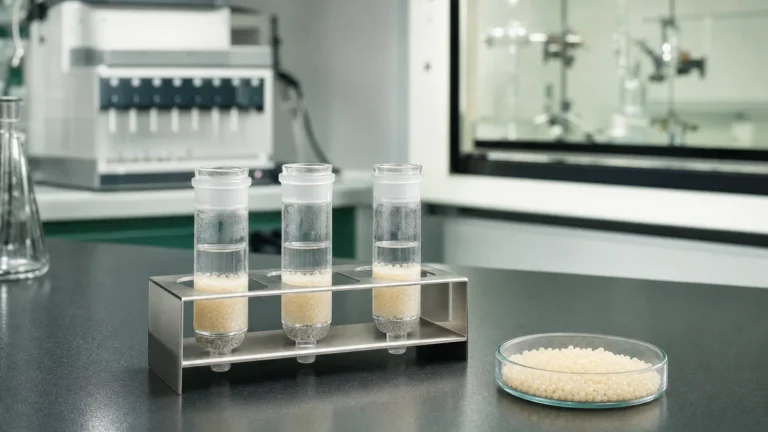
The method used in the laboratory is different. A common technique is known as solid-phase peptide synthesis (SPPS), by means of which the amino-acid residues are added one after another to the peptide chain that is growing and attached to a solid support.
During SPPS, protecting groups and coupling reagents are used to control which functional groups react at each stage. Repeated cycles of deprotection and coupling allow a predetermined amino-acid sequence to be assembled.
Incomplete coupling, deletion sequences and other synthesis-related impurities can occur during peptide production. For this reason, synthesis is typically followed by purification and analytical characterisation of the resulting material.
Where Are Peptide Bonds Found?
Peptide bonds occur wherever amino acids are connected within peptides and proteins.
A peptide containing several amino-acid residues contains a series of peptide bonds forming its backbone. Proteins contain much longer amino-acid chains, but the underlying linkage between neighbouring residues is the same.
These bonds are consequently found throughout biological systems in proteins, enzymes, signalling peptides and other naturally occurring polypeptides. They are also present in synthetic peptides produced for biochemical, structural and analytical research.
The peptide bond itself is only one part of a peptide’s overall molecular structure. Amino-acid sequence, side-chain chemistry, terminal groups and any chemical modifications can also influence the properties of a particular peptide.
Key Structural Features of Peptide Bonds
Peptide bonds have several structural characteristics that distinguish them from ordinary single C–N bonds.
Planar geometry
The atoms surrounding a peptide bond tend to occupy a relatively rigid, planar arrangement. This property results from resonance within the amide group.
Partial double-bond character
Electron delocalisation between the carbonyl oxygen, carbonyl carbon and amide nitrogen gives the C–N peptide bond partial double-bond character. As a result, rotation around this particular bond is restricted.
Restricted rotation
Even though the peptide bond itself has only a small degree of rotational freedom, rotation is still possible around the adjacent backbone bonds. The phi (φ) and psi (ψ) backbone angles are usually used to describe these rotations and account for the variety of conformations that a peptide chain can assume.
Predominantly trans configuration
Most peptide bonds occur in the trans configuration, in which neighbouring alpha-carbon atoms are positioned on opposite sides of the peptide bond. This arrangement generally reduces steric interference between adjacent residues. Bonds involving proline are a notable exception because cis configurations occur more frequently than with many other amino-acid residues.
Polar character
The carbonyl and amide groups give peptide bonds a polar character. They can participate in hydrogen-bonding interactions, which are important in many peptide and protein structures.
How Do Peptide Bonds Influence Peptide Structure?
A peptide is not simply a flexible chain of amino acids.
The structural properties of its backbone place constraints on the conformations the molecule can adopt.
Because rotation around the peptide C–N bond is restricted, much of the backbone’s conformational flexibility comes from rotation around bonds adjacent to the alpha carbon. The possible combinations of these backbone angles influence the three-dimensional arrangements available to the peptide.
In larger polypeptides and proteins, backbone hydrogen bonding contributes to recognised secondary structures such as alpha helices and beta sheets. Shorter peptides may adopt more dynamic conformations depending on their sequence, environment and chemical characteristics.
Peptide conformation is therefore determined by multiple interacting factors rather than the strength of individual peptide bonds alone.
Can Peptide Bonds Be Broken?
Yes. The cleavage of a peptide bond is known as hydrolysis.
Although peptide bonds are relatively stable under many conditions, they can be broken chemically or through enzyme-catalysed reactions. In biological systems, enzymes known as proteases or peptidases catalyse the cleavage of particular peptide bonds.
Laboratory hydrolysis can also be performed under controlled chemical conditions. Researchers may use these processes when investigating peptide composition, degradation pathways or protein and peptide structure.
The rate and extent of degradation depend on more than the peptide bond itself. Sequence, temperature, pH, solvent conditions, enzymes and other environmental factors can all influence peptide stability.
Peptide Bonds and Solid-Phase Peptide Synthesis
Solid-phase peptide synthesis is widely used to prepare synthetic peptides with predetermined amino-acid sequences.
The process begins with an amino acid attached to an insoluble resin. Additional protected amino acids are then introduced sequentially. Each cycle generally involves removing a temporary protecting group, activating the next amino acid and carrying out a coupling reaction to extend the peptide chain.
Once the required sequence has been assembled, the peptide can be cleaved from the resin and subjected to further processing.
Synthesis alone does not establish the identity or purity of the finished material. Analytical techniques are therefore used to characterise synthetic peptide samples and identify synthesis-related components that may be present.
How Are Synthetic Peptides Analysed?
Different analytical techniques can provide different information about a peptide sample.
High-performance liquid chromatography (HPLC) can be used to separate components within a sample and assess chromatographic purity under defined analytical conditions. Mass spectrometry can provide molecular-mass information that helps support peptide identity.
Other techniques may be used depending on the peptide, the purpose of the analysis and the information required.
Importantly, an HPLC purity value does not by itself confirm every structural characteristic of a peptide. Analytical results should be interpreted according to the method used and the specific property being measured.
Why Are Peptide Bonds Important in Research?
Peptide bonds are essential for an understanding of the structure of both peptides and proteins since they form the backbone that links together individual amino-acid residues.
The planar geometry, resonance features and limited rotation of these molecules assist researchers in describing the conformation of peptides and in examining how the sequences of amino acids are arranged in three-dimensional space.
Peptide-bond chemistry is also relevant to synthetic peptide production. Understanding coupling reactions, incomplete synthesis and bond cleavage helps researchers investigate how peptides are produced, characterised and degraded.
Rather than serving as an indicator of experimental performance on their own, peptide bonds are one of the fundamental structural features considered in peptide chemistry, biochemistry and molecular research.
Scientific references
- 1 Nelson DL, Cox MM. Lehninger Principles of Biochemistry. W.H. Freeman.
- 2 Berg JM, Tymoczko JL, Gatto GJ, Stryer L. Biochemistry. W.H. Freeman.
- 3 Merrifield RB. Solid phase peptide synthesis. I. The synthesis of a tetrapeptide. Journal of the American Chemical Society. 1963;85(14):2149–2154. https://pubs.acs.org/jacsat/article-abstract/85/14/2149/520698/Solid-Phase-Peptide-Synthesis-I-The-Synthesis-of-a
- 4 Coin I, Beyermann M, Bienert M. Solid-phase peptide synthesis: from standard procedures to the synthesis of difficult sequences. Nature Protocols. 2007;2:3247–3256. https://pubmed.ncbi.nlm.nih.gov/18079725/
- 5 Fosgerau K, Hoffmann T. Peptide therapeutics: current status and future directions. Drug Discovery Today. 2015;20(1):122–128. https://pubmed.ncbi.nlm.nih.gov/25450771/
Research-use disclaimer: For research and laboratory use only. Not for human or animal consumption.