
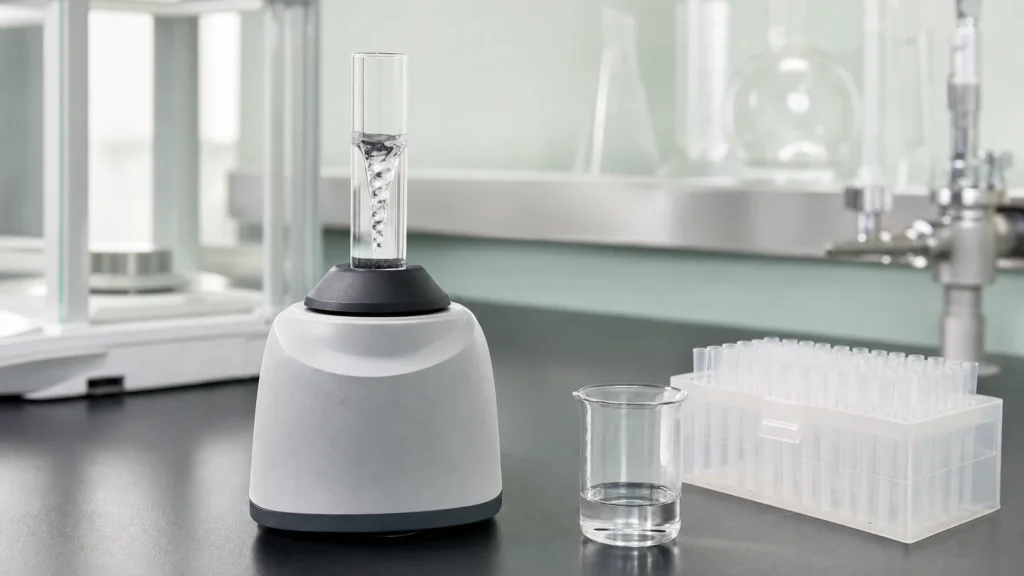
What Is Peptide Reconstitution?
Peptide reconstitution is the process of bringing a dry, lyophilized peptide into solution for laboratory research.
Lyophilization, also known as freeze-drying, removes water from a peptide preparation and leaves the material in a dry form that can be stored and handled under appropriate laboratory conditions.
Before a lyophilized peptide can be examined in research that requires a liquid sample, it must first be dissolved in a compatible solvent system. The conditions used for this process are not necessarily the same for every peptide. Amino acid sequence, charge, concentration, pH and other molecular characteristics can all influence solubility and stability.
That is why reconstitution should be regarded as a laboratory procedure which is specific to each peptide rather than as a single method applicable to all peptides.
Why Are Peptides Supplied in Lyophilized Form?
Research peptides are often provided in the form of lyophilized material since removing the water increases their stability when being stored rather than having the material remain in solution at all times.
During lyophilization, a prepared peptide solution is frozen and water is removed under reduced pressure. The resulting material may appear as a powder, cake or other dry solid depending on the peptide, formulation and manufacturing process.
The behaviour of the material may alter when it is again put into solution, so the researchers have to take into account not only the properties of the dry peptide but also the conditions that will apply to the solution when it is studied.
Lyophilization does not mean that every peptide has the same storage requirements or stability profile. The technical information relevant to the individual material should always be considered.
How Does Peptide Solubility Differ Between Compounds?
Peptides vary considerably in their physical and chemical properties.
Even relatively small changes in amino acid sequence can affect how a peptide interacts with a solvent.
Several factors can influence peptide solubility, including:
- amino acid composition and sequence
- overall molecular charge
- hydrophobic and hydrophilic regions
- peptide concentration
- solvent composition
- pH
- temperature
- ionic strength
- the presence of other components within the preparation
A solvent system that is appropriate for one peptide may therefore be unsuitable for another.
Researchers should base solvent selection on the characteristics of the specific compound, relevant technical documentation and an appropriate validated laboratory protocol rather than applying a universal reconstitution method.
Solvent Selection in Peptide Research
The choice of solvent is an essential aspect of experimental design since the chemical properties of both the peptide and the solvent have an effect on solubility.
In many laboratory applications water is used as the solvent, and in some cases different experimental conditions are needed for peptide sequences due to their charge, hydrophobicity or other structural features. The choice of solvent system will vary according to the compound being studied and the demands of the experiment.
Scientists might also have to think about whether the conditions they have chosen could have an effect on peptide stability, aggregation or the later analytical measurements.
Peptide Works supplies sterile water and bacteriostatic water as separate laboratory products. Their presence within the product range should not be interpreted as confirmation that either solvent is suitable for every peptide. Solvent selection should be determined independently for the specific research material and experimental protocol.
Factors That Affect Peptide Reconstitution
There is no universal reconstitution procedure for research peptides.
Several variables can influence what happens when lyophilized material is brought into solution.
Peptide Sequence and Charge
The amino acids within a peptide determine many of its chemical properties. Acidic, basic, polar and hydrophobic residues can influence how readily the material interacts with a particular solvent system.
The overall charge of the peptide may also change under different experimental conditions, particularly as pH changes.
Concentration
Solubility can depend on the concentration being studied. A peptide that remains soluble under one set of experimental conditions may behave differently at another concentration.
For this reason, concentration should be considered alongside solvent composition rather than as an independent variable.
pH and Ionic Environment
The pH and ionic composition of a solution can affect peptide charge, solubility and molecular interactions.
These relationships are compound-specific. Changes to conditions should be based on established methods, not assumed to apply to all peptide sequences.
Temperature
Temperature can influence dissolution and stability. It may also affect aggregation, degradation and other physical or chemical processes after a peptide enters solution.
Appropriate conditions depend on the individual peptide and the purpose of the experiment.
Reconstitution and Experimental Reproducibility
Documenting sample preparation is an important part of laboratory research.
Where a peptide is studied in solution, records may include information such as the identity of the material, batch or lot number, solvent system, concentration, preparation date and relevant storage conditions.
Recording these variables allows researchers to identify differences between experimental runs and provides a clearer account of the conditions under which data were generated.
Reproducibility, however, depends on the complete experimental design. Reconstitution alone cannot guarantee the accuracy, consistency or outcome of an experiment.
What Can Affect a Peptide After Reconstitution?
A peptide’s properties in solution can be influenced by its sequence and surrounding experimental environment.
Depending on the compound and conditions, researchers may need to consider processes such as:
- aggregation
- oxidation
- hydrolysis
- adsorption to laboratory surfaces
- temperature-dependent degradation
- changes associated with pH
- repeated changes in storage conditions
Not every peptide is affected in the same way or to the same extent.
Published literature, technical documentation and validated laboratory procedures should be consulted when determining appropriate conditions for a particular research material.
Reconstitution and Analytical Research
Reconstituted peptide samples may be examined using analytical techniques selected for the objectives of a particular study.
Methods such as high-performance liquid chromatography (HPLC) and mass spectrometry (MS) can provide different types of analytical information about peptide materials. The suitability of a particular method depends on what researchers are attempting to measure or characterize.
Analytical results should also be interpreted within the context of the method used, sample preparation and experimental conditions.
Peptide Works Research Materials
Peptide Works supplies research-grade peptides intended exclusively for laboratory and scientific research.
Where available, product pages contain information that is specific to each compound, and the analytical documentation can be consulted for the relevant products and batches. When evaluating research materials, researchers should combine this information with suitable scientific literature, laboratory protocols and their own experimental needs.
Peptide Works does not provide instructions for human or veterinary administration. Products sold for research use are not intended for human or animal consumption.
Reasons to Choose Peptide Works
Independent Analytical Documentation
For applicable products and batches, analytical documentation is provided so that researchers can examine the testing information that has been reported.
Product Information
The specifications and compound information that are available on the product pages are provided to assist researchers in identifying and recording the materials they use in their laboratory work.
Research-Focused Support
Our customer support team can assist with questions relating to orders, product documentation and available specifications. We cannot provide guidance on human or veterinary use.
Worldwide Shipping
Peptide Works ships research products to a range of international destinations, subject to availability, local restrictions and applicable regulations.
Research use only
ALL CONTENT AND PRODUCT INFORMATION AVAILABLE ON THIS WEBSITE IS FOR EDUCATIONAL AND SCIENTIFIC RESEARCH PURPOSES ONLY.
DISCLAIMER: Products supplied by Peptide Works as research chemicals are intended solely for laboratory research and research development. They are not intended for human or animal use or consumption in any manner. Handling should be limited to suitably qualified professionals operating within appropriate laboratory settings. Research products must not be represented or used as drugs, foods, cosmetics or medicinal products. Researchers and purchasers are responsible for ensuring that products are handled and used in accordance with applicable laws, regulations and institutional requirements.
Peptide Reconstitution FAQs
No. Peptides differ in sequence, charge, hydrophobicity, molecular size and other characteristics that can affect their behaviour in solution. Appropriate conditions should be determined for the specific compound and research protocol.
No. Solubility varies between peptide sequences and can also change with concentration, pH, temperature and solvent composition. A solvent system should not be assumed to be suitable simply because it has been used with another peptide.
Alterations in pH can cause changes to the ionization of the side chains of the amino acids and as a result affect the total charge of the peptide. This in turn can have an impact on molecular interactions and on solubility. The extent of this effect varies according to the sequence under investigation.
Compound-specific scientific literature, technical documentation and validated laboratory protocols should be consulted. Researchers should avoid assuming that a procedure developed for one peptide is suitable for another.