PROMO!

First order? Get 10% OFF with this code: 1storder

Research hub

Adipotide Research Hub

Adipotide is a synthetic peptidomimetic conjugate comprising a vascular-targeting peptide motif linked to a pro-apoptotic D-amino-acid sequence, investigated in preclinical models for its interactions with defined vascular cell-surface targets.

  • Adipotide
  • Synthetic peptidomimetic conjugate
  • Vascular homing peptide
  • Lyophilized powder
01

Technical Overview

Adipotide, also known as FTPP (Fat-Targeted Proapoptotic Peptide), is a synthetic peptide combination designed for targeted peptide delivery in studies and tissue-selective molecular interactions. The purpose of this bifunctional construct is to study receptor-mediated targeting tactics in preclinical models. It is made up of a proapoptotic peptide domain connected to a peptide ligand. Unlike native peptides, adipotide is a synthetic research peptide produced by chemical synthesis and logical peptide design.

The compound originated from research exploring vascular targeting peptides capable of recognizing molecular markers expressed on the endothelium of adipose tissue. Its design combines a tissue-targeting motif with a proapoptotic sequence, enabling investigators to examine targeted peptide delivery, receptor recognition and intracellular uptake mechanisms under controlled laboratory conditions. As a result, Adipotide has become recognized as a research tool for studying peptide targeting technologies, vascular biology, and ligand-directed molecular transport.

02

Chemical Classification

Chemical Name
Adipotide (synthetic adipose-targeting peptide conjugate)
Common name(s)
Adipotide; FTPP
Molecular Formula
C111H206N36O28S2
Molecular Weight
2557.2 g/mol
CAS Number
N/A
Purity
98.5%
Compound Class
Synthetic peptidomimetic peptide conjugate
Origin
Synthetic
Amino Acid Sequence
H-Cys-Lys-Gly-Gly-Arg-Ala-Lys-Asp-Cys-Gly-Gly-D-Lys-D-Leu-D-Ala-D-Lys-D-Leu-D-Ala-D-Lys-D-Lys-D-Leu-D-Ala-D-Lys-D-Leu-D-Ala-D-Lys-OH
03

Molecular Characteristics

Adipotide (FTPP) is an engineered synthetic peptide composed of two distinct peptide components connected through a covalent linkage. Its structure combines a tissue-targeting sequence with a proapoptotic peptide domain, creating a single bifunctional molecule for use in experimental research. In contrast to naturally occurring signaling peptides, Adipotide has been designed specifically for laboratory investigation using rational peptide engineering. Its amino acid sequence does not occur in nature but has been developed to facilitate studies of peptide targeting, receptor recognition and intracellular transport in preclinical models.

As a short synthetic peptide, Adipotide does not possess a stable tertiary structure and is generally considered to adopt a flexible conformation in aqueous solution. Any secondary structural elements are expected to be transient and dependent on the surrounding physicochemical environment. The peptide is typically supplied as a lyophilized powder and exhibits good solubility in appropriate aqueous laboratory buffers following reconstitution.

The physicochemical properties of Adipotide are determined by its amino acid composition, including the distribution of charged, polar and hydrophobic residues. Its overall net charge and hydrophobicity influence solution behavior, chromatographic separation and peptide–surface interactions during analytical characterization. The engineered peptide sequence incorporates structural features intended to preserve the functional integrity of both the targeting and effector domains while maintaining compatibility with standard peptide synthesis and purification methods.

04

Mechanism Under Investigation

Adipotide (FTPP), a targeted peptide compound intended to study receptor-mediated peptide delivery and intracellular transport processes, has been the subject of recent laboratory studies. According to published experimental studies, the chemical consists of a proapoptotic peptide domain connected to a tissue-targeting peptide. This allows researchers to characterize selective peptide localization and subsequent cellular uptake in preclinical models. Adipotide has mostly been studied as a ligand-directed targeting construct rather than via inhibiting enzymes.

Published research has characterized the targeting domain of Adipotide as demonstrating interaction with prohibitin (PHB) and prohibitin-2 (PHB2), proteins that have been identified on the surface of endothelial cells within the vasculature of adipose tissue in experimental models. In vitro models have explored receptor recognition, ligand binding, and peptide internalization following interaction with these cell-surface proteins. These studies have employed receptor-binding assays, fluorescence microscopy, and immunohistochemical techniques to investigate the specificity of peptide localization.

Following receptor-mediated binding, experimental investigations have examined intracellular transport of the peptide conjugate and subsequent delivery of the attached proapoptotic sequence. Published studies have characterized activation of mitochondrial apoptotic pathways associated with the D(KLAKLAK)₂ peptide domain after cellular internalization. Biochemical assays have examined mitochondrial membrane disruption, cytochrome c release and activation of caspase-dependent signalling pathways within experimental systems. These investigations have focused on defining the molecular sequence of intracellular events rather than establishing physiological outcomes.

Current laboratory investigations have also examined Adipotide as a model for targeted peptide delivery, providing insight into the design of ligand-directed peptide constructs and receptor-specific transport systems. Structural biology, molecular biology and cell-based studies continue to investigate receptor affinity, peptide internalization, intracellular trafficking and tissue-selective targeting using preclinical models. The molecular mechanism of Adipotide therefore remains an active area of research centered on receptor-mediated peptide targeting, intracellular transport and the characterization of downstream signaling events following cellular uptake.

The summary is based on findings that have been reported in previously published preclinical and in vitro research, and the original studies which support this information are given in the references.

05

Experimental Research Areas

01

Vascular Biology

Vascular biology represents one of the principal areas in which Adipotide has been investigated. Published studies have examined the interaction between the peptide’s targeting domain and endothelial cell surface proteins associated with the vasculature of white adipose tissue. Experimental models have been used to characterize ligand recognition, vascular targeting, and receptor-mediated peptide localization in preclinical systems.

02

Peptide Targeting and Drug Delivery

As a paradigm for ligand-directed peptide targeting, adipotide has been extensively studied. Designing bifunctional peptide structures that can combine intracellular delivery of an effector peptide with tissue-specific recognition has been the main focus of research. The field of targeted peptide delivery and molecular transport technologies has benefited from these investigations.

03

Cellular Biology

Cellular biology studies have utilized cultured endothelial cells and other in vitro model systems to investigate peptide binding, receptor-mediated uptake and intracellular trafficking. Researchers have employed a range of established laboratory techniques, including fluorescence microscopy, immunohistochemistry and cell-based biochemical assays, to examine peptide localization, cellular internalization, and transport mechanisms under controlled experimental conditions.

04

Molecular Biology

Published molecular biology research has examined the cellular responses associated with receptor-mediated peptide uptake using techniques such as quantitative PCR, Western blotting, and gene expression analysis. These investigations have focused on characterizing signaling pathways, transcriptional responses and molecular markers following exposure to targeted peptide constructs in experimental models.

05

Protein–Ligand Interaction Research

Adipotide has been investigated as a research tool for studying ligand–receptor recognition and binding specificity. Biochemical studies have examined the interaction between the peptide’s targeting sequence and prohibitin, together with the mechanisms governing receptor affinity, endocytosis and molecular recognition. Experimental techniques have included ligand-binding assays, immunochemical methods and structural analyses.

06

Preclinical Pharmacology

Preclinical pharmacology research has employed Adipotide in animal models to characterise its pharmacological behavior, biodistribution and tissue-targeting properties. These investigations have examined peptide distribution, receptor engagement and molecular transport within intact biological systems, providing experimental data for the study of targeted peptide technologies.

06

Analytical Verification

Adipotide (FTPP) is a synthetic peptide conjugate that is usually produced using Solid Phase Peptide Synthesis (SPPS), a well-known process for generating highly reproducible, specified peptide sequences. In order to eliminate shortened sequences, leftover chemicals, and other synthesis-related contaminants produced during peptide assembly, the crude peptide is purified after synthesis, most frequently using preparative high-performance liquid chromatography (HPLC).

Identity confirmation, purity determination, and batch-specific quality testing form part of standard analytical verification procedures. Analytical results are typically documented within a Certificate of Analysis, which includes information such as the batch number, peptide purity, molecular mass confirmation, and quality control data.

Certificate of Analysis
Batch20250826036
Document Download PDF
HPLC
Batch20250826036
Document Download PDF
07

Storage & Handling

In order to preserve stability during storage and shipping, adipotide is usually given as a lyophilized peptide. According to the manufacturer's instructions, the lyophilized material should be kept in a refrigerator (2–8°C) and shielded from moisture, extreme heat, and extended light exposure. The peptide should be handled carefully before being used in a lab. Adipotide should be stored according to the specified storage conditions and should not be subjected to many freeze-thaw cycles in order to maintain peptide integrity and reduce degradation during experimental investigations.

Supplied as Lyophilized powder
Storage 2–8°C, away from sun light
Reconstitution Sterile diluent
After Reconstitution Refrigerate, limit freeze - thaw
08

Questions researchers ask

Adipotide is a synthetic peptide conjugate that is not found in biological systems and was created for use in experiments. In contrast to endogenous peptides, it integrates two different functional domains: a proapoptotic peptide motif and a tissue-targeting peptide sequence. Researchers can study intracellular transport and ligand-directed peptide targeting with a single synthetic construct thanks to this logical design.

The information presented on this page is provided for scientific and educational purposes only and summarises the current published literature relating to Adipotide (FTPP). The content is intended to describe the compound’s chemical composition, molecular characteristics, analytical verification and experimental research context. References to peptide targeting, prohibitin binding, receptor-mediated internalization and intracellular signaling pathways are based on findings from biochemical studies, cell-based assays and preclinical research models and should be interpreted solely within that experimental context.

Adipotide is supplied exclusively as a research material and is not intended for human or veterinary use. It is not approved for use in the diagnosis, cure, or prevention of any disease. Descriptions of molecular targets, peptide transport mechanisms or intracellular pathways do not constitute evidence of clinical efficacy, physiological effects or therapeutic application.

Researchers are responsible for ensuring that Adipotide is handled, stored and utilized in accordance with recognized laboratory practices, institutional guidelines and all applicable regulations. Experimental procedures should be performed only by appropriately qualified personnel using validated laboratory methods, suitable safety controls and documented quality assurance practices.

Available now

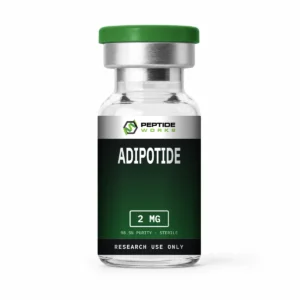
Adopitide from Peptide Works