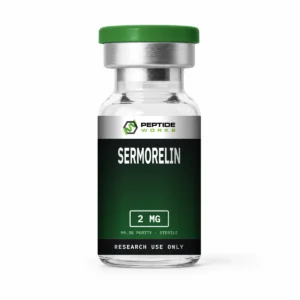
Sermorelin is investigated primarily through its interaction with the growth hormone-releasing hormone receptor (GHRH-R). As the synthetic amidated 1–29 fragment of human GHRH, it contains the N-terminal region associated with GHRH receptor activity. Research into this system provides a model for examining peptide–receptor recognition, G-protein-coupled receptor signaling and intracellular second-messenger pathways.
GHRH Receptor Interaction
GHRH-R belongs to the class B family of G-protein-coupled receptors (GPCRs). Interaction of GHRH-related peptides with this receptor promotes coupling predominantly to the stimulatory Gs protein, initiating intracellular signaling. Sermorelin can therefore be investigated in receptor-based experimental systems examining ligand binding, receptor activation and structure–activity relationships among GHRH-derived peptides.
Adenylyl Cyclase and cAMP Signaling
A main pathway involved when GHRH-R is activated is one in which Gs stimulates adenylyl cyclase, thus raising the level of intracellular cyclic adenosine monophosphate (cAMP). The increased level of cAMP then causes activation of protein kinase A (PKA) as well as of the related downstream signaling components. Hence, measurements of cAMP serve as a useful molecular endpoint for the investigation of GHRH-R activation under controlled experimental conditions.
Calcium-Associated Signalling
Experimental studies have also linked GHRH-R signaling with changes in intracellular calcium (Ca²⁺). Signaling that is dependent on cAMP can affect membrane depolarisation and voltage-sensitive calcium channels, and furthermore, pathways involving phospholipase C have also been described in the GHRH receptor system. These processes thus offer complementary endpoints for investigating how the activation of receptors leads to cellular responses.
Structure–Activity Research
Since Sermorelin is equivalent to GHRH(1–29)-NH₂, it is especially pertinent to research that aims to determine which parts of the larger GHRH molecule are needed for receptor recognition and signaling. The N-terminal segment consisting of 29 residues has been found to retain the main biological activity of GHRH, which means that Sermorelin can be used as a well-defined molecular probe in the study of GHRH-R pharmacology, GPCR signaling, and investigations into the structure–activity relationship of peptides.
Sermorelin Research Peptide Experimental Research Areas
GHRH Receptor Interaction
Sermorelin is investigated as a defined GHRH(1–29)-NH₂ peptide interacting with the growth hormone-releasing hormone receptor (GHRH-R). Receptor-based experiments provide a framework for examining peptide recognition, ligand binding and activation of this class B GPCR. Structural research on GHRH-R has identified specific receptor regions involved in recognition of GHRH-family peptide sequences.
cAMP-Dependent Signaling
GHRH-R activation is principally associated with Gs-protein coupling, adenylyl cyclase activation and intracellular cAMP production. These molecular endpoints can be measured in receptor-expressing cellular systems to investigate signaling initiated by GHRH-derived peptides.
Peptide Structure–Activity Research
Since Sermorelin consists of the N-terminal 29 residues of human GHRH, it serves as a useful model for studying the relationship between peptide sequence and receptor activity. Experiments involving native GHRH and structurally modified GHRH analogs can then be carried out to see how substitutions, truncation or conjugation affect receptor interactions and molecular behavior.
Proteolytic Stability
Sermorelin has likewise been looked at in studies concerning peptide degradation and stability. Research using LC-HRMS/MS showed that Sermorelin undergoes progressive degradation under in-vitro conditions simulating human plasma and found GHRH(3–29)-NH₂ to be a compound associated with this degradation. These experiments offer a basis for the investigation of peptide stability and proteolytic processing.
Comparative GHRH Analog Research
Sermorelin may be examined together with other peptides such as Tesamorelin and modified GHRH analogs in order to find out how changes in structure influence molecular stability and analytical behavior. Making such comparisons is especially helpful in distinguishing the characteristics of the unmodified GHRH(1–29) sequence from those of the more extensively modified analogs.
Analytical Detection Research
Sermorelin has been studied using liquid chromatography and high-resolution/tandem mass spectrometry in order to identify the peptide and to characterize its degradation products. These methods aid research into molecular identity, the fragmentation of the peptide and the analytical distinction between closely related GHRH analogs.
This summary reflects findings reported in published preclinical and in vitro research. The original studies supporting this information are listed in the references.