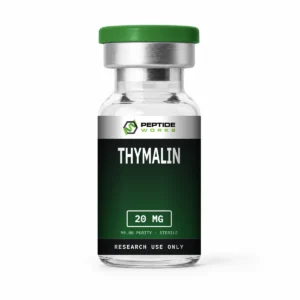
PROMO!

First order? Get 10% OFF with this code: 1storder

Research hub

Thymalin Research Peptide Hub

Thymalin is a polypeptide complex isolated from thymic tissue and characterized as a preparation of thymus-derived polypeptides.

  • Thymic polypeptide complex
  • Thymic polypeptide preparation
  • Polypeptide thymus factor
  • Natural thymic peptide complex.
01

Technical Overview

Thymalin is referred to in the scientific literature as a complex of polypeptides derived from the thymus, not as a single peptide having a specific amino-acid sequence. Published research describes it as a preparation that includes low-molecular-weight peptide components isolated from thymic tissue.

Laboratory studies have investigated Thymalin and identified short peptide components in relation to cell differentiation, gene-expression regulation, and molecular signaling. Among the components discussed in the literature are the short peptides Glu-Trp (EW), Lys-Glu (KE), and Glu-Asp-Pro (EDP), which have also been examined separately in experimental systems.

Experimental work involving Thymalin has included cell-based models examining hematopoietic stem-cell differentiation and changes in molecular markers associated with different stages of cellular differentiation. Other research has examined individual short peptides found within the complex to better characterize their molecular properties and relationship to the preparation.

Because Thymalin is a polypeptide complex, its technical characterization differs from that of a single synthetic peptide. A single molecular formula, molecular weight, or amino-acid sequence should therefore not automatically be assigned to Thymalin unless the specific batch COA defines the supplied material that way. Batch-specific analytical documentation should determine how its composition and specifications are presented.

This distinction is important because Thymalin, Thymulin, and individual thymic peptides should not be treated as interchangeable defined molecules.

02

Chemical Classification

Chemical name
L-pyroglutamyl-L-alanyl-L-lysyl-L-seryl-L-glutaminyl-glycyl-glycyl-L-seryl-L-asparagine
Common name(s)
Thymulin
Alternative nomenclature
Nonathymulin; Thymic Factor; Serum Thymic Factor; FTS (Facteur Thymique Sérique)
Molecular Formula
C₃₃H₅₄N₁₂O₁₅
Molecular weight
858.85 g/mol
Compound class
Thymic polypeptide complex, Thymic polypeptide preparation, Polypeptide thymus factor, Natural thymic peptide complex.
Amino acid sequence
H-Pyr-Ala-Lys-Ser-Gln-Gly-Gly-Ser-Asn-OH
Origin
Calf thymus (bovine thymus)
Purity
99.0%
03

Molecular Characteristics

Thymalin differs from many research peptides because it is described as a multicomponent thymic polypeptide complex rather than a single chemically defined peptide. Consequently, Thymalin as a whole does not have one fixed amino-acid sequence, molecular formula, or molecular weight that can accurately represent every peptide within the preparation. Historical characterization has described the complex as containing multiple low-molecular-weight polypeptide fractions.

Analytical research has identified several short peptides within the Thymalin complex. These include Glu-Trp (EW) and, in more recent UPLC-MS investigations, Lys-Glu (KE) and Glu-Asp-Pro (EDP) as minor components. Because each constituent has its own sequence and molecular properties, these individual peptides should not be presented as though any one of them represents the complete molecular structure of Thymalin.

This heterogeneous composition also means that analytical characterization of Thymalin differs from verification of a single synthetic peptide. Techniques capable of examining multiple peptide species and their chromatographic or mass-spectrometric profiles are particularly relevant when investigating its composition.

For a research-material product page, specific molecular weight, formula, sequence, and other specifications should be presented according to the batch-specific Certificate of Analysis for the material supplied.

04

Mechanism Under Investigation

Thymalin is a complex consisting of several peptides, and therefore its molecular mechanism cannot be based on a single interaction between a peptide and a receptor. Instead, experimental research that has been carried out has looked at the complex together with the shorter peptide components, especially Glu-Trp (EW) and Lys-Glu (KE), in order to examine their possible effects on gene regulation, protein synthesis, and cellular differentiation. The exact molecular mechanism is still under investigation.

Gene-Expression Research

A possible area for investigation is the way in which short thymalin-associated peptides interact with DNA regulatory regions. Molecular-modeling studies have looked at whether EW and KE can interact with certain double-stranded DNA sequences. It should not be assumed that these findings, which are computationally predicted molecular interactions, prove direct transcriptional regulation in all biological systems.

Cellular Differentiation

Thymalin has also been investigated in human hematopoietic stem-cell cultures. In one experimental study, researchers measured changes in the expression of the cellular markers CD44, CD117, and CD28 following exposure to the polypeptide complex. The observed changes were interpreted within that study as evidence of altered cellular differentiation, providing a laboratory model for examining how Thymalin may interact with differentiation-associated processes.

Protein and Signaling Research

More in-vitro research has looked at Thymalin and the EW and KE peptides linked to it with regard to protein synthesis and cellular signaling networks. Experimental and computational studies have examined changes in cytokine production as well as possible gene and protein targets. However, these findings still depend on the specific experimental model and do not prove the existence of a single universal signaling pathway for the entire Thymalin complex.

Overall, Thymalin is a multicomponent material used in research into short-peptide interactions, gene expression, and cell differentiation. Because it contains a mixture of peptide components, findings linked to a specific peptide cannot necessarily be applied to Thymalin as a whole.

This summary reflects findings reported in published preclinical and in vitro research. The original studies supporting this information are listed in the references.

05

Experimental Research Areas

01

Hematopoietic Cell Differentiation

Thymalin was studied in cultured human hematopoietic stem cells in order to look at changes in the markers associated with differentiation. Experiments measured the expression of CD44, CD117 and CD28 after the cells had been exposed to the peptide complex, thus providing a cell-based model for the study of differentiation-related processes.

02

Gene-Expression Research

Research has looked at the Thymalin-associated short peptides, especially Lys-Glu (KE) and Glu-Trp (EW), with regard to gene-expression processes. To investigate the changes in gene expression and the supposed interactions between these short peptides and particular DNA sequences, both experimental and computational methods have been employed. However, these observations still depend on the experimental systems that have been used.

03

Cytokine-Expression Models

Laboratory studies have investigated Thymalin and its associated peptides using human peripheral blood mononuclear cell models. Measurements of IL-1β, IL-6 and TNF-α have been used as molecular endpoints for examining changes in cytokine synthesis under defined experimental conditions.

04

Monocyte Cell-Culture Research

The human THP-1 monocytic cell line has also been used to investigate Thymalin in vitro. Researchers have looked at cell proliferation, changes in protein phosphorylation and related signaling activity. This model has also been used to compare Thymalin with other short-peptide preparations under the same experimental conditions.

05

Short-Peptide Component Research

The fact that Thymalin is a mixture of polypeptides and not a single particular peptide has led to the various short-peptide constituents being studied individually in order to examine their molecular properties; research into KE, EW and the other identified components provides a basis for deciding whether particular molecular observations can be associated with specific peptide sequences.

06

Comparative Peptide Research

Experimental studies have compared Thymalin with other peptide preparations using the same cell-culture conditions. By doing so, the researchers were able to look at the differences in cellular signaling, cell proliferation, and the expression of molecular markers while separating the effects linked to the entire Thymalin complex from those attributable to the individual short peptides.

06

Analytical Verification

Because Thymalin is a multicomponent polypeptide complex, its analytical verification differs from that of a single peptide with one defined molecular mass and sequence. Liquid chromatography, including HPLC or UPLC, can be used to examine the chromatographic profile of the preparation and separate individual peptide components for further characterization.

Mass spectrometry coupled with liquid chromatography (LC-MS) provides complementary information by allowing individual molecular species within the complex to be investigated. Published UPLC-MS research has identified the short peptides Lys-Glu (KE) and Glu-Asp-Pro (EDP) as minor components of Thymalin, while Glu-Trp (EW) had previously been reported within the preparation.

For research material, analytical results should be interpreted according to the composition and identity established for the supplied batch. Batch-specific documentation should be reviewed for the applicable composition, analytical methods and specifications.

Certificate of Analysis
Batch20250926046
MethodCOA 2026
Document Download PDF
HPLC
Batch20250926046
MethodHPLC 2026
Document Download PDF
07

Storage & Handling

Store Thymalin research material according to the conditions specified on the current batch-specific Certificate of Analysis. For the supplied batch, the COA specifies storage at 2–8°C. The material should remain sealed and protected from light and moisture.

Laboratory handling should minimize exposure to humidity, unnecessary temperature fluctuations, and contamination. Where the material is supplied as a lyophilized peptide complex, repeated freeze–thaw cycles should be avoided, as changes in individual peptide components may affect the overall analytical profile of the preparation.

Because Thymalin is a multicomponent preparation, storage requirements may vary according to its composition and physical form. The conditions stated on the current batch COA and accompanying analytical documentation should therefore take precedence over general peptide-storage guidance.

Supplied as Lyophilized Powder in Vial
Storage 2–8°C
Handling Reconstitution Required
08

Questions researchers ask

Thymalin is referred to in published research as a complex of polypeptides, not as a single peptide which has a definite chemical structure. Thus, the entire preparation contains several peptide components rather than one molecule with a fixed sequence.

Thymalin is offered exclusively as a substance for use in laboratory research for scientific and analytical applications. It is not meant for use in humans or animals, nor is it provided for diagnostic, therapeutic, clinical, or veterinary purposes.

Information on this page is provided for scientific and technical reference only. References to peptide components, molecular interactions, gene expression or cellular pathways relate solely to laboratory research and should not be interpreted as evidence of clinical efficacy or therapeutic suitability.

Available now

Thymalin Peptide from Peptide Works