

PROMO!
First order? Get 10% OFF with this code: 1storder


Written by
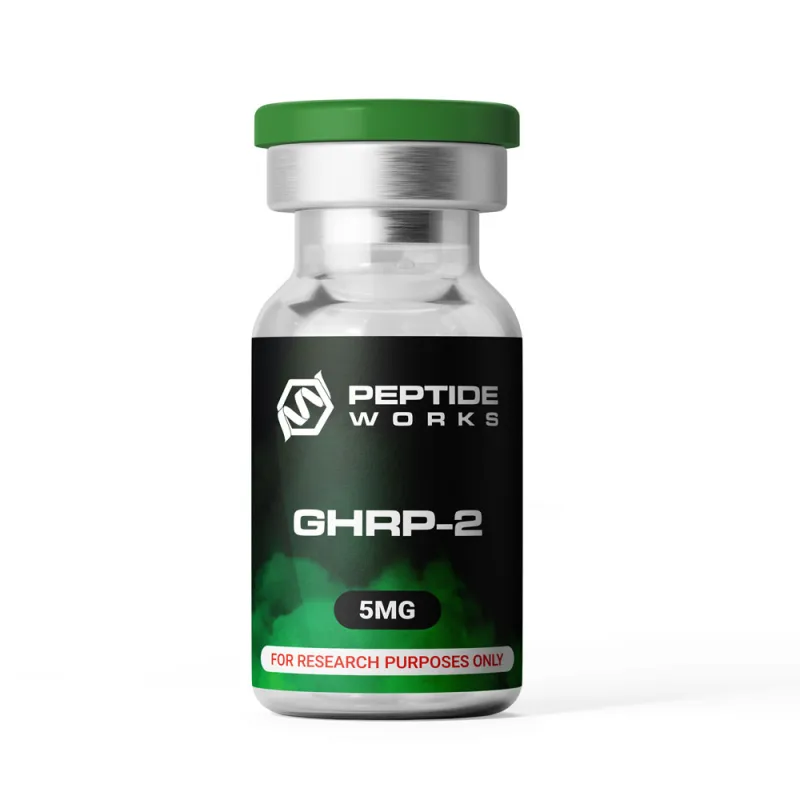
GHRP-2 is a research peptide studied for its effects on hormone signaling and regulation. It activates the growth hormone secretagogue receptor (GHS-R), which influences the pituitary gland and affects the release of different hormones.
Research shows that GHRP-2 can increase growth hormone (GH) levels and may also influence adrenocorticotropic hormone (ACTH) and cortisol responses. Through its effects on the hypothalamic-pituitary-adrenal (HPA) axis, GHRP-2 may help raise cortisol levels by increasing ACTH release in research settings.
To understand how GHRP-2 may affect cortisol levels, it is important to look at the role of ACTH. ACTH acts as a signal that tells the adrenal cortex to produce cortisol.
Explore GHRP-2 from Peptide Works, a growth hormone secretagogue studied for its ability to stimulate ACTH and elevate cortisol levels.
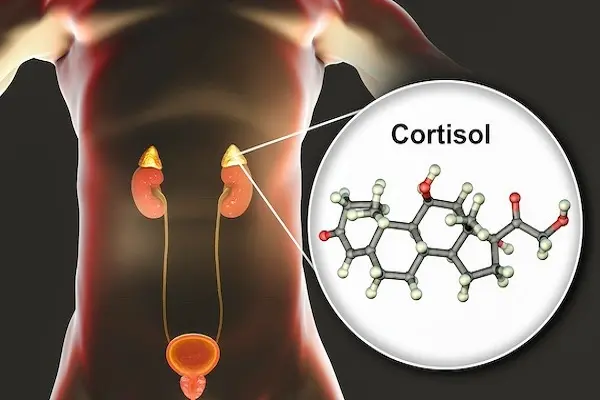
ACTH (adrenocorticotropic hormone) is a signal hormone released by the pituitary gland. It controls cortisol production by acting on the adrenal cortex. When ACTH reaches the adrenal cortex, it signals the cells to produce and release cortisol.
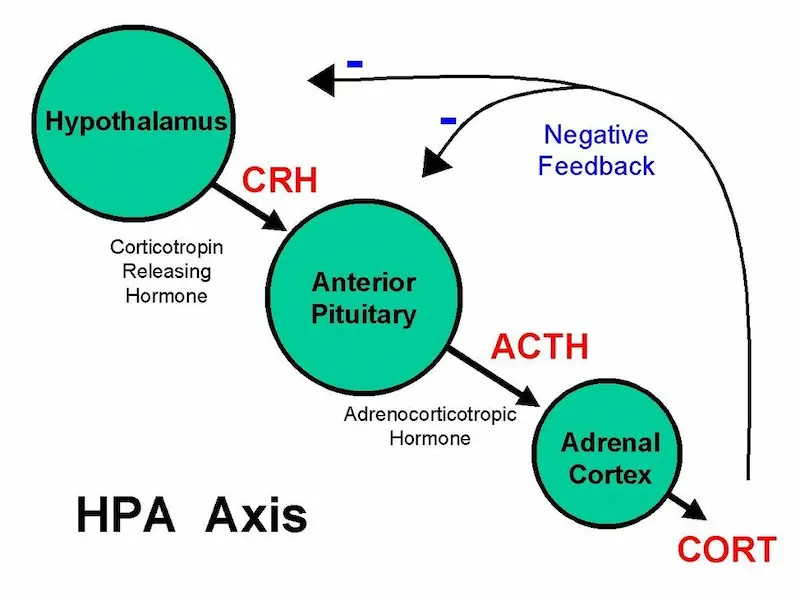
ACTH is part of the hypothalamic-pituitary-adrenal (HPA) axis. The hypothalamus releases CRH, which signals the pituitary gland to release ACTH. ACTH then activates pathways in adrenal cells that increase cortisol synthesis. Cortisol helps regulate stress response, metabolism and immune activity.
Discover Ipamorelin from Peptide Works, a selective peptide known for promoting GH and ACTH release without significantly affecting prolactin or cortisol spikes.
The adrenal glands raise cortisol levels through the adrenal cortex, the outer layer of the gland. When ACTH reaches the adrenal cortex, it binds to receptors on adrenal cells and signals them to produce and release cortisol.
This process activates pathways that increase cholesterol use and cortisol synthesis. The released cortisol helps regulate stress response, metabolism and immune activity. The adrenal glands are a key part of the HPA axis, which controls cortisol production.
Understanding how ACTH signals the adrenal glands helps researchers study hormone balance and endocrine function.
Checkout Hexarelin from Peptide Works, a potent synthetic peptide shown to boost growth hormone and ACTH levels, aiding cortisol regulation studies.
The body raises cortisol levels naturally in response to stress, low blood sugar, and changes in the sleep cycle. Cortisol helps manage energy and immune function during these times.
Activity, temperature changes, and infections also trigger cortisol release. Research shows peptides like GHRP-2, Ipamorelin, and Hexarelin can affect these natural processes by increasing ACTH, which then signals the adrenal glands to raise cortisol levels.
Understanding natural cortisol regulation helps researchers study how stress signals and research peptides may influence hormone pathways.
Stress causes the body to raise cortisol levels through a complex system involving nerves and hormones. This hormone helps the fight-or-flight response by providing energy and boosting metabolism.
The pituitary gland controls ACTH, which signals the adrenal glands to release cortisol. Chronic stress can cause the body to keep cortisol levels high, which may harm health.
Cortisol also balances immune functions and inflammation during stress. Understanding the stress and cortisol relationship is key to managing health risks linked with high cortisol.
This interaction relies on specific receptors and molecular signals that convert ACTH’s presence into cortisol production.
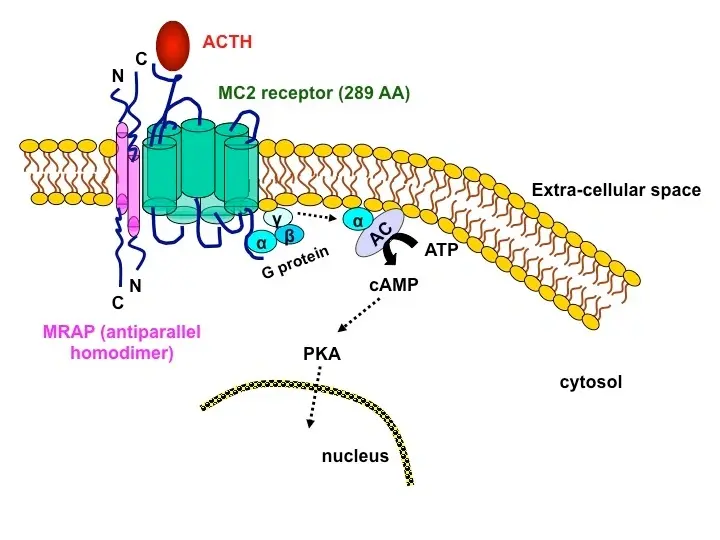
ACTH, a peptide hormone produced by the pituitary gland, binds to melanocortin 2 receptors (MC2R) on adrenal cortex cells. This triggers intracellular signaling pathways such as cAMP/PKA, leading to the activation of enzymes that synthesize cortisol.
The process includes both rapid effects, like cholesterol mobilization, and longer-term gene transcription, supporting cortisol production.
This ACTH-driven pathway, involving cAMP and protein kinase A, is also influenced by GH secretagogues, which enhance upstream pituitary signaling.
Understanding ACTH signaling clarifies how the body controls cortisol levels in stress and other conditions.
Central to this response is MC2R, the receptor that initiates cortisol synthesis once ACTH binds to it.
The melanocortin 2 receptor (MC2R) is a key protein found on adrenal cortex cells. It binds ACTH, which sets off a chain reaction that helps produce cortisol.
This process relies on cAMP and protein kinase A to activate enzymes and start gene transcription. With elevated ACTH, MC2R receptors become activated on adrenal cells initiating the biochemical cascade needed for cortisol synthesis.
This step is indirectly modulated by certain research peptides. At Peptide Works, we supply these peptides for research, supporting new advances in hormone regulation and health science.
These mechanisms are shaping the direction of current and future peptide-based research.
Peptides like GHRP-2, Ipamorelin, and Hexarelin help research how to raise cortisol levels through hormone pathways.
By targeting hormone regulators like ACTH and adrenal receptors, these peptides open up new research avenues in hormonal therapy and stress-related disorders.
Peptide Works supplies high-quality peptides for science and research. Ongoing studies will improve what we know and may lead to new treatments. These could help manage health problems related to cortisol.
All products discussed are supplied for research purposes only and are not intended for human use.
(1) Arvat E, di Vito L, Maccagno B, Broglio F, et al. Effects of GHRP-2 and hexarelin, two synthetic GH-releasing peptides, on GH, prolactin, ACTH and cortisol levels in man. Comparison with the effects of GHRH, TRH and hCRH. Peptides. 1997;18(6):885-91.
(2) Kimura T, Shimatsu A, Arimura H, Mori H, et al. Concordant and discordant adrenocorticotropin (ACTH) responses induced by growth hormone-releasing peptide-2 (GHRP-2), corticotropin-releasing hormone (CRH) and insulin-induced hypoglycemia in patients with hypothalamopituitary disorders: evidence for direct ACTH releasing activity of GHRP-2. Endocr J. 2010;57(7):639-44.
(3) Ghigo E, Arvat E, Ramunni J, Colao A, et al. Adrenocorticotropin- and cortisol-releasing effect of hexarelin, a synthetic growth hormone-releasing peptide, in normal subjects and patients with Cushing’s syndrome. J Clin Endocrinol Metab. 1997 Aug;82(8):2439-44.
(4) Arvat E, Ramunni J, Giordano R, Maccagno B, et al. Effects of the combined administration of hexarelin, a synthetic peptidyl GH secretagogue, and hCRH on ACTH, cortisol and GH secretion in patients with Cushing’s disease. J Endocrinol Invest. 1999 Jan;22(1):23-8.
(5) Raun K, Hansen BS, Johansen NL, Thøgersen H, et al. Ipamorelin, the first selective growth hormone secretagogue. Eur J Endocrinol. 1998 Nov;139(5):552-61.
ALL CONTENT AND PRODUCT INFORMATION AVAILABLE ON THIS WEBSITE IS FOR EDUCATIONAL PURPOSES ONLY.
DISCLAIMER: These products are intended solely as a research chemical only. This classification allows for their use only for research development and laboratory studies. The information available on our Peptide Works website: https://peptide-works.com/ is provided for educational purposes only. These products are not for human or animal use or consumption in any manner. Handling of these products should be limited to suitably qualified professionals. They are not to be classified as a drug, food, cosmetic, or medicinal product and must not be mislabelled or used as such.
Peptide Works
Related Articles
How can ARA-290 Peptide Help Diabetic Patients?
Diabetes affects millions of people around the world and leads to serious health problems. Research shows that the ARA-290 peptide

Can AICAR Peptide Improve Endurance?
AICAR peptide has shown promising results for improving endurance capacity in studies. Research shows that AICAR activates AMPK, increasing glucose

Enhancing Energy with NAD+ Supplements
Energy is the driving force behind focus, movement, and recovery. When cells have less energy to work with, the body