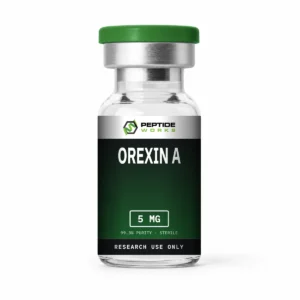
Most experimental studies have mainly described Orexin A on the basis of its interactions with two G protein-coupled receptors: the orexin receptor type 1 (OX1R) and the orexin receptor type 2 (OX2R). These receptors are part of the class A rhodopsin-like GPCR family and offer well-established experimental systems for the study of peptide–receptor recognition and intracellular signal transduction.
It has been demonstrated that orexin A interacts with both OX1R and OX2R. The structural areas of the peptide implicated in ligand recognition, especially residues within its conserved C-terminal domain, have been investigated in receptor-binding and mutagenesis experiments. Conformational changes in the transmembrane receptor structure after ligand binding have also been investigated in studies of receptor activation.
Present laboratory research shows that orexin receptors are able to couple with several pathways of heterotrimeric G proteins, particularly those associated with Gq/11 being well understood. Experiments have looked at the activation of phospholipase C that is linked to the formation of the intracellular messengers inositol trisphosphate and diacylglycerol. The signalling events have been investigated in connection with intracellular calcium mobilisation and the pathways associated with protein kinase C.
Further investigations have analysed the signalling processes involving phospholipase A, phospholipase D, ERK1/2, p38 MAP kinase, and other downstream signalling proteins. In some experimental systems coupling with Gi/o or Gs proteins has also been studied, although receptor signalling depends on the receptor subtype, the cellular background, and the experimental conditions.
β-arrestin recruitment, receptor desensitization, receptor trafficking, and internalization have also been studied as part of the pharmacology of the orexin receptor. Such studies offer molecular models for examining how the binding of Orexin A leads to intracellular signalling, without having to make any assumptions regarding a specific physiological or therapeutic outcome.
This summary reflects findings reported in published preclinical and in vitro research. The original studies supporting this information are listed in the references.