PROMO!

First order? Get 10% OFF with this code: 1storder

Research hub

SNAP-8 Research Peptide Hub

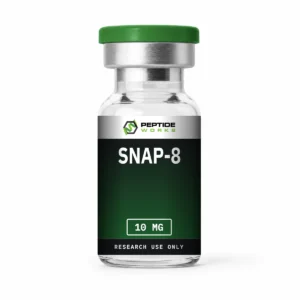
SNAP-8 is a synthetic acetylated octapeptide consisting of eight amino-acid residues and classified as a peptide-based chemical compound for laboratory research.

  • Synthetic peptide
  • Acetylated peptide
  • Octapeptide
  • Amidated peptide
01

Technical Overview

SNAP-8, which is also called Acetyl Octapeptide-3, is a synthetic peptide consisting of eight amino acid residues and has been developed as an extended version of acetyl hexapeptide-8. The specific sequence of its amino acids is Ac-Glu-Glu-Met-Gln-Arg-Arg-Ala-Asp-NH₂, with an acetyl group at the N-terminus and an amide at the C-terminus. According to PubChem, SNAP-8 is listed as Acetyl Octapeptide-3 and has the molecular formula C41H70N16O16S with a molecular weight of about 1075.16 g/mol.

From the point of view of molecular research, SNAP-8 has been studied in connection with the biology of the SNAP-25-associated SNARE complex. SNAP-25 is one of the components of the soluble N-ethylmaleimide-sensitive factor attachment protein receptor (SNARE) system, which is involved in the processes of vesicle docking and membrane fusion. The existing literature states that SNAP-8 is an elongated form of acetyl hexapeptide-8 that has been designed around the peptide structure related to SNAP-25.

Laboratory investigation of SNAP-8 can therefore focus on peptide–protein interactions, SNARE-complex-associated molecular processes, peptide structure–activity relationships, and analytical characterization.

02

Chemical Classification

Chemical name
N-acetyl-L-α-glutamyl-L-α-glutamyl-L-methionyl-L-glutaminyl-L-arginyl-L-arginyl-L-alanyl-L-α-asparagine
Common name(s)
SNAP-8 / Acetyl Octapeptide-3
Molecular Formula
C41H70N16O16S
Molecular weight
1075.16 g/mol
Compound class
Synthetic peptide, Octapeptide, Amidated peptide
Amino acid sequence
Ac-Glu-Glu-Met-Gln-Arg-Arg-Ala-Asp-NH2
Origin
Synthetic
Purity
99.6%
03

Molecular Characteristics

SNAP-8, which is also called Acetyl Octapeptide-3, is a synthetic peptide composed of eight amino acid residues. Its sequence is Ac-Glu-Glu-Met-Gln-Arg-Arg-Ala-Asp-NH₂ (Ac-EEMQRRAD-NH₂), this sequence including the N-terminal acetylation and C-terminal amidation which are considered to be structural features. The FDA's substance records also list SNAP-8 as Acetyl Octapeptide-3 and give the corresponding systematic peptide name.

The sequence contains two glutamic acid residues, methionine, glutamine, two arginine residues, alanine and aspartic acid. Its single methionine residue contributes sulfur to the molecular composition, while the peptide contains no cysteine residues and therefore has no cysteine-derived disulfide bonds.

PubChem reports the molecular formula as C41H70N16O16S, an average molecular weight of approximately 1075.16 g/mol, and CAS number 868844-74-0.

The combination of acidic and basic side chains gives SNAP-8 a chemically diverse peptide architecture. The two arginine residues provide strongly basic guanidinium groups, while glutamate and aspartate contribute acidic functionality. Its terminal modifications further distinguish the molecule from an unmodified linear octapeptide.

For laboratory characterization, SNAP-8 should therefore be defined according to its eight-residue sequence, N-terminal acetylation, C-terminal amidation, molecular identity and chromatographic purity. Where a particular salt or counterion form is supplied, the specifications stated on the batch-specific Certificate of Analysis should take precedence over general reference values.

04

Mechanism Under Investigation

SNAP-8, or Acetyl Octapeptide-3, has mainly been studied in connection with SNAP-25 and the molecular processes associated with the SNARE complex. The suggested mechanism rests on the fact that SNAP-8 has a structural relationship to the peptide sequences linked with SNAP-25, a protein that plays a role in regulated vesicle fusion and exocytosis. Nevertheless, the direct experimental evidence concerning SNAP-8 is relatively scarce, and therefore its molecular activity is most accurately described as being under investigation rather than as a mechanism that has been conclusively established.

SNAP-25-Associated Research

SNAP-25 is a component of the SNARE (soluble NSF attachment protein receptor) complex, alongside syntaxin and synaptobrevin/VAMP. Assembly of these proteins forms a molecular complex involved in bringing vesicular and cellular membranes together during regulated membrane fusion.

SNAP-8 was developed as an extension of the shorter SNAP-25-derived peptide acetyl hexapeptide-3, with two additional amino acid residues incorporated into its sequence.

SNARE Complex Investigation

A proposed area of SNAP-8 research concerns competitive interference with SNARE-complex assembly. In experimental models, SNAP-25-derived peptide sequences can be examined for their ability to alter protein–protein interactions required for efficient formation of the SNARE complex.

With regard to SNAP-8, this model suggests that its SNAP-25-related sequence might compete during the molecular assembly process. The degree and specificity of this interaction, however, have to be established through careful experimental validation and cannot be assumed merely on the basis of sequence similarity.

Vesicle-Fusion Research

Because the SNARE complex participates in membrane docking, fusion and regulated exocytosis, SNAP-8 provides a defined synthetic peptide for investigating these molecular processes. Laboratory endpoints may include SNARE-complex formation, protein interactions and vesicle-associated signaling.

Overall, SNAP-8 is most appropriately presented as a research peptide for studying SNAP-25-related molecular interactions, SNARE-complex biology and peptide structure–activity relationships. Proposed molecular mechanisms should remain clearly distinguished from therapeutic, clinical or human-use claims.

This summary reflects findings reported in published preclinical and in vitro research. The original studies supporting this information are listed in the references.

05

Experimental Research Areas

01

SNAP-25-Associated Research

SNAP-8 is studied in connection with SNAP-25, a component of the cellular SNARE machinery which is involved in regulated vesicle fusion. This peptide was created by adding two further amino acid residues to the acetyl hexapeptide sequence related to SNAP-25, thus obtaining a well-defined structure for use in comparative molecular research.

02

SNARE Complex Research

A principal research area concerns the SNARE complex, which includes SNAP-25, syntaxin and synaptobrevin/VAMP. SNAP-25-derived peptides have been studied experimentally for their ability to interfere with SNARE-complex formation, making this system relevant for examining peptide-mediated modulation of protein–protein assembly. Evidence directly specific to SNAP-8 is more limited than that available for related SNAP-25-derived peptides.

03

Vesicle-Fusion and Exocytosis Models

Because SNARE proteins participate in vesicle docking and membrane fusion, SNAP-8-related research can examine molecular processes associated with regulated exocytosis. Appropriate experimental endpoints include SNARE-complex formation, vesicle-associated protein interactions and changes in membrane-fusion systems.

04

Comparative Peptide Research

SNAP-8 can be compared to acetyl hexapeptide-8 (Argireline) in order to study the relationship between peptide structure and activity. Although the two substances have the Ac-EEMQRR sequence in common, SNAP-8 includes two extra amino acids and thus provides a model for investigating how extending the peptide chain influences the molecule's physical and chemical properties.

05

Peptide Stability and Analytical Research

The fact that SNAP-8 has a well-defined structure also means that it is appropriate for use in the development of analytical methods and for studies involving the characterisation of peptides. Research that has already been published has established an LC-MS/MS method specifically for acetyl octapeptide-3, showing how chromatographic separation and mass-spectrometric detection can be used for its identification and for the quantitative analysis.

06

Structure–Function Investigation

Further research could look into how N-terminal acetylation, C-terminal amidation, peptide length and individual residues affect the molecular properties of SNAP-8. Such experiments offer a controlled setting in which to study the relationships between peptide structure and its interactions with SNARE-associated systems.

06

Analytical Verification

The analysis of SNAP-8 (Acetyl Octapeptide-3) should centre on verifying its molecular identity, chromatographic behaviour, and purity. Liquid chromatography coupled with tandem mass spectrometry (LC-MS/MS) has been specially developed and validated for use in the analysis of SNAP-8, enabling both the chromatographic separation and mass-based detection of the peptide.

Published research using a C18 reversed-phase column and electrospray ionization detected the doubly protonated SNAP-8 ion [M+2H]²⁺ at m/z 538 and characterised product ions using multiple-reaction monitoring (MRM). The reported method demonstrated good linearity, repeatability and analytical accuracy under the conditions evaluated.

For research materials, RP-HPLC can provide information about chromatographic purity, while MS or LC-MS/MS provides complementary evidence of molecular identity. Where available, these results should be reviewed alongside the batch-specific Certificate of Analysis, with particular attention to identity, purity, chemical form and the analytical methods used.

Certificate of Analysis
Batch20250916038
MethodCOA 2026
Document Download PDF
HPLC
Batch20250916038
MethodHPLC 2026
Document Download PDF
07

Storage & Handling

Store SNAP-8 at 2–8°C, according to the supplied batch COA. Keep the container tightly sealed and protect the material from light and moisture. Minimize humidity exposure and avoid prolonged periods at room temperature. Before opening a chilled, sealed container, allow it to reach temperature equilibrium to reduce condensation.

For prepared SNAP-8 solutions, follow a validated laboratory procedure based on the solvent or buffer, concentration, and pH. When using frozen aliquots, minimize freeze–thaw cycles.

Supplied as Lyophilized Powder in Vial
Storage 2–8°C
Handling Reconstitution Required
08

Questions researchers ask

SNAP-8 is a synthetic octapeptide, also known as Acetyl Octapeptide-3. It was designed as an extended peptide related to the SNAP-25-associated acetyl hexapeptide sequence and contains eight defined amino acid residues.

SNAP-8 (Acetyl Octapeptide-3) is supplied for laboratory research and scientific or analytical purposes only. It is not for human or animal consumption or administration and is not intended for diagnosis, treatment, or prevention of disease. The material is not supplied for clinical or veterinary use.

Information on this page is provided for scientific and technical reference only and does not constitute medical, therapeutic, or usage guidance.

Available now

SNAP-8 Peptide from Peptide Works