PROMO!

First order? Get 10% OFF with this code: 1storder

Research hub

Tesamorelin Research Peptide Hub

Tesamorelin is a synthetic peptide analog of human growth hormone–releasing hormone (GHRH) that acts as a growth hormone–releasing factor analog.

  • Synthetic peptide
  • Growth hormone–releasing hormone (GHRH) analog
  • Growth hormone–releasing factor analog
  • GHRH receptor agonist
01

Technical Overview

Tesamorelin is a synthetic version of human growth hormone-releasing hormone (GHRH); it is derived from the 44-amino-acid GHRH sequence and has a trans-3-hexenoyl group attached to its N-terminus, a structural change which sets it apart from native GHRH and one that is related to its molecular stability and analytical identity.

In laboratory research Tesamorelin is mainly studied as a ligand of the growth hormone-releasing hormone receptor (GHRH-R). The GHRH-R belongs to the class B of G-protein-coupled receptors and mainly involves adenylyl cyclase and cAMP-dependent signalling as a result of receptor activation. These systems offer well-established experimental models for the investigation of peptide–receptor recognition, receptor activation and the downstream second-messenger pathways.

Tesamorelin can therefore be used in controlled research examining GHRH-R pharmacology, peptide structure–activity relationships, receptor signaling and the effects of N-terminal peptide modification on molecular behavior.

In order to characterise the research material, the Tesamorelin provided should be assessed in terms of its chemical form, molecular identity, purity and the analytical data specific to the batch. The Peptide Works Certificate of Analysis provided attached indicates that the material in question is Tesamorelin, with the CAS number 901758-09-6, a molecular weight of 5135 g/mol and a molecular formula containing an acetate group.

02

Chemical Classification

Chemical name
N-(trans-3-hexenoyl)-human growth hormone-releasing factor (1–44) acetate
Common name(s)
Tesamorelin acetate
Molecular Formula
C221H366N72O67S · xC2H4O2
Molecular weight
5135 g/mol
Amino acid sequence
trans-3-hexenoyl-Tyr-Ala-Asp-Ala-Ile-Phe-Thr-Asn-Ser-Tyr-Arg-Lys-Val-Leu-Gly-Gln-Leu-Ser-Ala-Arg-Lys-Leu-Leu-Gln-Asp-Ile-Met-Ser-Arg-Gln-Gln-Gly-Glu-Ser-Asn-Gln-Glu-Arg-Gly-Ala-Arg-Ala-Arg-Leu-NH₂
Compound class
Synthetic peptide, Growth hormone–releasing hormone (GHRH) analog
Origin
Synthetic analogue of human growth hormone-releasing hormone (GHRH/GRF).
Purity
99.5%
03

Molecular Characteristics

Tesamorelin is a synthetic peptide analogue consisting of 44 amino acids of the human growth hormone-releasing hormone (GHRH/GRF), the peptide chain is derived from the 44-amino-acid sequence of human GHRH, but it is distinguished by the presence of a trans-3-hexenoyl group attached to the tyrosine residue at the N-terminus, the six-carbon modification with the double bond at position 3 is an essential part of Tesamorelin's molecular identity.

The peptide has a leucinamide at its C-terminus and includes one methionine residue, which is the source of the sulphur atom in the molecular formula. Since there are no cysteine residues in the sequence, the molecule does not form intramolecular disulphide bonds derived from cysteine. As shown in the FDA substance record, the full 44-residue peptide sequence and its specified N-terminal structural modification are confirmed.

Tesamorelin can be prepared in the form of an acetate salt. In the case of the acetate form, the FDA documentation provides the molecular formula C₂₂₁H₃₆₆N₇₂O₆₇S · xC₂H₄O₂, where x stands for the amount of acetate associated with it, and states that the molecular weight, on a free-base basis, is about 5135 g/mol.

The attached Peptide Works COA similarly identifies the supplied material with an acetate-containing formula and a stated molecular weight of 5135 g/mol.

For laboratory characterization, the peptide sequence, N-terminal modification, chemical form, molecular identity and batch-specific analytical specifications should therefore be considered together.

04

Mechanism Under Investigation

Tesamorelin is being studied as a synthetic growth hormone-releasing hormone (GHRH) receptor agonist. The molecular mechanism of Tesamorelin can be examined using receptor-binding and cell-based signalling systems which are designed to examine the interactions between the GHRH receptor (GHRH-R) and the intracellular pathways involved upon receptor activation. In vitro evidence shows that Tesamorelin binds to and stimulates human GHRH receptors.

GHRH Receptor Interaction

The GHRH receptor is a class B G-protein-coupled receptor (GPCR). Tesamorelin's interaction with this receptor provides an experimental model for investigating peptide–receptor recognition and comparing the molecular behavior of synthetic GHRH analogs with endogenous GHRH.

cAMP-Dependent Signaling

The signaling through GHRH-R is mainly linked to the activation of Gs-proteins and adenylyl cyclase, which in turn leads to a rise in intracellular cyclic adenosine monophosphate (cAMP). This cAMP then takes part in the activation of protein kinase A (PKA) as well as of the downstream signaling elements. Tesamorelin has also been tested in cell assays that express the receptor, using the amount of cAMP produced as an indicator of GHRH-R activation.

Calcium and Downstream Signaling

Experimental research into GHRH-R signaling has additionally examined changes in intracellular calcium, CREB phosphorylation and other signaling pathways. These processes provide complementary molecular endpoints for investigating how receptor activation is translated into cellular responses. Some secondary pathways have been described for GHRH-R systems, although the cAMP-dependent pathway remains the principal signaling mechanism.

Structural Modification

Tesamorelin is different from native GHRH because of a trans-3-hexenoyl group attached to its N-terminal end. Research shows that this modification leads to greater peptide stability as compared with native human GHRH, which means that the structural change is relevant to investigations into peptide stability and structure–activity relationships.

To sum up, tesamorelin can be used as a well-defined molecular probe for the investigation of GHRH-R binding, GPCR signalling, second-messenger pathways, and peptide structure–activity relationships under controlled experimental conditions.

This summary reflects findings reported in published preclinical and in vitro research. The original studies supporting this information are listed in the references.

05

Experimental Research Areas

01

GHRH Receptor Interaction

Tesamorelin is investigated as a defined ligand of the growth hormone-releasing hormone receptor (GHRH-R). In-vitro studies have shown that it binds to and stimulates human GHRH receptors, providing an experimental model for examining peptide–receptor recognition and receptor activation.

02

GHRH Receptor Signaling

The GHRH receptor is mainly a G-protein-coupled receptor of the class B type, which is linked to Gs-dependent signaling. In laboratory models of this receptor system, adenylyl cyclase activation and the production of intracellular cAMP are used as molecular endpoints, enabling the activity of GHRH analogs to be examined under controlled conditions.

03

Receptor Structure Research

The structure of GHRH-R has been studied using cryo-electron microscopy in order to examine the molecular arrangement of the receptor and how it interacts with the GHRH-family of ligands. The models thus obtained throw light on the process of ligand recognition, the conformational changes of the receptor, and G-protein coupling within the entire class B GPCR family.

04

Peptide Stability Research

The fact that tesamorelin has an N-terminal trans-3-hexenoyl modification means that peptide stability is a key focus of laboratory studies. Research comparisons show that this modification results in greater stability when compared with native human GHRH and thus provides a useful model for investigating how changes to the N-terminal structure affect peptide degradation.

05

Proteolytic Stability and LC-MS Research

Studies using mass spectrometry have looked at tesamorelin under controlled in-vitro conditions to examine its susceptibility to proteolytic degradation; LC-HRMS/MS experiments showed that it has a considerable resistance to degradation in human plasma when compared to some other GHRH-related peptides, thus illustrating the way in which analytical techniques can be employed to investigate peptide stability and molecular integrity.

06

Comparative GHRH Analog Research

Tesamorelin may also be studied in conjunction with native GHRH and structurally altered GHRH analogs. Comparative research involving the receptor, structure and analytical aspects offers a basis for looking at how modifications to the structure of the GHRH peptide affect its interaction with the receptor, its signalling and molecular stability, without extending the laboratory results to therapeutic outcomes.

06

Analytical Verification

The molecular identity, peptide integrity, and chromatographic purity of Tesamorelin Peptide must be verified by analytical methods. Reverse-phase high-performance liquid chromatography (RP-HPLC) can be used to examine the purity by separating the main Tesamorelin component from any detectable peptide-related impurities. The FDA's chemistry documentation states that among the analytical specifications for Tesamorelin are HPLC identification and the measurement of both the individual and total peptide-related impurities.

Mass spectrometry, including MALDI-TOF MS or LC-MS, provides complementary molecular-identity information by comparing the observed molecular mass with the expected Tesamorelin mass. FDA characterization has additionally used amino-acid analysis, peptide mapping and circular dichroism to support structural identification.

More specialized LC-HRMS/MS methods can provide sequence-related information through peptide fragmentation and have been applied to Tesamorelin analytical research.

For research material, results should be assessed against the batch-specific Certificate of Analysis, with particular attention to identity, purity, chemical form and the analytical methods used.

Certificate of Analysis
Batch20250923026
MethodCOA 2026
Document Download PDF
HPLC
Batch20250923026
MethodHPLC 2026
Document Download PDF
07

Storage & Handling

Store Tesamorelin research material at 2–8°C in a tightly sealed container. Protect the material from moisture, light and excessive heat during storage.

During laboratory handling, minimize exposure to humidity and temperature fluctuations. Keep the container closed when not in use and avoid unnecessary exposure to ambient conditions. Because Tesamorelin contains a methionine residue, minimize exposure to conditions that may promote oxidation.

Supplied as Lyophilized Powder in Vial
Storage 2–8°C
Handling Reconstitution Required
08

Questions researchers ask

Tesamorelin is a synthetic peptide which is analogous to the naturally occurring human growth hormone-releasing hormone (GHRH/GRF); it has the 44-amino-acid GHRH structure but includes a specific modification at the N-terminal position.

Tesamorelin is provided strictly for laboratory research and scientific investigation only. The research material described on this page is not intended for human or animal consumption, administration, diagnostic, therapeutic, or veterinary use.

It is not offered as a drug, medicine, dietary supplement, or treatment. Nothing on this page is intended to diagnose, treat, cure, or prevent any disease or medical condition. All information provided is for laboratory research and scientific reference purposes only.

Available now

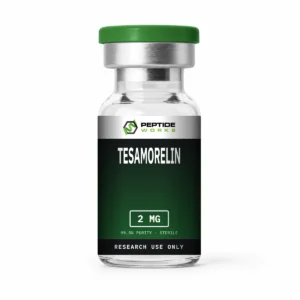
Tesamorelin Peptide from Peptide Works