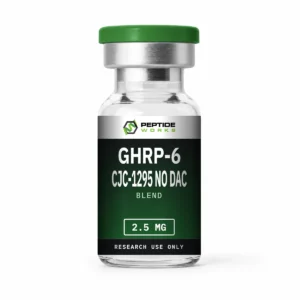
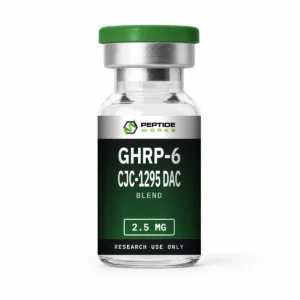
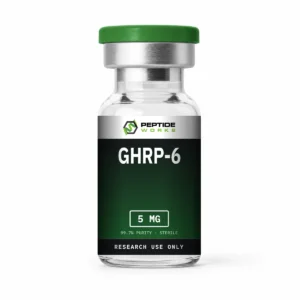
GHRP-6 (growth hormone-releasing peptide-6) is a synthetic hexapeptide secretagogue studied for its interaction with growth-hormone regulatory pathways and stimulation of growth hormone release.
The synthetic hexapeptide GHRP-6 (Growth Hormone-Releasing Peptide-6) has the following sequence: His-D-Trp-Ala-Trp-D-Phe-Lys-NH₂. It has a C-terminal amide and six amino acid residues, including the synthetic D-amino acids D-tryptophan and D-phenylalanine. GHRP-6 is a defined substance for biochemical and receptor-based laboratory study because of these structural characteristics that set it apart from naturally occurring peptide hormones. The scientific literature has established the sequence.
GHRP-6 has been investigated primarily in relation to the growth hormone secretagogue receptor (GHS-R1a) and associated molecular signalling systems. Laboratory studies have examined receptor activation, intracellular signal transduction, calcium-dependent processes and interactions between GHRP-associated and GHRH-associated signalling pathways. Cell-based experiments have also demonstrated that GHRP-6 and GHRH operate through distinguishable signalling mechanisms, providing a basis for investigating receptor-specific molecular responses.
A synthetic linear hexapeptide is called GHRP-6. Its structure includes a C-terminally amidated lysine residue and two D-configured amino acids, D-tryptophan and D-phenylalanine.
GHRP-6 does not contain disulfide bonds or glycosylation and is structurally distinct from larger, naturally occurring protein hormones. Its defined sequence, stereochemistry and terminal amidation are important characteristics when confirming molecular identity and evaluating research-grade material using analytical techniques such as HPLC and mass spectrometry.
04
Mechanism Under Investigation
GHRP-6 has been investigated primarily as a ligand of the growth hormone secretagogue receptor type 1a (GHS-R1a), a G-protein-coupled receptor also known as the ghrelin receptor. Laboratory studies have used GHRP-6 to characterise receptor activation and associated intracellular signaling mechanisms.
According to experimental study, GHS-R1a signaling may involve the Gαq/11–phospholipase C (PLC) pathway, leading to the production of intracellular second messengers such as diacylglycerol and inositol trisphosphate (IP3). Studies using GHRP-6-specific cells have shown altered intracellular calcium concentrations and enhanced inositol phosphate production after peptide treatment.
These molecular responses make GHRP-6 useful for controlled laboratory investigations of GHS-R1a receptor pharmacology, second-messenger signaling and calcium-dependent cellular processes. Research has also examined molecular interactions between GHS-R1a-associated signaling and the separate GHRH receptor pathway, providing a model for studying communication between distinct receptor systems.
The precise signaling response can vary according to the experimental system, receptor expression and assay conditions, so these mechanisms should be interpreted within the context of the individual laboratory model.
This summary reflects findings reported in published preclinical and in vitro research. The original studies supporting this information are listed in the references.
05
Experimental Research Areas
01
GHS-R1a Receptor Pharmacology
The growth hormone secretagogue receptor type 1a (GHS-R1a) has been studied using GHRP-6 as a synthetic ligand. Receptor activation and the molecular processes connected to GHS-R1a signaling have been studied in the lab.
02
Intracellular Signal Transduction
Cell-based research has investigated GHRP-6-associated phosphatidylinositol turnover, protein kinase C (PKC) activity and second-messenger signaling. These experiments provide a biochemical framework for characterising molecular responses following GHS-R1a activation.
03
Calcium Signalling
GHRP-6 has also been studied in relation to intracellular Ca²⁺ mobilisation. Experimental cell systems have demonstrated changes in intracellular calcium following GHRP-6 exposure, allowing researchers to examine calcium-dependent signaling associated with receptor activation.
04
Gene-Expression Research
Research has focused on changes in Pit-1 transcription and protein expression following exposure to GHRP-6. Receptor-associated transcriptional regulation has been studied utilizing Western blotting, Northern blotting, and reporter-gene experiments.
05
Comparative Receptor Signaling
GHRP-6 and GHRH act through distinct receptor systems and signaling pathways. GHRP-6 is associated with GHS-R signaling, while GHRH acts through the GHRH receptor pathway. Studies in pituitary cell models have compared their different receptor-linked signaling responses.
06
Analytical Verification
HPLC evaluates GHRP-6 purity by separating the peptide from related substances. LC-MS confirms chemical identity by measuring the peptide’s mass and can identify related molecular species. NMR provides additional structural information when further characterization is appropriate.
A Certificate of Analysis (COA) records the analytical results for a specific GHRP-6 batch. It should include the compound identity, purity result, test method, batch or lot number, testing date, and testing laboratory.
Together, these analytical records show what the laboratory material contains and document its measured chemical quality. They give researchers a clear record of the testing performed on the specific batch used for research. Analytical documentation verifies product identity and quality, not biological performance.
Store GHRP-6 at 2–8°C in its original sealed container. Protect the material from moisture, heat, light, contamination and unnecessary environmental exposure. Avoid repeated temperature changes during storage.
During laboratory handling, use clean laboratory equipment and minimize unnecessary exposure to air and ambient conditions. Keep the container closed when not in use and handle the material in a clean, dry laboratory environment. Reseal the container securely after handling.
Supplied AsLyophilized Powder in Vial
StorageStore at 2–8°C
HandlingReconstitution Required
08
Questions researchers ask
In lab studies, GHRP-6 is a synthetic linear hexapeptide. Its unusual six-residue structure, which includes a C-terminal amide and two D-amino acids, sets it apart chemically from peptide hormones found in nature.
GHRP-6 stands for Growth Hormone-Releasing Peptide-6. It is also described in chemical databases as growth hormone-releasing hexapeptide.
GHRP-6 is synthetic and is not a naturally occurring endogenous peptide. Its incorporation of D-tryptophan and D-phenylalanine is characteristic of its designed peptide structure.
The sequence of GHRP-6 is: H-His-D-Trp-Ala-Trp-D-Phe-Lys-NH₂
The molecule therefore contains two D-configured residues and an amidated C-terminus.
GHRP-6 contains six amino-acid residues, making it a hexapeptide. These are histidine, D-tryptophan, alanine, tryptophan, D-phenylalanine and lysine.
The molecular formula of the defined GHRP-6 peptide H-His-D-Trp-Ala-Trp-D-Phe-Lys-NH₂ is C₄₆H₅₆N₁₂O₆.
The molecular weight of GHRP-6 is approximately 873.0 g/mol for the defined uncomplexed peptide. Salt or counter-ion forms should be identified separately because these can have different formula weights.
GHRP-6 is provided for laboratory research and scientific investigation only. It is not for human consumption or veterinary use and is not intended for administration. It is not intended to diagnose, treat, cure, or prevent any disease or medical condition. Information on this page is provided for scientific research purposes only.