PROMO!

First order? Get 10% OFF with this code: 1storder

Research hub

Gonadorelin Peptide Research Hub

Gonadorelin is a synthetic decapeptide corresponding to gonadotropin-releasing hormone (GnRH), classified as a peptide hormone and studied for its role in regulating gonadotropin secretion.

  • Synthetic decapeptide
  • oligopeptide
  • peptide hormone
  • gonadotropin-releasing hormone (GnRH)
01

Technical Overview

The basic sequence of mammalian gonadotropin-releasing hormone (GnRH-I) is represented by the synthetic decapeptide gonadorelin. Ten amino acid residues make up the sequence, which includes a glycinamide at the C-terminal and a pyroglutamyl residue at the N-terminal.

Gonadorelin's interaction with the class A G-protein-coupled gonadotropin-releasing hormone receptor (GnRHR) has been the main focus of laboratory studies. Receptor conformational changes, downstream G-protein-associated signaling, and ligand recognition have all been studied in molecular and receptor-binding research. Gonadorelin is a helpful reference ligand for examining peptide–receptor structure–activity correlations because specific portions of the GnRH decapeptide contribute differently to receptor recognition and activation.

Gonadorelin's specific sequence, terminal alterations, and molecular mass offer distinctive features for verifying the identity of research materials from an analytical standpoint. Two methods that can be used to evaluate chromatographic purity and verify the expected molecular species are mass spectrometry and RP-HPLC.

02

Chemical Classification

Chemical name
L-pyroglutamyl-L-histidyl-L-tryptophyl-L-seryl-L-tyrosyl-glycyl-L-leucyl-L-arginyl-L-prolyl-glycinamide
Common name(s)
Gonadorelin, GnRH-I, LH-Releasing Factor, Gonadoliberin I, Gonadotropin-Releasing Factor, Gonadorelin Decapeptide, LHRH, Synthetic Gonadoliberin, Synthetic LH-RH
Molecular formula
C55 H75 N17 O13
Molecular weight
1182.29 g/mol
Compound Class
Synthetic decapeptide, oligopeptide, peptide hormone, gonadotropin-releasing hormone (GnRH)
Origin
Synthetic
Purity
99.6%
Amino acid sequence
H-Pyr-His-Trp-Ser-Tyr-Gly-Leu-Arg-Pro-Gly-NH2
CAS number
33515-09-2
03

Molecular Characteristics

Gonadotropin-releasing hormone (GnRH-I) and gonadorelin, a synthetic linear decapeptide, share the same sequence. Ten amino acids make up its composition. Two important structural components that contribute to the peptide's unique molecular identity are its C-terminal glycinamide and N-terminal pyroglutamyl residue (pGlu).

Gonadorelin is a linear, rather tiny peptide without glycosylation or disulfide linkages. Characteristic parameters for analytical identification are provided by its specified amino acid sequence and terminal modifications.

04

Mechanism Under Investigation

Gonadorelin has mostly been studied as a ligand of the class A G-protein-coupled receptor (GPCR) known as the gonadotropin-releasing hormone receptor (GnRHR). The described GnRH-I decapeptide's interactions with extracellular GnRHR areas and its promotion of receptor conformational changes linked to intracellular signal transduction have been studied in the lab.

GnRHR Activation

Gαq/11 protein activation is mostly linked to ligand binding to GnRHR. Phospholipase Cβ (PLCβ), which hydrolyzes phosphatidylinositol 4,5-bisphosphate (PIP₂) to produce the second messengers inositol trisphosphate (IP₃) and diacylglycerol (DAG), is stimulated by this receptor–G-protein interaction.

Calcium and Protein Kinase Signaling

Protein kinase C (PKC) is activated by DAG, and intracellular Ca2+ is triggered by IP3-associated signaling. In GnRHR-expressing experiments, biochemical reactions have been recorded and offer quantitative endpoints for exploring receptor activation and second-messenger signaling.

Downstream Signaling Networks

Downstream signaling networks linked to GnRHR activation, such as mitogen-activated protein kinase (MAPK) pathways like ERK, JNK, and p38 MAPK, have also been studied experimentally. These pathways offer more laboratory markers for studying the conversion of an extracellular peptide-receptor interaction into intracellular metabolic reactions.

Structure–Receptor Relationships

Research on structure-activity and receptor-binding also makes use of gonadorelin. The structural characteristics involved in ligand recognition and receptor activation have been better understood because to studies looking at specific residues within the GnRH-I sequence.

Under laboratory conditions, gonadorelin is usually used as a specific peptide ligand, normally to investigate downstream molecular signaling, GnRHR binding, GPCR activation, calcium mobilization, and PLC-dependent second-messenger production.

This summary reflects findings reported in published preclinical and in vitro research. The original studies supporting this information are listed in the references.

05

Experimental Research Areas

01

GnRHR Receptor–Ligand Interactions

The gonadotropin-releasing hormone receptor (GnRHR) has been studied using gonadorelin as a specified peptide ligand. Receptor residues implicated in ligand binding have been identified and molecular recognition has been characterized using structural methods, mutagenesis, and receptor-binding experiments.

02

Receptor Structure and Conformation

Structural biology research has studied the structure of GnRHR and the conformational alterations linked to ligand recognition and receptor activation. The characterization of GnRHR architecture and peptide–receptor interactions has been aided by methods such as molecular modeling, cryo-electron microscopy, and X-ray crystallography.

03

Intracellular Signal Transduction

Molecular signaling downstream of GnRHR activation has been studied in cell-based research studies. Gαq/11, phospholipase Cβ, IP₃, diacylglycerol, and intracellular Ca2+ signaling have received special interest because they offer quantifiable biochemical endpoints for research involving receptor activation.

04

Structure–Activity Relationships

Gonadorelin is appropriate for structural–activity relationship (SAR) studies due to its well-defined decapeptide structure. The role of particular residues and terminal structural characteristics in receptor affinity, molecular recognition, and ligand-associated receptor activation has been investigated experimentally.

05

Comparative Ligand Research

Additionally, gonadorelin can be used as a reference peptide for comparing structurally altered GnRH analogs in the lab. These investigations aid in describing the ways in which particular chemical alterations affect peptide shape, receptor binding, and signaling activity in well regulated experimental settings.

06

Analytical Verification

Gonadorelin's identification and purity as a peptide should be verified analytically. The target peptide can be separated from associated contaminants or degradation products using reverse-phase high-performance liquid chromatography (RP-HPLC) to evaluate chromatographic purity. Gonadorelin stability and degradation investigations have been the focus of published analytical research using RP-HPLC.

Mass spectrometry (MS) offers supplemental confirmation of the anticipated molecular species for molecular identification. Gonadorelin and similar synthetic peptides have been precisely identified using collision-induced dissociation mass spectrometry.

Certificate of Analysis
Batch20250822032
MethodCOA 2026
Document Download PDF
HPLC
Batch20250822032
MethodHPLC 2026
Document Download PDF
07

Storage & Handling

Store gonadorelin research material according to the specified conditions for the supplied chemical form and batch. Lyophilized Gonadorelin should remain in its original sealed container and be protected from moisture, excessive light, heat, and unnecessary temperature fluctuations. Store the supplied material at 2–8°C. During laboratory handling, keep the container sealed when not in use and minimize unnecessary exposure to environmental conditions.

Supplied As Lyophilized Powder in Vial
Storage Store at 2–8°C
Handling Reconstitution Required
08

Questions researchers ask

Gonadorelin is a synthetic decapeptide whose chemical structure corresponds to mammalian gonadotropin-releasing hormone (GnRH-I). This defined structure makes it suitable as a reference peptide in biochemical and receptor-based laboratory investigations.

Gonadorelin is supplied for research and laboratory use only. It is not intended for human or animal consumption or for the diagnosis, treatment, cure, or prevention of any disease or condition. It is not intended for clinical, therapeutic, or veterinary use. The information on this page is provided for scientific and technical reference only and covers the chemical structure, molecular characteristics, analytical properties, and laboratory research of Gonadorelin.

Available now

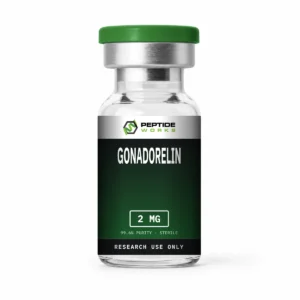
Gonadorelin Peptide from Peptide Works