PROMO!

First order? Get 10% OFF with this code: 1storder

Research hub

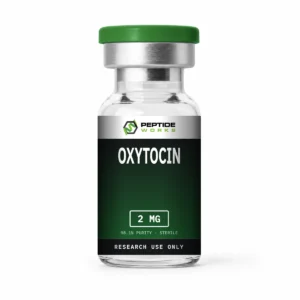
Oxytocin Research Peptide Hub

Oxytocin is a cyclic nonapeptide consisting of nine amino acids, with an intramolecular disulfide bond between Cys¹ and Cys⁶ that forms its characteristic cyclic structure.

  • Peptide hormone
  • cyclic nonapeptide
  • neurohypophyseal hormone
01

Technical Overview

Oxytocin is a cyclic nonapeptide which occurs naturally and is a member of the neurohypophyseal peptide family; its primary structure is made up of nine amino acids with a disulfide bond joining the cysteine residues found at positions 1 and 6. This covalent bond results in a six-amino acid cyclic section together with a short C-terminal tripeptide sequence. The glycine at the C-terminus is amidated.

Oxytocin is known in the fields of biochemical and molecular research since its compact cyclic structure serves as a well-defined model for the study of peptide conformation, disulfide-bond formation, receptor–ligand recognition, and G-protein-coupled receptor signaling.

Oxytocin can be studied in laboratory conditions through the use of peptide chemistry, receptor-binding techniques, methods from structural biology, as well as chromatographic and mass-spectrometric methods. The research material can be analysed with well-established analytical techniques to determine its identity, purity, molecular mass and properties related to its sequence.

02

Chemical Classification

Chemical name
L-Cysteinyl-L-tyrosyl-L-isoleucyl-L-glutaminyl-L-asparaginyl-L-cysteinyl-L-prolyl-L-leucylglycinamide cyclic (1→6)-disulfide
Common name(s)
Oxytocin
Alternative nomenclature
OXT; oxytocic peptide/hormone
Molecular Formula
C₄₃H₆₆N₁₂O₁₂S₂
Molecular weight
1007.2 g/mol
Amino acid sequence
Cys–Tyr–Ile–Gln–Asn–Cys–Pro–Leu–Gly-NH₂
Compound clas
Peptide hormone, cyclic nonapeptide, neurohypophyseal hormone, endogenous peptide, heterodetic cyclic peptide.
Origin
Endogenous
Purity
98.1%
03

Molecular Characteristics

The glycine at the C-terminus is amidated, which is an important structural characteristic of the mature peptide; oxytocin thus contains peptide bonds, side chains with amide groups, a phenolic tyrosine residue and a covalent disulfide bond all within a fairly compact molecular structure.

The way in which it adopts different conformations is affected by the region containing the cyclic disulfide and by the interactions between the polar and hydrophobic side chains of the amino acids. Investigations into the structure have looked at the role this conformation plays in molecular recognition by the oxytocin receptor. High-resolution studies of the receptor have given direct information about the position of the cyclic peptide in the receptor-binding pocket.

For other peptides which have disulfide bonds, laboratory stability can be affected by temperature, the oxidation state, moisture, pH and frequent handling as well; furthermore, solubility and solution stability will also depend on concentration, solvent composition and the experimental conditions.

04

Mechanism Under Investigation

The main way oxytocin is described in published experimental research is through its interaction with the class A G protein-coupled receptor, the oxytocin receptor (OTR). Oxytocin and the orthosteric ligand-binding pocket of the receptor have been shown to interact through structural studies, which have also identified certain molecular interactions involved in ligand recognition. An oxytocin-bound OTR signaling complex has been resolved at around 3.2 Å resolution using cryo-electron microscopy, offering molecular-level details regarding ligand placement and receptor activation.

Further research has looked at the downstream pathways linked to OTR activation, such as mitogen-activated protein kinase signaling, Rho-associated pathways and receptor regulatory processes. Investigations have also been carried out into GPCR kinase-mediated receptor phosphorylation, β-arrestin recruitment, receptor desensitization and internalization as part of the regulation of OTR signaling.

Structural and pharmacological studies additionally investigate the relationship between oxytocin and closely related vasopressin-family receptors. Because these receptors belong to a structurally related GPCR subfamily, receptor-selectivity experiments and ligand-binding studies are used to characterize the molecular determinants responsible for oxytocin recognition.

The studies offer a laboratory setting in which peptide–receptor interactions, changes in GPCR conformation, second-messenger signalling and ligand specificity can be examined without having to rely on therapeutic or outcome-based interpretations.

This summary reflects findings reported in published preclinical and in vitro research. The original studies supporting this information are listed in the references.

05

Experimental Research Areas

01

Peptide Chemistry

In studies pertaining to peptide synthesis, sequence confirmation, disulfide bond formation, C-terminal amidation, and structure activity connections, oxytocin has been used as a model cyclic peptide. Its small size offers a well-defined system for studying synthetic and analytical peptides.

02

Receptor Pharmacology

The relationship between oxytocin and the oxytocin receptor has been studied in the lab utilizing molecular pharmacology techniques, ligand-binding tests, and receptor expression systems. Oxytocin and comparable ligands may be compared in future studies to assess receptor selectivity and affinity.

03

Structural Biology

The oxytocin receptor and the complexes it forms have been investigated using x-ray crystallography, cryo-electron microscopy and molecular modeling. Structural information has been obtained concerning the position of the ligand, the conformational states of the receptor and the molecular interactions in the binding pocket.

04

Cellular Signaling Research

The coupling of OTR to G-proteins, signaling via phospholipase C, phosphoinositide turnover, intracellular calcium signaling, protein kinase pathways, and β-arrestin-associated receptor modulation have all been investigated using methods based on cell cultures.

05

Peptide Stability and Degradation

The impact of temperature, pH, oxidation, enzymatic exposure, and formulation conditions on the stability of oxytocin can be examined using experimental peptide research, and under controlled laboratory conditions, intact peptides as well as degradation products can be identified by analytical monitoring.

06

Ligand–Receptor Selectivity

Oxytocin is also examined in conjunction with other neurohypophyseal peptides that are structurally related to it and with their receptors. Comparative studies at the molecular level look into the amino acid factors, the regions that bind to receptors, and the structural characteristics linked with ligand recognition and receptor subtype selectivity.

06

Analytical Verification

Synthetic oxytocin can be produced by means of well-established peptide-synthesis methods, such as solid-phase peptide synthesis (SPPS), after which the molecule is cleaved, the protective groups are removed and the disulfide bond between Cys¹ and Cys⁶ is formed under controlled conditions. It is usual for the subsequent purification to involve preparative reversed-phase high-performance liquid chromatography.

Peptide-related contaminants can be detected and the chromatographic purity can be determined by means of analytical HPLC. Liquid chromatography–mass spectrometry (LC-MS) provides additional confirmation of identity by calculating the molecular mass and looking at the mass-to-charge signals which correspond to the target peptide.

Where necessary, further analytical methods can be used to examine sequence integrity, disulfide bond formation or peptide-related degradation products.

In order to comply with Broad Payments requirements, an independent Certificate of Analysis specific to the batch in question should identify the compound, the batch or lot number, the date of the testing, the analytical method used and the measured purity. The compliance document sets out a minimum purity standard of 98% and says that the relevant COA should be shown on the individual product page.

Certificate of Analysis
Batch20250923031
MethodCOA 2026
Document Download PDF
HPLC
Batch20250923031
MethodHPLC 2026
Document Download PDF
07

Storage & Handling

Lyophilised peptides must be stored at controlled low temperatures, protected from moisture and direct light, unless the batch-specific documentation states otherwise. When it comes to long-term storage in the laboratory, storage at around −20°C in a dry and sealed environment is appropriate, on the condition that the product documentation is available.

When it is necessary to prepare a laboratory solution, the suitable research solvent should be chosen on the basis of the experimental method. The prepared solutions should be handled in accordance with the appropriate laboratory procedures and, wherever possible, repeated freeze/thaw cycles should be avoided. Solution stability should be evaluated taking into account concentration, solvent, pH and the conditions under which the solutions are stored.

Supplied as Lyophilized Powder in Vial
Storage 2–8°C
Handling Reconstitution Required
08

Questions researchers ask

Oxytocin is a cyclic nine-amino-acid peptide characterized by a disulfide bond between cysteine residues at positions 1 and 6 and an amidated C-terminal glycine. Its molecular formula is C₄₃H₆₆N₁₂O₁₂S₂ and its molecular weight is approximately 1007.2 g/mol.

For research and laboratory use only. Not for human or animal consumption.

Oxytocin supplied as research material is intended exclusively for qualified laboratory and analytical research. It is not intended for human or animal consumption, diagnosis, treatment, cure or prevention of any disease or medical condition. No dosing, administration or usage guidance is provided.