PROMO!

First order? Get 10% OFF with this code: 1storder

Research hub

Pinealon Peptide Research Hub

Pinealon is a synthetic tripeptide composed of Glu-Asp-Arg (EDR), characterized in experimental studies of cellular oxidative-stress responses and intracellular signaling.

  • Synthetic tripeptide
  • short-chain peptide
  • EDR peptide
  • linear tripeptide
  • regulatory peptide
  • Glu-Asp-Arg peptide
01

Technical Overview

Pinealon, also known as Glu-Asp-Arg or EDR, is a synthetic tripeptide comprised of three L-amino acid residues organized in the pattern glutamic acid–aspartic acid–arginine.

The scientific literature has described pinealon in relation to studies on short regulatory peptides. Peptide chemistry, cellular signaling, gene expression mechanisms, peptide–nucleic acid interactions, and molecular reactions in cultured cell systems have all been investigated experimentally in relation to EDR. Interactions between intracellular signaling proteins and DNA-associated molecular models have also been described in published studies.

As a defined three-residue peptide, Pinealon can be studied using standard peptide analytical methods for identity, purity, molecular mass and batch-specific chemical characterization.

02

Chemical Classification

Chemical name
L-α-Glutamyl-L-α-aspartyl-L-arginine
Common name(s)
Pinealon
Alternative nomenclature
Glu-Asp-Arg, EDR, EDR peptide, H-Glu-Asp-Arg-OH
Molecular formula
C15H26N6O8
Molecular Weight
418.40 g/mol
Compound Class
Synthetic tripeptide
Origin
Synthetic
CAS number
175175-23-2
Amino acid sequence
Glu-Asp-Arg (EDR)
03

Molecular Characteristics

Pinealon is a linear tripeptide consisting of glutamic acid, aspartic acid and arginine joined by two peptide bonds. Its primary structure is therefore represented as H-Glu-Asp-Arg-OH, with a free N-terminal amino group and a free C-terminal carboxyl group. The molecule contains both acidic and basic side-chain functionality: glutamate and aspartate contribute carboxyl groups, while arginine contains a guanidinium-containing side chain.

Because Pinealon contains only three amino-acid residues, it does not possess the extended secondary structural motifs normally associated with larger peptides and proteins. Its physicochemical behavior is instead determined primarily by its ionisable functional groups, hydrogen-bonding capacity and short peptide backbone.

As with other short peptides, chemical stability can be affected by environmental conditions including temperature, moisture, pH, and prolonged solution storage. Analytical evaluation is therefore important when confirming the identity and integrity of research material.

04

Mechanism Under Investigation

Current laboratory investigations involving Pinealon have examined molecular processes associated with intracellular signaling, peptide–DNA interactions and regulation of gene-expression-associated pathways. These mechanisms remain areas of experimental investigation rather than established functional pathways for the molecule.

One published cell-based study examined Pinealon in cerebellar granule cells, PC12 cells and other experimental cellular systems. The researchers characterized changes involving reactive oxygen species, cell-cycle parameters and the temporal activation profile of extracellular signal-regulated kinases ERK1/2. The authors proposed that the observed concentration-dependent cellular responses could indicate molecular interactions extending beyond conventional extracellular signaling.

Separate experimental research has explored whether the short EDR sequence can interact with nucleic-acid-associated molecular structures. Molecular modeling and peptide–DNA studies have described possible interactions between Glu-Asp-Arg and nucleotide sequences within DNA, including hydrogen-bonding interactions involving the peptide and DNA bases. These observations have contributed to investigation of short peptides as potential molecular participants in gene-regulatory systems.

EDR has also been studied in conjunction with the tryptophan-hydroxylase gene system in published experimental studies. While cultured-cell research looked at related changes in molecular expression, molecular docking analysis revealed suggested complimentary interactions between short peptide sequences and particular nucleotide regions.

These proposed mechanisms remain dependent on the experimental model and analytical method employed. Pinealon is not generally characterized as a conventional receptor-selective peptide, and a single validated receptor target has not been established. Current research therefore focuses largely on intracellular signaling, molecular recognition, short-peptide interactions and gene-expression-associated processes.

This summary reflects findings reported in published preclinical and in vitro research. The original studies supporting this information are listed in the references.

05

Experimental Research Areas

01

Peptide Chemistry

Pinealon is investigated as a defined three-residue peptide consisting of glutamic acid, aspartic acid and arginine. Laboratory studies can examine sequence-dependent physicochemical properties, peptide-bond stability, molecular mass and the influence of individual amino-acid side chains on overall chemical behavior.

02

Cellular Signalling

Experimental cellular systems have examined Pinealon in connection with signalling processes including ERK1/2-associated pathways, cell-cycle regulation and intracellular molecular responses. These studies provide a basis for investigating how short peptides behave within controlled cellular models.

03

Gene-Expression Research

In models that include transcription-associated processes and the expression of specific biological proteins, short-peptide research has investigated EDR. Rather than clinical results, these studies concentrate on molecular regulation and signaling.

04

Peptide–DNA Interaction Research

Molecular modelling and experimental studies have investigated possible interactions between EDR and DNA structures. Research has considered electrostatic interactions, hydrogen bonding, nucleotide-sequence recognition and positioning of short peptides relative to DNA grooves.

05

Molecular Modelling

Computational techniques have been used to examine possible binding geometries involving EDR and nucleotide sequences. Molecular docking provides a method for investigating theoretical peptide–macromolecule interactions that can subsequently be compared with laboratory observations.

06

Neuroscience Laboratory Models

Pinealon has also been investigated in experimental studies involving cultured neuronal and neuron-related cell systems. These models have been used to study cellular signaling, molecular expression, oxidative chemistry and other biochemical parameters under controlled laboratory conditions.

06

Analytical Verification

Solid-phase peptide synthesis (SPPS), which uses protected amino acid derivatives to progressively construct the Glu-Asp-Arg sequence, is one of the established peptide-synthesis methods that can be used to create synthetic pinealon. Chromatographic methods like preparative reversed-phase high-performance liquid chromatography can be used to purify crude peptide material after synthesis and cleavage.

Analytical HPLC can then be used to determine chromatographic purity by calculating the ratio of the principal Pinealon peak to detected peptide-related impurities. Orthogonal identity verification can be accomplished using liquid chromatography–mass spectrometry (LC-MS) or comparable mass spectrometric methods by comparing experimentally obtained molecular ions with the expected molecular mass of the EDR sequence.

Additional analytical techniques may be used to assess peptide composition, residual solvents, water content or other batch-specific parameters.

Each research batch should be supported by a batch-specific Certificate of Analysis (CoA) documenting compound identity, purity, lot or batch number, testing date and analytical method. Broad Payments additionally requires a third-party batch-specific CoA and a minimum stated product purity of 98%.

No certificate has been published for this compound yet.

07

Storage & Handling

Pinealon supplied as a lyophilised research material should be maintained under controlled conditions designed to limit chemical degradation. Unopened lyophilised material is typically stored under refrigerated or frozen laboratory conditions according to the supplier’s validated specification, with protection from moisture and unnecessary light exposure.

Containers should remain tightly sealed and dry because repeated exposure to atmospheric moisture can affect the stability of peptide preparations. Repeated temperature fluctuations and unnecessary freeze–thaw cycles should also be minimised.

Following preparation of a laboratory solution, stability will depend on factors including solvent composition, concentration, pH, temperature and storage duration. Appropriate sterile laboratory technique and validated experimental procedures should therefore be used for solution preparation and storage.

Supplied As Lyophilized Powder in Vial
Storage Store at 2–8°C
Handling Reconstitution Required
08

Questions researchers ask

The synthetic tripeptide Glu-Asp-Arg, also known as EDR, is commonly referred to as pinealon. It is categorized chemically as a tripeptide and is made up of three L-amino acid residues joined successively by peptide bonds.

For research and laboratory use only. Not for human or animal consumption.

Pinealon is supplied solely as a research material for qualified laboratory investigation. Information presented on this page is limited to chemical, analytical and scientific characteristics and is not intended to provide dosing, administration, diagnostic, therapeutic or medical guidance.

Available now

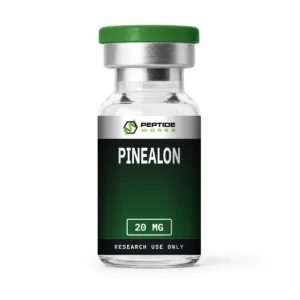
Pinealon Peptide from Peptide Works