

PROMO!
First order? Get 10% OFF with this code: 1storder


Written by

GH peptide research continues to advance as scientists investigate compounds that stimulate the body’s natural growth hormone release.
Although these compounds share the same goal, they differ in their receptor targets, release patterns, and mechanisms of action. These differences influence how they are studied across different research settings.
This guide provides an overview of GH peptides and highlights the key differences that shape their research applications.
Explore Ipamorelin from Peptide Works, a selective GH peptide that stimulates rapid growth hormone release without affecting cortisol or prolactin levels.

GH peptides stimulate the body’s natural release of growth hormone by activating receptors involved in growth hormone signaling. Some act through the growth hormone secretagogue receptor (GHS-R1a), also known as the ghrelin receptor.
Others activate the growth hormone-releasing hormone (GHRH) receptor. Both pathways stimulate pituitary somatotroph cells to release growth hormone, but they use different signaling mechanisms.
Although GH peptides have the same overall goal. Their receptor targets and signaling pathways are different. These differences influence the pattern of growth hormone release and are an important focus of laboratory research. Scientists continue to study how receptor-specific signaling affects growth hormone secretion and related biological processes.
Understanding the underlying mechanisms naturally leads to questions about selectivity, especially why Ipamorelin is often highlighted for its focused action.
Ipamorelin works in a special way compared to other GH peptide options. It only targets ghrelin receptors in the body. This means it raises growth hormone levels without affecting cortisol or prolactin hormones.
Other peptides like GHRP-6 or GHRP-2 affect many different hormones at once. Ipamorelin’s focused action reduces unwanted side effects that happen with other peptides.
This selectivity makes Ipamorelin safer for longer study protocols without causing hormonal problems. CJC peptides work through different pathways, giving scientists more options for various study needs.
Having compared overall selectivity, the next step is to map out exactly which receptors each peptide influences and how that shapes their research use.
Discover CJC-1295 from Peptide Works, a long-acting GH peptide that promotes prolonged growth hormone release for sustained effects.
Each GH peptide activates a different receptor pathway. These differences affect how growth hormone is released and help researchers study specific patterns of hormone signaling.
| Peptide | Primary Receptor | Growth Hormone Release Pattern | Research Focus |
| Ipamorelin | Ghrelin receptor (GHS-R1a) | Short GH release pulses with high selectivity | Studies focused on selective GH secretion |
| Sermorelin | GHRH receptor (GHRHR) | Pulsatile GH release through the natural GHRH pathway | Studies focused on GH regulation and pituitary function |
| CJC-1295 (DAC) | GHRH receptor (GHRHR) | Longer-lasting GH and IGF-1 elevation | Studies focused on extended GH signaling |
Clarifying receptor targets makes it easier to appreciate the measurable outcomes researchers can expect in practical studies.
GH peptides are studied for their ability to stimulate growth hormone release through different receptor pathways. Research shows that some GH peptides produce short, selective growth hormone pulses, while others support longer-lasting increases in growth hormone and IGF-1 levels. These differences affect how each compound is investigated in growth hormone research.
The results depend on the specific GH peptide, its receptor activity, and the research model used. Studies mainly examine changes in growth hormone secretion, IGF-1 signaling and pituitary hormone regulation rather than confirmed effects on muscle growth, fat loss, or recovery.
Side effects of GH peptide can include mild injection-site reactions like redness or swelling. Ipamorelin may cause headaches or nausea but these happen rarely in research settings.
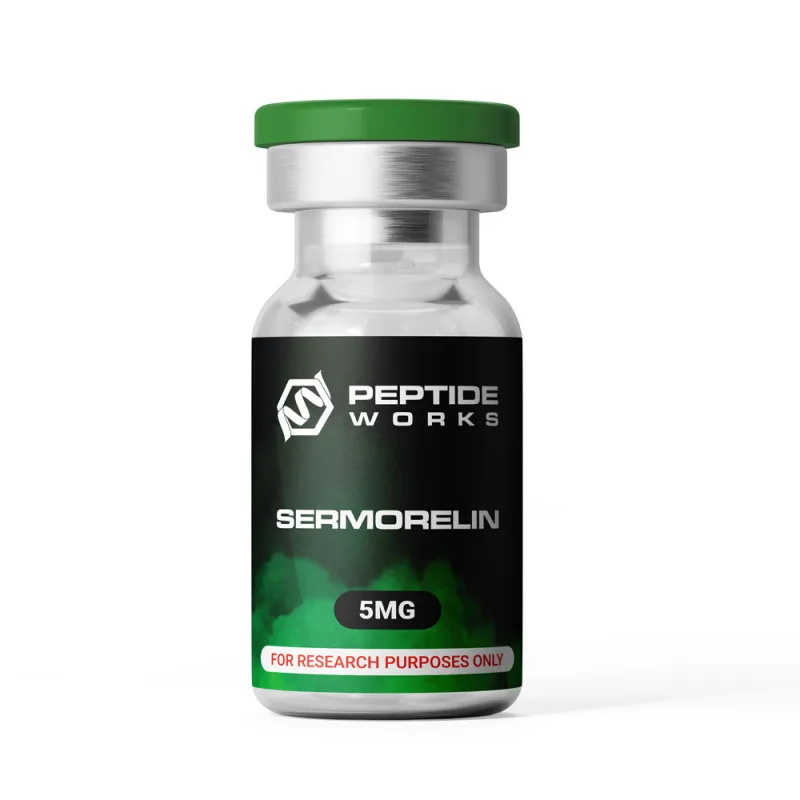
Sermorelin sometimes leads to dizziness, flushing, or sleepiness in test subjects. Severe allergic responses are uncommon but researchers should watch for breathing problems or rash. Joint discomfort and fluid retention have been noted in some research cases.
Monitoring side effects helps scientists adjust research conditions for better safety. CJC peptides show different side-effect patterns due to their longer action time.
Understanding safety profiles helps researchers choose the right peptide for their specific study needs. With benefits and risks outlined, a direct comparison of overall performance helps researchers decide which peptide best fits their protocol.
Check out Sermorelin from Peptide Works, a GHRH-mimicking peptide that promotes natural, pulsatile growth hormone release for physiologic research studies.
The best GH peptide depends on the research goal. Each compound has a different release pattern and duration of action. Researchers study these differences to understand growth hormone signaling, receptor activity and hormone response patterns.
| Ipamorelin | Rapid | Short-Moderate | Reported effects vary by study | Quick GH release studies |
| Sermorelin | Moderate | Short | Reported effects vary by study | Natural GHRH pathway research |
| CJC-1295 (DAC) | Sustained | Long | Reported effects vary by study | Extended GH and IGF-1 signaling studies |
No single GH peptide is best for every research application. The choice depends on the study design, desired GH release pattern, and research objective.
Research on GH peptides continues to grow. Scientists are studying how these peptides control growth hormone release and hormone signaling. Current studies also examine receptor activity, growth hormone release patterns and the biological processes affected by GH-releasing peptides.
Future research may improve the understanding of how Ipamorelin and Sermorelin can be used in laboratory models to study growth hormone biology. Advances in peptide design and delivery methods may also expand their value in research settings.
Peptide Works supports this ongoing research by providing high-quality peptides for laboratory research only.
All products discussed are supplied for research purposes only and are not intended for human use.
(1) Ghigo E, Arvat E, Muccioli G, Camanni F. Growth hormone-releasing peptides. Eur J Endocrinol. 1997 May;136(5):445-60.
(2) Sinha DK, Balasubramanian A, Tatem AJ, Rivera-Mirabal J, et al. Beyond the androgen receptor: the role of growth hormone secretagogues in the modern management of body composition in hypogonadal males. Transl Androl Urol. 2020 Mar;9(Suppl 2):S149-S159.
(3) Berlanga-Acosta J, Abreu-Cruz A, Herrera DGB, Mendoza-Marí Y, et al. Synthetic Growth Hormone-Releasing Peptides (GHRPs): A Historical Appraisal of the Evidences Supporting Their Cytoprotective Effects. Clin Med Insights Cardiol. 2017 Mar 2;11:1179546817694558.
(4) Prakash A, Goa KL. Sermorelin: a review of its use in the diagnosis and treatment of children with idiopathic growth hormone deficiency. BioDrugs. 1999 Aug;12(2):139-57.
ALL CONTENT AND PRODUCT INFORMATION AVAILABLE ON THIS WEBSITE IS FOR EDUCATIONAL PURPOSES ONLY.
DISCLAIMER: These products are intended solely as a research chemical only. This classification allows for their use only for research development and laboratory studies. The information available on our Peptide Works website: https://peptide-works.com/ is provided for educational purposes only. These products are not for human or animal use or consumption in any manner. Handling of these products should be limited to suitably qualified professionals. They are not to be classified as a drug, food, cosmetic, or medicinal product and must not be mislabelled or used as such.
Peptide Works
Related Articles
How can ARA-290 Peptide Help Diabetic Patients?
Diabetes affects millions of people around the world and leads to serious health problems. Research shows that the ARA-290 peptide

Can AICAR Peptide Improve Endurance?
AICAR peptide has shown promising results for improving endurance capacity in studies. Research shows that AICAR activates AMPK, increasing glucose

Enhancing Energy with NAD+ Supplements
Energy is the driving force behind focus, movement, and recovery. When cells have less energy to work with, the body