

PROMO!
First order? Get 10% OFF with this code: 1storder


Written by

Losing weight is not always as simple as eating less and exercising more. Tesofensine, AOD-9604, and FTPP are the most effective weight loss peptides currently being studied in obesity and metabolic research. Their different mechanisms have made them important areas of research for weight management.
Each peptide works differently and has been studied for different purposes. Understanding these differences helps explain why they continue to attract interest in weight management research.
Discover Tesofensine from Peptide Works, one of the weight loss peptides studied for its influence on appetite control and energy balance.

Tesofensine supports weight loss mainly by reducing appetite and food intake. It works by blocking the reuptake of dopamine, serotonin, and noradrenaline, three neurotransmitters involved in appetite, satiety, and food reward.
By increasing the activity of these neurotransmitters, Tesofensine helps increase feelings of fullness and reduce the desire to eat. Clinical studies have shown that these effects can lower food intake and promote greater weight loss than a placebo.
Research also suggests that Tesofensine may increase 24-hour fat oxidation and slightly raise nighttime energy expenditure. However, its primary weight loss effect appears to come from appetite suppression rather than a large increase in total daily energy expenditure.
Neurotransmitters play a central role in weight loss by regulating feeding behavior, appetite, energy balance, and body weight. Dopamine, serotonin, and noradrenaline are the primary neurotransmitters involved in these processes. And they are major targets for anti-obesity therapies.
Some weight loss peptides act through different biological pathways. In contrast, Tesofensine targets monoamine neurotransmitter signaling by blocking the reuptake of dopamine, serotonin, and noradrenaline. This increases satiety and reduces food intake.
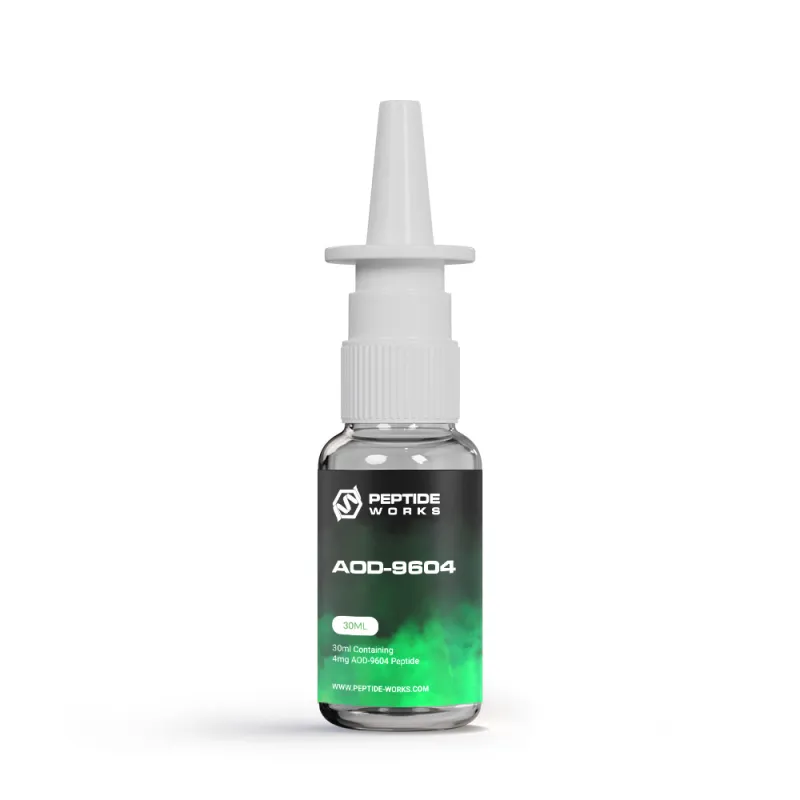
AOD-9604 influences peripheral fat regulation by increasing lipolytic activity in adipose tissue. In preclinical studies, long-term treatment reduced body weight and body fat while increasing lipolytic sensitivity in obese mice.
Long-term treatment also increased β3-adrenergic receptor RNA expression in adipose tissue to levels comparable with those in lean mice. However, the study found that the lipolytic actions of AOD-9604 are not mediated directly through the β3-adrenergic receptor, although increased β3-adrenergic receptor expression may subsequently contribute to enhanced lipolytic sensitivity.
Explore AOD-9604 from Peptide Works, a weight loss peptides examined for its role in fat metabolism and regulation of adipose tissue.
FTPP, also known as Adipotide, influences adipose tissue by targeting the blood vessels of white adipose tissue. In preclinical studies, treatment induced targeted apoptosis within the blood vessels of white adipose tissue, resulting in a marked reduction in white adipose tissue and rapid weight loss.
In obese monkeys, FTPP treatment also improved insulin resistance. Magnetic resonance imaging and dual-energy X-ray absorptiometry confirmed a marked reduction in white adipose tissue following treatment.
Check out FTPP at Peptide Works, a weight loss peptides investigated for its unique impact on the blood supply of white fat in research studies related to metabolic syndrome.

Current studies do not show which peptide causes the fastest fat loss because Tesofensine, AOD-9604, and FTPP have not been compared in head-to-head clinical trials. Tesofensine produced the largest weight-loss effects in human clinical trials, while AOD-9604 and FTPP also reduced body weight or white adipose tissue in separate studies.
Because these peptides were evaluated in different study populations, treatment durations, and research models, their rates of fat loss cannot be directly compared. Current evidence does not establish which peptide causes the fastest fat loss, even though all three have shown weight- or fat-reducing effects in their respective studies.
The time needed to observe weight-loss effects varies across studies. Tesofensine, AOD-9604, and FTPP were evaluated over different treatment durations and study populations, so their timelines cannot be directly compared. The reported treatment periods and outcomes are summarized below.
| Peptide | Study Population | Treatment Duration | Reported Outcome |
| Tesofensine | Adults with obesity | 24 weeks | Mean weight loss of 4.5%, 9.2%, and 10.6% above diet and placebo with 0.25 mg, 0.5 mg, and 1.0 mg, respectively. |
| AOD-9604 | Adults with obesity | 12 weeks | Weight loss was evaluated over a 12-week treatment period in clinical studies. |
| FTPP (Adipotide) | Obese nonhuman primates | 28 days | Treatment induced rapid weight loss and a marked reduction in white adipose tissue. |
These insights naturally lead to the broader outlook, as ongoing studies continue to shape the future direction of weight loss peptides research.
Research on weight loss peptides continues to improve the understanding of body weight regulation. Tesofensine, AOD-9604, and FTPP have each been studied for different pathways involved in appetite regulation, fat metabolism, and adipose tissue regulation. More research is needed to better understand their safety, effectiveness, and long-term effects.
At Peptide Works, we provide high-quality research peptides for laboratory research. As new studies continue, researchers will gain a better understanding of the role of weight loss peptides in obesity and metabolic research.
All products discussed are supplied for research purposes only and are not intended for human use.
(1) Gao Y, Yuan X, Zhu Z, Wang D, et al. Research and prospect of peptides for use in obesity treatment (Review). Exp Ther Med. 2020 Dec;20(6):234.
(2) Barnhart KF, Christianson DR, Hanley PW, Driessen WH, et al. A peptidomimetic targeting white fat causes weight loss and improved insulin resistance in obese monkeys. Sci Transl Med. 2011 Nov 9;3(108):108ra112.
(3) Li Z, Zhang B, Wang N, Zuo Z, et al. A novel peptide protects against diet-induced obesity by suppressing appetite and modulating the gut microbiota. Gut. 2023 Apr;72(4):686-698.
(4) Gao Y, Yuan X, Zhu Z, Wang D, et al. Research and prospect of peptides for use in obesity treatment (Review). Exp Ther Med. 2020 Dec;20(6):234.
ALL CONTENT AND PRODUCT INFORMATION AVAILABLE ON THIS WEBSITE IS FOR EDUCATIONAL PURPOSES ONLY.
DISCLAIMER: These products are intended solely as a research chemical only. This classification allows for their use only for research development and laboratory studies. The information available on our Peptide Works website: https://peptide-works.com/ is provided for educational purposes only. These products are not for human or animal use or consumption in any manner. Handling of these products should be limited to suitably qualified professionals. They are not to be classified as a drug, food, cosmetic, or medicinal product and must not be mislabelled or used as such.
Peptide Works
Related Articles

How can ARA-290 Peptide Help Diabetic Patients?
Diabetes affects millions of people around the world and leads to serious health problems. Research shows that the ARA-290 peptide

Can AICAR Peptide Improve Endurance?
AICAR peptide has shown promising results for improving endurance capacity in studies. Research shows that AICAR activates AMPK, increasing glucose

Enhancing Energy with NAD+ Supplements
Energy is the driving force behind focus, movement, and recovery. When cells have less energy to work with, the body